

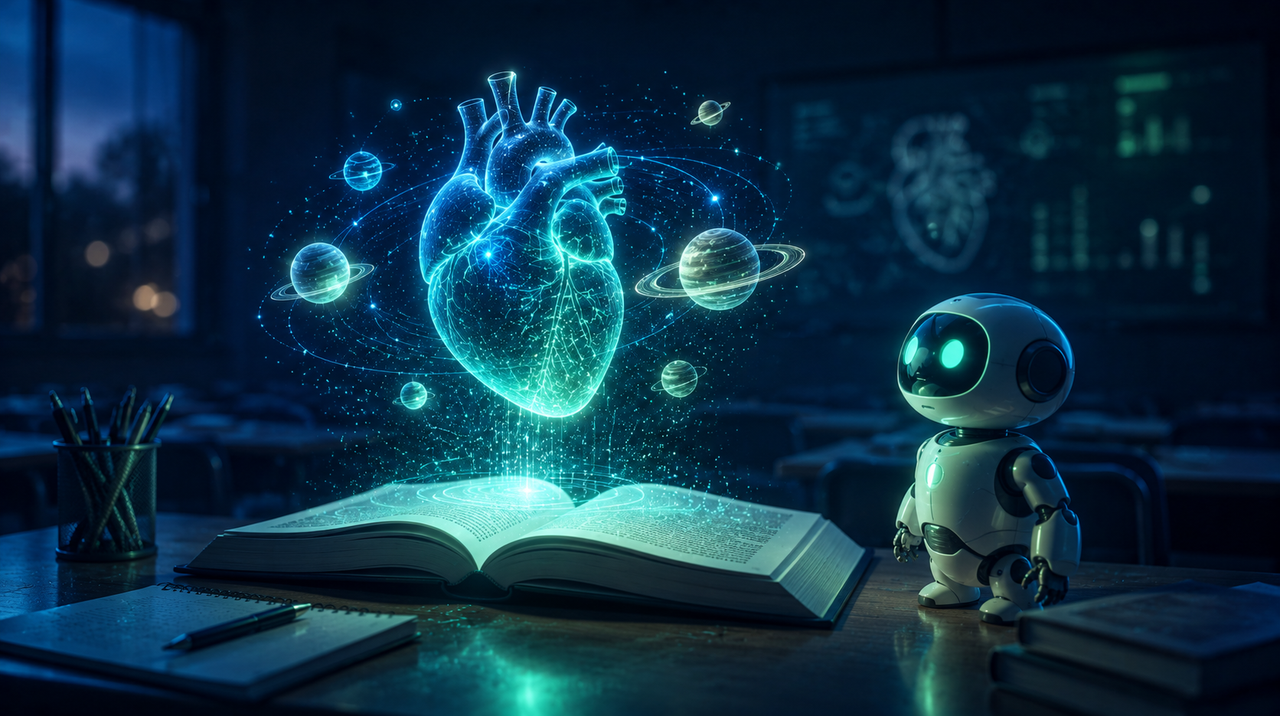
School 3.0 is the educational model in which students stop being spectators and become the protagonists of their own learning, with technology integrated into the act of learning itself — not as decoration, but as a tool: they program a robot, explore the human body in 3D, "travel" through the solar system wearing virtual reality headsets. Instead of hearing about a subject, students live it. This article explains where the concept comes from, what changes in practice, and how an ordinary school can make this transition without overhauling its entire structure.
Want to bring School 3.0 to your school? Explore the School 3.0 program: what it includes, how teacher training works and how to implement it.
School 1.0, 2.0, and 3.0: the timeline behind the name
The name comes from a three-stage evolution:
- School 1.0 — the teacher talks, the student copies. This is the model inherited from the 19th century: rows of desks, a chalkboard, printed materials, and tests. Knowledge flows in one direction only, and every student receives exactly the same lesson at the same pace.
- School 2.0 — technology enters as support. A projector instead of a chalkboard, slides instead of notebooks, internet searches instead of encyclopedias. It may seem modern, but notice: the dynamic is the same as in 1.0 — the student is still watching. Only the screen has changed.
- School 3.0 — the student does. Technology stops being the teacher's resource and becomes an instrument in the student's hands: assembling and programming a robot, scanning an image from a textbook and watching it come to life in 3D, solving a challenge inside a virtual environment. The teacher moves out of the role of transmitter and into the role of mediator — and mistakes stop being a source of embarrassment and become steps in the process.
The pillars of School 3.0 in practice
- Robotics and programming: students assemble the robot, program its movements using visual blocks, and see the result immediately. Along the way, they develop logical reasoning, teamwork, and the persistence to try again when something does not work — skills that apply to any profession.
- Augmented reality: the 2D image of the heart in the textbook appears in 3D, beating, right on the page; planet Earth rotates 360 degrees on the classroom desk. Abstract content becomes a concrete — and memorable — experience.
- Virtual reality: wearing the headset, students float through space like astronauts, travel through the human body from the inside, or experience a historical moment as though they were there. The immersion generates a level of attention no slide can match.
- Artificial intelligence: supports the teacher in lesson planning and helps personalize the pace for each student — the entire class no longer needs to move at the same speed.
- Trained teachers: the pillar that sustains all the others. Technology without training becomes equipment sitting idle in a closet. In School 3.0, teachers are trained to lead the activities — technology does not replace them; it empowers them.
Why schools are adopting the model
The most frequently cited reason is this: a large share of today's children will work in professions that do not yet exist. Preparing them for that future requires more than content — it requires familiarity with technology, problem-solving ability, and the confidence to learn new things without fear.
The second reason is the battle for attention. The lecture-style class competes with the smartphone — and has been losing. When the activity involves assembling a robot or exploring a volcano in virtual reality, attention stops being a problem: participating is more engaging than drifting off.
The third reason is strategic for school management: differentiation in enrollment acquisition. During a parent visit, a room equipped with robotics, AR, and VR communicates in seconds that the school prepares students for the future — an argument that elevates the school's educational value proposition (and its tuition), while also generating great photos and videos for the school's social media channels.
How to implement without letting it become a shelved project
- Start lean. There is no need to renovate the school: a kit with robots, augmented reality tablets, and VR headsets is enough to sustain a complete activity program. A compact lab used every week is better than a massive project that sits unused.
- Train the teachers first. Implementation begins with teacher training — that is what turns equipment into actual lessons. Without it, the technology launches with enthusiasm and dies in a closet within three months.
- Integrate it into the curriculum (or after-school programs). Technology works best when connected to what the class is already studying — the solar system from science class is the same one explored in the VR experience. In an after-school format, it becomes the school's differentiator without touching the required timetable.
- Communicate and measure. Show the activities to parents and track student engagement. Results show up in day-to-day learning — and in enrollment numbers the following year.
The software behind the school: management and an AI for every student
Technology in the student's hands is the visible part of School 3.0. The invisible part — and equally transformative — is the system that organizes everything: during implementation, we produce custom software for the institution, which manages all students and gives each one their own artificial intelligence that knows their pace, their strengths, and their difficulties — and adapts the study path student by student, not by class average.
That same system grades assessments automatically. Consider what this means in practice: hours of repetitive grading returned to the teacher every week — time that can then be invested in what no machine can do: listening to students, developing the class's social-emotional skills, and teaching with genuine presence.
Where does the digital whiteboard fit in?
Into everyday teaching. Robotics and virtual reality are project activities that happen at set moments; the digital whiteboard is the only item on the list that takes part in every single lesson. It is also the one that causes the most regret, because schools often buy the panel and go on delivering exactly the same lesson as before — just on a far more expensive board.
The rule of thumb is simple: if only the teacher touches the screen, that is still School 2.0. It becomes a 3.0 class when the student goes to the panel to solve something in front of the group, when the class builds the diagram together, and when the record of what was done leaves the board and reaches the study material. The equipment is identical in both cases — what changes is who is holding the pen.
We now implement digital whiteboards in the schools on the program: choosing the equipment, installing it in the classroom, integrating it with the school's software and, above all, training the teachers — which is the part that decides whether the panel gets used or ends up as a noticeboard.
From theory to your school
School 3.0 is not a pedagogical trend — it is the school's adjustment to the world students already live in. And it does not require starting from scratch: there is a ready-made path. Learn about the School 3.0 program, which brings buildable and programmable robots, augmented reality tablets, virtual reality headsets, an online course, and teacher training directly to your institution — from the first day of training to the activity that sends students home eager to share what they learned.
Frequently asked questions
Does the school need to replace its infrastructure?
No. Well-designed programs work with the existing structure: the equipment (robots, tablets, VR headsets) arrives ready to use, and the activities take place in the classrooms the school already has.
Can teachers with no technology experience apply this?
They can — that is precisely what the training is for. The tools are designed for beginners (visual block programming, guided applications), and teachers receive training and ongoing support to lead lessons with confidence.
From what age does it work?
Activities are adapted by age group: younger children start with build-and-assemble robotics and guided AR experiences; older students advance to programming, VR challenges, and independent projects.
How much does implementation cost?
It depends on the format: number of devices, number of classes, and depth of training. The investment is far lower than one might expect for the impact it generates — complete programs fit within the budget of a mid-sized private school and pay for themselves through the perceived value they add to enrollment.
Does a school need a digital whiteboard to be a School 3.0?
No. What defines the model is the design of the lesson, not the equipment — you can start with what the school already has. A digital whiteboard speeds things up because it is the only device present in every lesson, but bought before the teachers are trained it becomes an expensive board. The order that works is: change the lesson first, equip afterwards.