

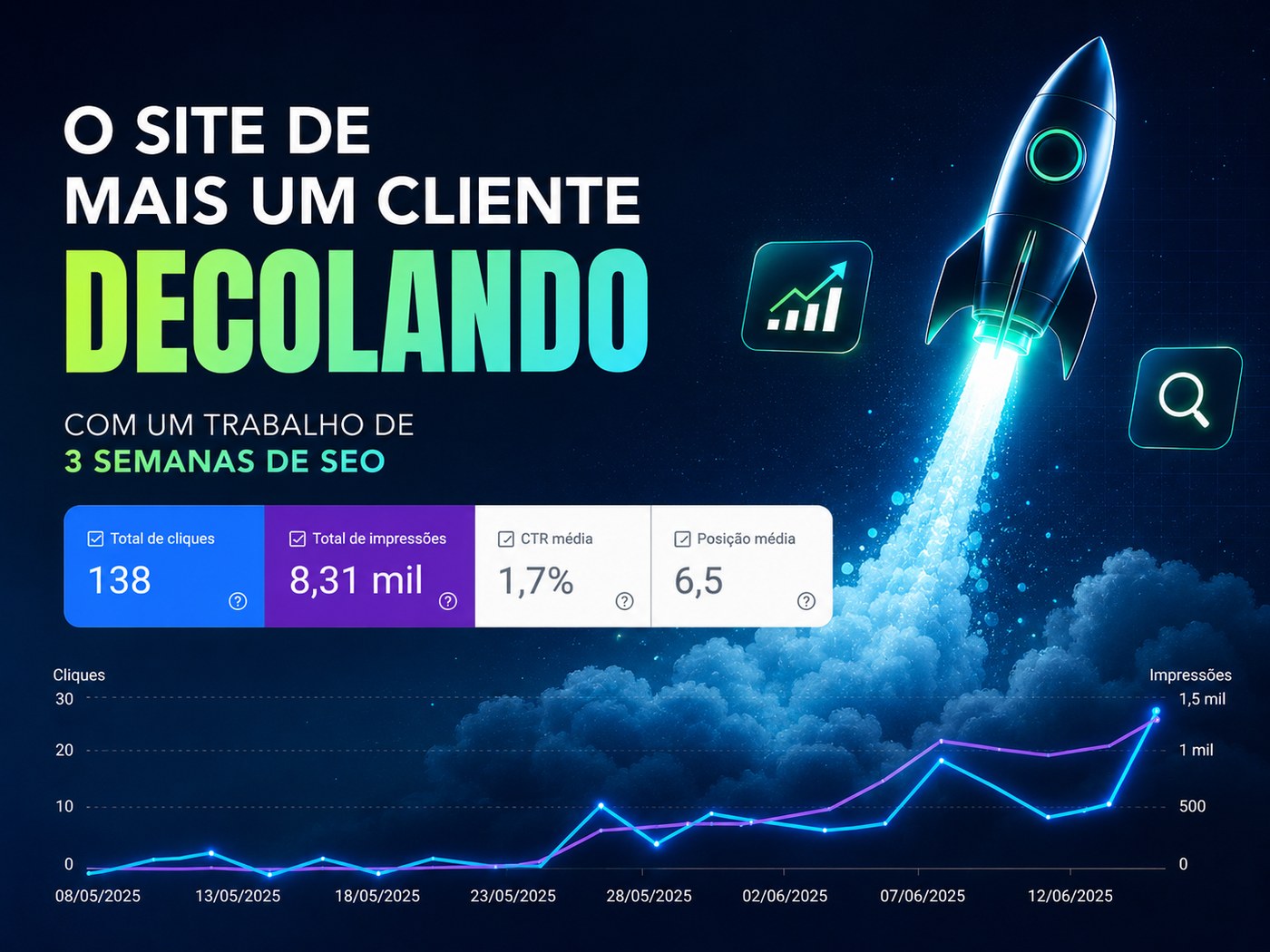

What SEO is and what it actually delivers
SEO is the body of work that makes a site show up in search results without paying per click. It does not buy position: it removes the obstacles that stop the search engine from understanding the site, creates the pages that answer what people look for, and accumulates trust signals over time. That is why the effect takes a while to arrive and keeps paying off after the contract ends — unlike advertising, which stops the moment you stop paying.
It is worth saying plainly what SEO is not: it is not a list of words hidden in the footer, it is not publishing text every day without a criterion, and it is not a promise of first place. Anyone guaranteeing a position is selling what they do not control, because the search engine decides the order, not the supplier.
The three fronts of the work
Every SEO project splits into three parts that have to move together. The technical front handles what blocks the site from being read: pages returning empty, duplicate addresses, an incomplete sitemap, slowness, indexing errors. The content front handles what the site says and to whom: which questions it answers and how deeply. Authority is time plus consistency — how many of your pages cover the same subject well and how many sources point at you.
When a site stalls, it is almost always because one of those fronts was handled on its own. Excellent content on a site the crawler cannot read will not rank. A technically flawless site with no content has nothing to rank.
Where we start: the audit
No honest quote comes before the audit, because the audit is what reveals the size of the problem. In it we look at what already exists: which pages are indexed and which are not, whether the same content answers at more than one address, whether each page has a single H1 and a title describing what it does, whether the sitemap lists everything it should, how long the page takes to appear on a phone, and which errors Search Console is already flagging.
It is the invisible part of the job and usually the one that unlocks results fastest. We have found a site with two service pages returning blank content — status 200, four kilobytes, not a line of text — indexed that way for weeks. No amount of new copy would have fixed that.
How we choose keywords
Search volume on its own is misleading. A term with ten thousand searches a month can be made entirely of curiosity, and one with a hundred can be people with a card in hand. What we look at is the intent behind the search, and it usually falls into four groups: someone who wants to understand a subject, someone comparing options, someone ready to hire, and someone who already knows the company name and is looking for you.
A service page should target hiring intent. Blog content covers the other three and walks the reader to it. Mixing the two is the mistake we see most: a commercial page trying to answer "what is" and an article trying to sell.
Content: the pair that converts
A service page on its own rarely ranks for informational terms, and an article on its own rarely sells. What works is the pair: a piece that answers a real question well, ranks for it, and takes the reader to the page that sells, with the link inside the text rather than buried in the footer.
The same applies to a free tool. A tool page published with no supporting content usually stays invisible — we had one with two impressions in twenty-eight days. What brought people in was the piece explaining the problem the tool solves.
On-page SEO: what changes at every address
Page-level work is painstaking and it is where the gain shows first. Every address needs a title written for the query and for the click, a description that states what the page answers, a single H1 naming the subject, headings that organise the reading, images with descriptive alt text, and internal links connecting what covers the same theme.
FAQs with structured data deserve a separate mention: they take up more space in the result and are what AI assistants extract most easily. And they are commonly found written as ordinary text in the middle of the page, without the markup — pretty for the reader and invisible to the search engine.
When the position is good and the click does not come
There is a problem almost no report shows: the page sits in first place and nobody comes in. That happens when the title does not promise what the person was looking for, when the answer is given inside the search results themselves, or when the query carries an intent your page does not serve.
It is a title and fit problem, not a ranking problem, and it is fixed in an afternoon. We have seen an entire cluster with more than three thousand impressions and almost no clicks because the search was for the meaning of a phrase — the engine answered right there and nobody needed to click. Recognising that saves months of work invested in the wrong place.
AEO: showing up when the AI is the one answering
A growing share of searches ends with no click at all, answered by ChatGPT, by Gemini, or by Google's own AI block. Appearing in those answers is what is called AEO, and much of the path overlaps with SEO: clear content, structured data, consistent information across the web.
What changes is the format. The answer has to be written so a machine can extract it: the definition in the first lines, one idea per paragraph, explicit questions with short answers, and the same name, address and phone number everywhere the company appears. And there is a lesson we have seen first-hand: borrowed visibility changes without warning. A domain heavily cited by an AI can lose almost all of that presence within days when the criteria shift — which is why the asset that matters is still your own site.
Local SEO: when the customer is nearby
For businesses serving an area, much of the game happens on the business profile and the map. The order that works is the right category first, then a complete profile, identical contact details across the web, reviews, and photos last — almost everyone starts at the end. Distance is the factor nobody controls: if a competitor is closer to the customer and their profile is as good as yours, that particular search is lost, and it is more productive to attack the others.
How we measure, and why four numbers
Every report we produce compares two equal periods — two twenty-eight-day blocks — and always shows the four metrics together: impressions, how many people saw you; clicks, how many came in; CTR, what share of those who saw you clicked; and average position. Each one on its own lies.
Impressions rising with clicks flat means showing up for the wrong query. Position improving while CTR falls usually means a weak title. Clicks growing faster than impressions is the best signal there is, because it means the gain is not empty volume. A report showing only one of the four hides half the story — and that is how a bad project disguises itself as a good one.
How long it takes
The first signals appear between four and eight weeks, and consistent gains usually take three to six months. It depends on how much authority the site already has, how contested the term is, and how often new content ships. It is also worth knowing that the engine has to crawl the page again before it re-evaluates: a day or two after a change the report still shows nothing, and reacting to that gap only produces noise.
What we deliver
A technical audit with the fix list ordered by impact; the fixes that are within our reach; a keyword map by intent; a content calendar tied to the pages that sell; optimisation of titles, descriptions, headings, FAQs and internal links; AEO preparation; and the two-block report with all four metrics, explained in plain language with no jargon. We work in Portuguese, Spanish, French and English — and when the site is multilingual we make sure each language has its own address and its own links, which is exactly where most international projects come undone.