
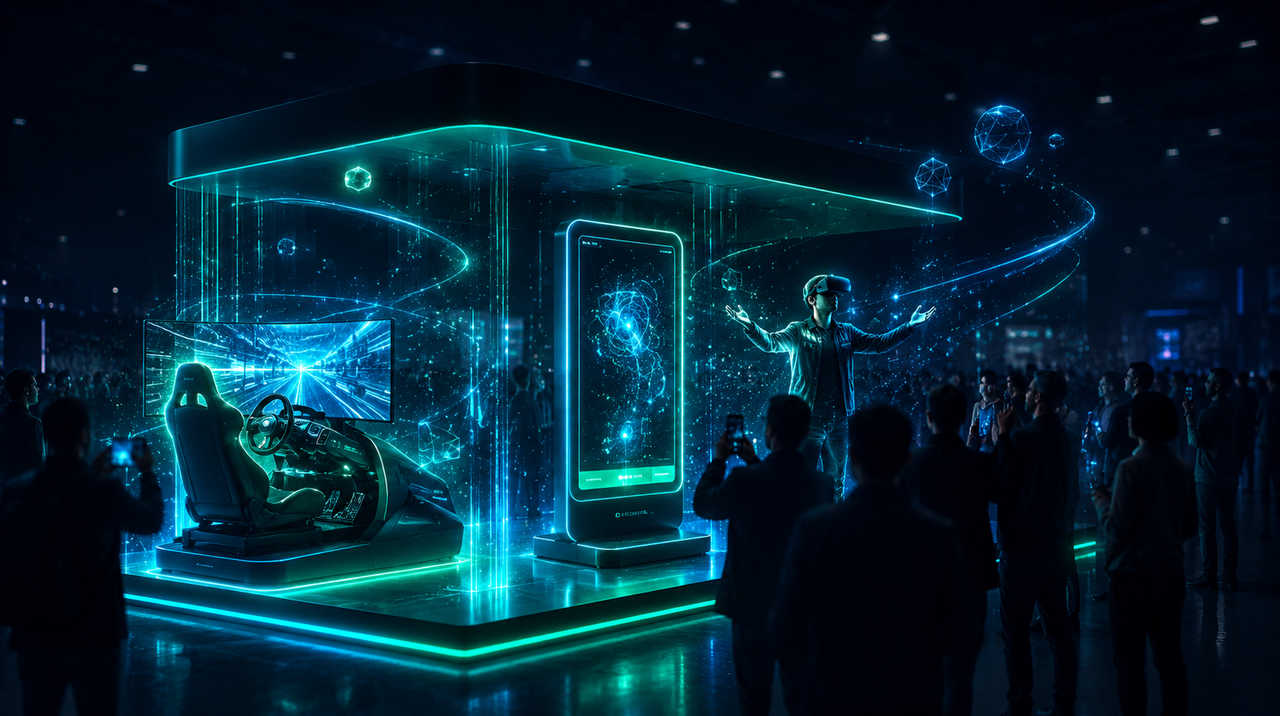
At a packed event, every booth is competing for the same thing: attention. Visitors walk the aisles deciding in seconds where to stop — and they almost always gravitate toward movement, the sound of people having fun, or something they've never seen before. That's exactly what a well-chosen tech activation does: it turns your space into the busiest spot on the floor and turns curious passersby into business contacts.
Why activations work (when a beautiful booth alone doesn't)
A well-designed booth is a baseline — every serious competitor has one. Attraction is a different matter. An activation gives visitors a reason to stop (curiosity: "what's that?"), a reason to stay (to participate, play, or try something), and a reason to share their contact details (to get on the leaderboard, receive their photo, or see their result). Every extra minute spent at the booth is a minute of conversation your team gains.
And there's a multiplier effect: participants share their experience. The crowd gathering around the simulator becomes a showcase — people attract people — and the photobooth picture posted on social media becomes organic brand exposure, reaching people who weren't even at the event.
7 activation ideas that draw crowds
- 1. Racing simulators (F1, motorcycle, and sports): the classic activation that keeps queues moving. With a live leaderboard on the big screen, it becomes a championship — nobody wants to finish in second place, and everyone submits their details to compete for the top spot. Works for general audiences and corporate events alike.
- 2. Augmented reality: the product leaps off the screen of the visitor's own phone, no app download required. A package, a card, or a booth kiosk comes to life in 3D — ideal for showcasing what can't be brought physically and for generating that "look at this!" moment that makes people call a colleague over.
- 3. Virtual reality: take visitors somewhere the booth can't fit: inside the factory, the development under construction, the product in operation. Full immersion with VR headsets is the most powerful way to make someone experience your offering rather than just hear about it.
- 4. Interactive kiosks and quizzes: present a complex product in layers — each visitor explores at their own pace, on the topic that interests them. A quiz not only entertains but also reveals what each lead chose to learn about: automatic qualification.
- 5. Branded photobooth: the keepsake visitors take home — and post. Lead capture is built into the delivery: the photo arrives by email or WhatsApp, together with the brand's visual identity.
- 6. Holograms and interactive tables: immediate visual impact for product launches. A product floating in hologram stops the entire aisle; the interactive table organizes the sales conversation around visual content.
- 7. Branded games and arcade: fast, fun dynamics with your message woven into the game. Short rounds keep the queue moving and maximize the number of participants per hour.
How to choose the right activation
The choice starts with the objective, not the equipment. Before deciding between VR, a simulator, or a kiosk, answer this: what should the visitor do, understand, or remember after the experience?
- Drive foot traffic: competition and entertainment — simulators, games, live leaderboards.
- Explain a product: interactive presentation, augmented reality, VR — the visitor explores instead of listening to a monologue.
- Capture leads: quizzes, leaderboard registration, photobooth with digital delivery.
Then come the practical criteria: the available space (a simulator needs a clear area; a kiosk fits in a corridor), the expected foot traffic, the duration of each round — a short round is a queue that moves — and the venue's power and internet infrastructure.
From attraction to leads: the part that pays for the booth
Foot traffic is a means, not an end. The difference between a fun attraction and an activation that delivers ROI lies in what happens with the contact details of those who participated. When well-designed, the activation captures the lead as part of the experience, not as a tedious form: registration to join the leaderboard, photo delivered by email, quiz result on the phone.
After the event, those leads come pre-qualified by behavior: what the person played, what they chose to view on the kiosk, how long they stayed. The sales team doesn't receive a cold list of scanned badges — they receive contacts who engaged with the brand, with context for a meaningful follow-up.
Common mistakes (and how to avoid them)
- Technology without a message: an impressive attraction that has no connection to what the company sells generates a queue — and zero business.
- Rounds that are too long: at a high-traffic event, a 10-minute experience creates a queue that discourages people. Ideally, the dynamic should be understood in seconds and completed in a few minutes.
- Screens full of text: an activation interface means simple commands, short messages, and immediate feedback.
- An experience with no next step: the round ends and… nothing? The participant should be guided to the next action: speaking with a specialist, watching a demo, receiving content.
The busiest booth at the event could be yours
F1 and motorcycle simulators, augmented reality, VR headsets, interactive kiosks, photobooths, holograms, arcade games: all of this is available to rent and customize with your brand — with on-site operation and real-time metrics of everything that happened at the booth. Explore our interactive media for events service and browse the full catalog of attractions. From objective to results measurement, we build the experience that makes visitors stop, engage — and become customers.
Frequently asked questions
Does it work at B2B events?
It does — and very well. At trade fairs, activations break the ice, present complex products visually, and qualify visitors before the sales conversation. A simulator with a leaderboard between participating companies tends to be a magnet at corporate conferences.
Is an internet connection required?
It depends on the solution. Many experiences run locally without relying on the venue's connection — which is advisable, since event Wi-Fi is notoriously unreliable. Anything that needs to sync (photo delivery, online leaderboards) should have a backup plan defined during the planning phase.
How much space is needed?
It varies by equipment: kiosks and photobooths fit in just a few square meters; simulators and movement-based experiences require a clear area for safe operation and circulation. There is an option for virtually any booth footprint.
How far in advance should you plan?
Ideally, the activation should be confirmed alongside the booth design. Visual customization, content, transportation, setup, and testing all belong on the timeline — and the most sought-after event dates concentrate demand for equipment.