
Split payment will not launch in January 2027. The IBS Steering Committee announced in August 2026 that the mechanism won't be ready by that date, and no new date has been announced.
That's good news for companies' cash flow and a terrible excuse to delay preparation — because the rest of the tax reform still starts on schedule.
What split payment is, in one sentence
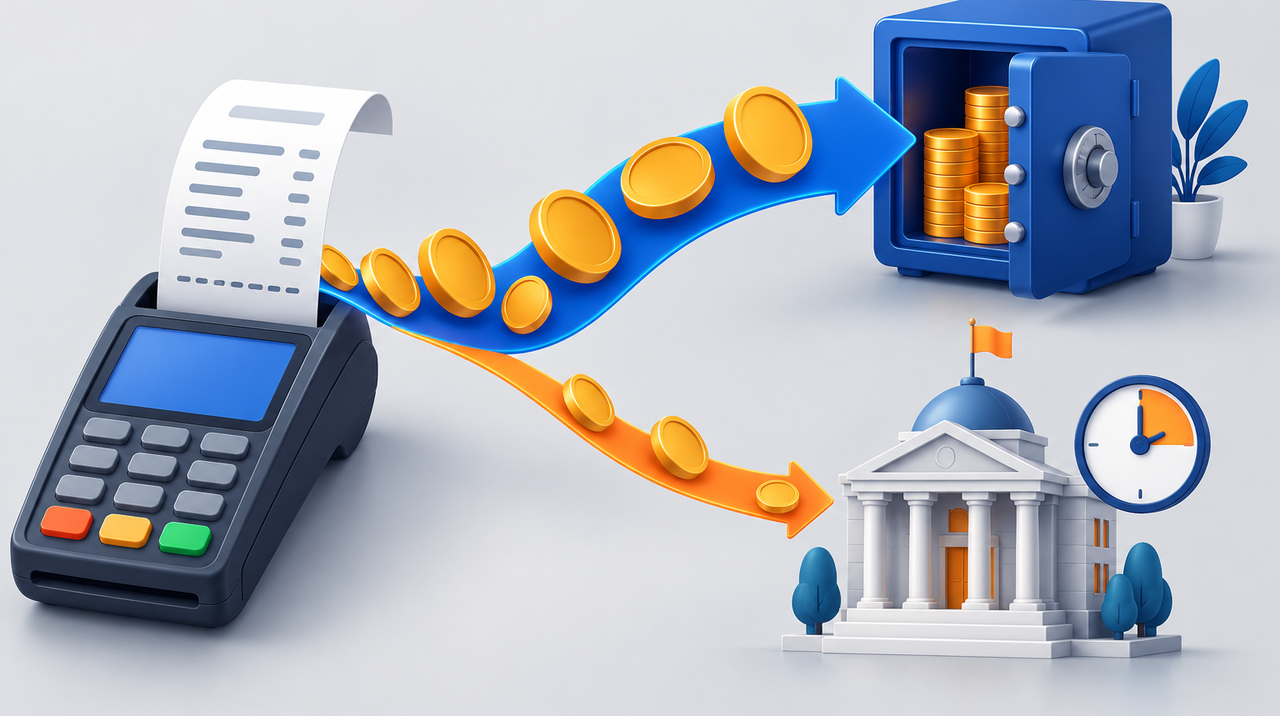
It's the collection of tax at the moment a payment settles. Today, when a customer pays, the full amount lands in your account and you remit the tax later, within the deadline. With split payment, the tax is born already separated: the government's share goes straight to the government, and only the net amount reaches you, with the transfer typically consolidated the day after the transaction.
The difference isn't about the tax rate. It's about who holds the money along the way — which is why it hits working capital before it touches anything else.
Why it was delayed
Because of the complexity of getting four worlds to talk to each other in real time: the tax document, the payment method, the financial institution, and the tax authorities. Add to that the financial sector's request for more implementation time.
What's known today, and worth repeating because it's being reported incorrectly: there is no official new date. There was a plan to start in 2027 on an optional basis, concentrated on business-to-business transactions; that's what was left without a timeline.
What was NOT delayed
This is the part that usually gets lost in the headline. On January 1, 2027:
- PIS and Cofins cease to exist and are replaced by CBS, the Contribution on Goods and Services.
- The Selective Tax takes effect.
- IPI drops to a zero rate for most products, with exceptions mainly aimed at the Manaus Free Trade Zone.
- IBS begins its transition, gradually replacing ICMS and ISS between 2029 and 2032, with the full model in place by 2033.
- Roughly R$40 billion in tax benefits will cease to exist, according to estimates from Brazil's federal tax authority.
In other words: the invoice format changes, tax calculation changes, credit rules change, and prices may change — all at the same turn of the year. The only thing pushed back was the moment the tax leaves your cash flow.
The delay bought you cash-flow time, not system time
This is the distinction that separates companies that will sail through 2027 from those that will discover the problem while issuing an invoice in January. The heavy lifting of the reform was never split payment — it's everything else.
What needs to be adjusted, and depends on software:
- Tax document issuance in the new formats, with the new fields.
- Tax calculation for CBS and IBS coexisting with what's left of the old system during the transition.
- Credit rules. The logic for claiming tax credits changes, and an unclaimed credit is lost money.
- Product and service records with the correct classification, which is where the tax rate comes from.
- Contracts and pricing policy, because whoever signed a long-term contract at full price needs to know who absorbs the difference.
None of this gets solved the night before, and much of it depends on a software vendor delivering the update on time. The most useful question you can ask this week is to your vendor: on what date will the CBS-compliant version be available for testing? If the answer is vague, that's already telling you something.
What to do in the coming months
- Ask your software vendor for a date, in writing, and request a test environment. A deadline without a test environment isn't a real deadline.
- Map out which systems issue or record invoices in your operation. It's usually more than one, and the second one is the one nobody remembers.
- Ask your accountant for a map of your credits today and what changes under the new rules. This is the part that turns into money.
- Redo your cash-flow projection as if split payment were already in place. It will come back at some point, and it's better to find out now whether your operation can handle receiving only the net amount.
- Review long-term contracts with tax clauses, before the turn of the year.
Important point: the tax side is your accountant's job, not ours. What we do is the other half — making sure the systems you use issue, record, and communicate with each other correctly, which is custom software development and, when the question is whether to adapt what exists or replace it, is covered in custom software or off-the-shelf system. On the other change that has already hit your cash flow, see what instant payments changed.
Sources
Statement from the IBS Steering Committee on the delay, reported in August and September 2026; tax reform tracking materials on the 2027 timeline, the replacement of PIS and Cofins by CBS, and the IBS transition; and estimates from Brazil's federal tax authority on the end of tax benefits. This text is informational and does not replace guidance from your accountant.
Frequently asked questions
Is split payment still starting in 2027?
Not in January. The IBS Steering Committee announced in August 2026 that the mechanism wouldn't be ready for January 1, 2027, and there's still no official new date. The earlier plan called for an optional rollout, focused on business-to-business transactions.
What is split payment under the tax reform?
It's the collection of IBS and CBS at the moment a payment settles. Instead of the full amount landing in the company's account and the tax being collected afterward, the tax is split off instantly: the government's share goes straight to the tax authorities, and only the net amount reaches the supplier, typically passed through the day after the transaction.
Why was split payment postponed?
Because of how complex it is to integrate the tax document, payment method, financial institutions, and tax authorities in real time — on top of the financial sector's request for more implementation time.
What still changes in the tax reform in 2027, despite the postponement?
On January 1, 2027, PIS and Cofins are eliminated and replaced by the CBS, the Excise Tax (Imposto Seletivo) takes effect, IPI drops to a zero rate for most products (with exceptions tied to the Manaus Free Trade Zone), and the IBS begins its transition to replace ICMS and ISS between 2029 and 2032. Roughly R$40 billion in tax breaks also disappear.
Does the postponement give my company more time to prepare?
It buys cash-flow time, not system time. What's been delayed is the moment the tax leaves your account. The changes to invoicing, tax calculation, credit rules, and product registration still take effect starting January 1, 2027.
What should I ask my software vendor?
Ask when the CBS-ready version will be available and whether there'll be a testing environment before the cutover. A deadline with no testing environment isn't really a deadline. It's also worth checking how many systems in your operation issue or record invoices — it's usually more than one.