
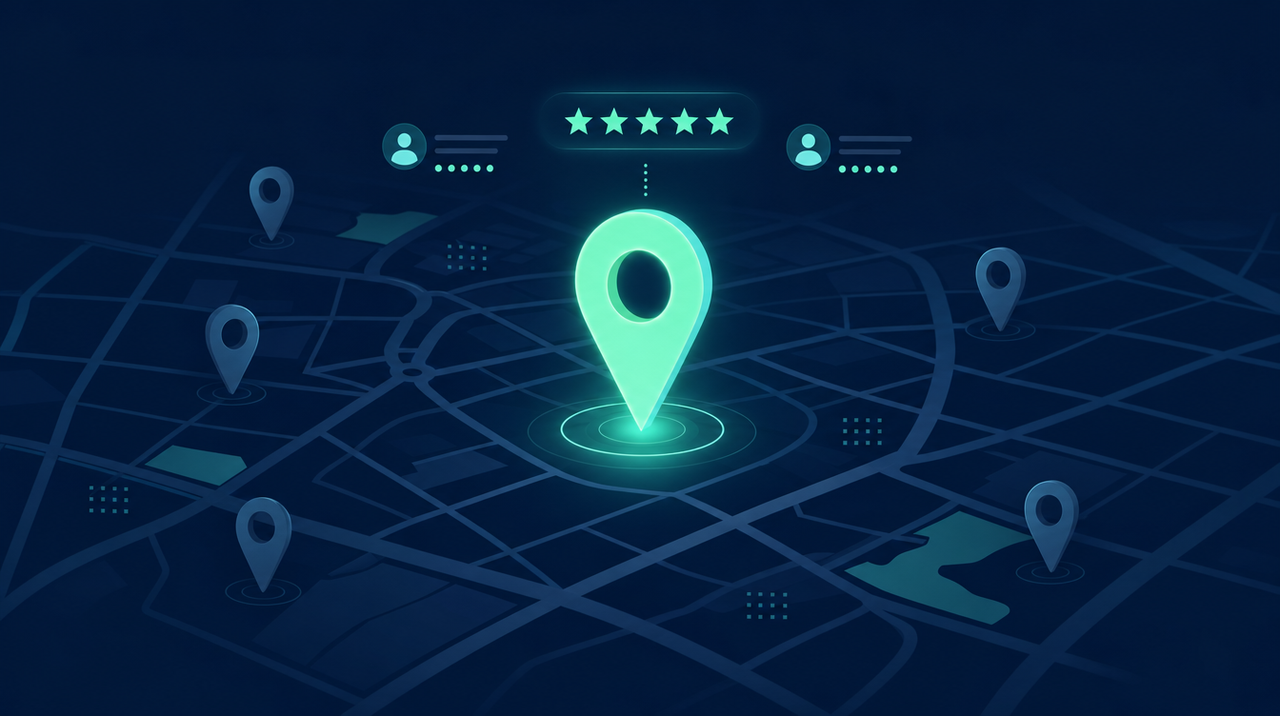
To appear at the top of Google Maps you have to win three things Google measures — relevance, distance and prominence — and the only tool that moves two of them is free: your Google Business Profile. This guide is the practical version of that: what to fill in, in what order, and what usually keeps a business off the map pack.
How do you get to the top of Google Maps search results?
The short answer, in order of impact:
- Claim and verify the profile — an unverified profile barely ranks.
- Pick the right primary category, the single strongest relevance signal.
- Complete 100% of the profile: hours, services, service area, website, description, photos.
- Keep name, address and phone identical everywhere they appear online.
- Collect reviews steadily and answer all of them, good and bad.
- Post updates and add photos every week, so the profile looks alive.
None of it costs money. All of it costs consistency, which is exactly why most competitors stop halfway.
Why the Google profile decides so much
About 46% of all Google searches have local intent — someone looking for something nearby. And the map pack (those three pinned results at the top) takes the attention: businesses in it get roughly 126% more traffic and 93% more calls, clicks and direction requests than the ones from position four down. On top of that, 76% of people who run a local search visit a business within 24 hours. That is near-immediate buying intent, decided by a free tool.
The three factors Google uses
Google's local ranking rests on three pillars. Relevance: how well your profile and website match what the person searched. Distance: how close you are to the searcher. Prominence: how well known and trusted the business is — reviews, web presence, consistent information. You do not control distance. You control the other two, and that is where almost all the result lives.
The checklist that actually moves the needle
- Complete the profile to 100%. Complete profiles get around 7 times more clicks and 70% more visits than incomplete ones. Empty fields are ranking left on the table.
- Choose the primary category carefully. "Dental clinic" is not the same as "Dentist". Pick the one that describes what you do and how customers actually search, and use the secondary categories for the rest.
- Keep NAP identical. Name, address and phone must match exactly on the profile, the website and every listing. Each variation weakens the trust signal.
- Reviews, continuously. Volume, score and recency all feed prominence. Ten reviews spread over the year beat forty in one week — and answering every review is a signal too.
- Real photos, updated. Interior, exterior, team, product. Photos hold attention on the profile and reduce the click to the competitor.
- Fill in the services and the description with the words people use, not the words your industry uses internally.
Why you might not be showing up at all
When a business is invisible on Maps, the cause is usually one of five, in this order: the profile was never verified; the primary category describes something else; the business is a service-area business with the address hidden and the area drawn wrong; there are duplicate profiles competing with each other; or the profile was suspended for an information mismatch. Fixing the cause matters more than any optimisation — no amount of posts will rank a profile that Google is not sure exists.
How long does it take?
Verification is days. The effect of category, completeness and NAP consistency shows up in two to six weeks. Prominence is the slow one: it grows with review cadence and with the business being mentioned elsewhere on the web, so it is measured in months. Anyone promising the top of the map pack in a week is selling something else.
Do Google Ads put you at the top of the map?
No — and this confusion costs money. Paid ads can place you in a sponsored slot, marked as such, but they do not buy a position in the organic map pack. The pack is earned with the signals above. Ads are a valid complement while prominence is still growing; they are not a substitute for it.
Local search and AI move together
The same signals that rank you on Maps now feed the answers people get from AI assistants: consistent information, clear categories, real reviews and a website that says plainly what you do and where. A business that is invisible on Maps tends to be invisible in those answers too — the underlying data is the same.
What this means for your business
If you sell to people who are physically near you, the map pack is the cheapest acquisition channel available: no click cost, high intent, and a competitor list that mostly gave up on the basics. Start with verification and the primary category this week; the rest is maintenance.