

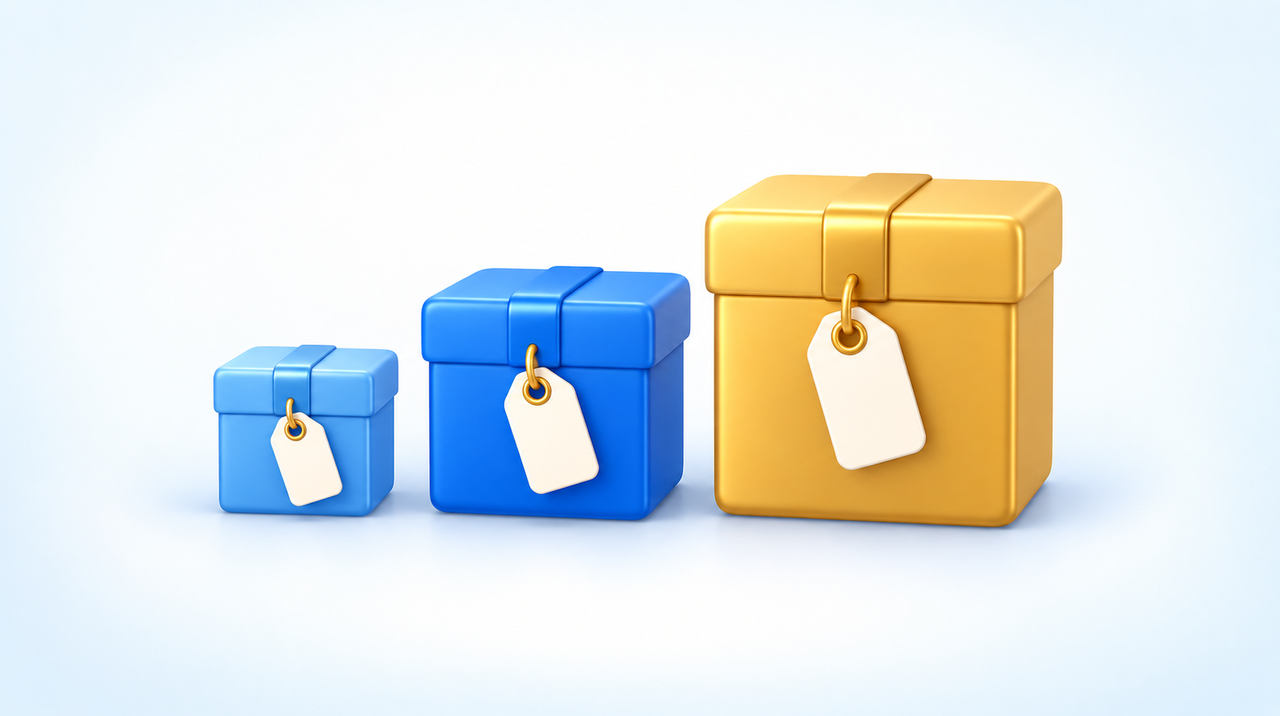
Request a quote for custom software from three vendors and you'll get back three proposals that can't be compared. It's not a lack of market standards: the same term is simply being used to sell three different products.
Whoever finds this out in the middle of a project usually finds out the expensive way. The cheapest of the three solves little and hits a wall fast; the most expensive solves everything and charges accordingly. Knowing which one is on your table is what separates a good hire from a twelve-month regret.
Type 1: Configuring an Off-the-Shelf System
This is off-the-shelf software, the same one hundreds of other companies use, adjusted within the options it already offers: extra fields in a form, a report built the way you asked for it, your company's logo in the footer, user-level permissions.
How to recognize it: the proposal talks about deployment, configuration, training, and a per-user monthly fee. The timeline is short, from days to a few weeks.
What you gain: you start fast, it costs little to get in, and the vendor fixes bugs for everyone at the same time.
The limit: you can only do what the system already anticipated. When your process doesn't fit the available options, the answer is "that's not possible" — and no budget can fix that, because it isn't a matter of paying more.
Type 2: An Off-the-Shelf System With a Custom-Built Piece
The foundation is still off-the-shelf software, but someone writes code for your specific case: an integration with your client's system, a screen the product doesn't have, a calculation only your company performs, a bot that moves data from one place to another.
How to recognize it: the proposal splits into two line items, the product license and development hours. Words like integration, module, API, and connector show up.
What you gain: it solves the specific bottleneck without throwing away what already works. It's the middle path, and for most small companies it's the most sensible one.
The limit, and it's a serious one: the custom piece hangs off a product that isn't yours. When the base vendor releases a new version, your piece can break, and you're the one who pays to fix it. Ask about this in writing before signing.
Type 3: Software Built From Scratch
There's no base product. The system is designed around your process, the code is written for you, and if the contract says so, the code is yours.
How to recognize it: the proposal talks about requirements gathering, scope, stage-by-stage deliverables, and acceptance testing. The timeline is months, not weeks.
What you gain: the system does exactly what your operation does, with no contortions, and no one can change the rules of the game partway through.
The limit: it takes longer, costs more upfront, and maintenance becomes someone's responsibility — yours or the builder's. Software built from scratch without a maintenance plan turns into a problem in year two.
How to Figure Out Which One Is in Your Quote
Five questions settle it, and all of them fit in one email:
- What exactly is being written for me? Ask for the list. If the answer is generic, it's probably Type 1 wearing a Type 3 label.
- Is there a base product underneath? Which one, whose is it, and what happens to me if that product is discontinued or sold.
- Who owns the code? In Type 3 this is negotiable and needs to be in writing. In the other two, the honest answer is "not you".
- Who pays when the base product is updated? This is the question that separates a serious proposal from an optimistic one.
- How much does it cost in year two? License, hosting, support, and adjustment hours. The first year is never the problem.
Which of the Three Is Right for You
The rule that works for choosing between the three types of custom software isn't company size, it's where your differentiator lies. If the process you want to computerize is the same as any competitor's — issuing invoices, tracking inventory, payroll — Type 1 is almost always the right answer, and insisting on proprietary software just means paying to reinvent something that already exists, ready-made and cheap.
If the process is precisely what makes clients choose your company, or if the off-the-shelf system is already forcing your operation to work in a worse way just to fit it, Type 2 solves most cases, and Type 3 when the patchwork can no longer hold.
The next two steps are covered in detail: the four signs that custom-built pays off and how pricing is formed, with the real range. And whichever type you choose, it's worth knowing what happens when the system goes down — because that isn't a hypothesis, it's a matter of when.
The Most Expensive Mistake When Hiring Custom Software
It isn't picking the wrong type. It's buying Type 1 while believing you bought Type 3. The company pays little, stays happy for six months, and when the process grows, discovers it can't change anything — and that migrating means starting over, now with two years of data locked in a format that isn't its own.
The defense is boring and it works: ask in writing what's yours, what's rented, and what happens if the relationship ends. A good vendor answers this without hesitation.
How We Work
When we build custom software for a company, the first conversation is about which of the three types solves the problem — and it's not uncommon for the honest answer to be Type 1, which we don't sell. A project that starts with the wrong type doesn't get fixed later.
Frequently asked questions
What is custom software?
It's software tailored to a specific company's process rather than built to fit everyone the same way. The term actually covers three very different things: configuring an off-the-shelf system using the options it already has, adding a purpose-built piece on top of an off-the-shelf system, or building the entire system from scratch. Price and timeline shift by an order of magnitude between these three.
What's the difference between custom software and bespoke software?
In practice, none — the market uses both terms interchangeably, along with tailor-made and made-to-order. What actually matters isn't the wording, it's what the proposal describes. Configuring an off-the-shelf system and building a brand-new one are sold under the same name, but they're not the same product.
How do I know if a quote is for an off-the-shelf system or software built from scratch?
Ask exactly what's being written for you, whether there's an underlying base product, and who owns the code. A quote for an off-the-shelf system talks about deployment, configuration, and a per-user monthly fee. A quote for software built from scratch talks about requirements gathering, scope, staged deliverables, and sign-off, with a timeline measured in months.
Who owns the code for custom software?
It depends on the type and the contract. When there's an underlying base product, its code stays with the vendor, and at most the piece written specifically for you can be yours. With software built from scratch, ownership is negotiable and needs to be spelled out in the contract, with the repository and documentation handed over to you.
Can custom software break when the base system gets updated?
It can, and that's the least talked-about risk of this model. The custom-built piece relies on the base product's rules, and when that product's vendor ships a new version, those rules can change. Get it in writing who pays for the fix in that scenario before you sign anything.
When is custom software not worth it?
When your process is the same as any competitor's — issuing invoices, managing inventory, running payroll. For cases like these, cheap, battle-tested off-the-shelf systems already exist, and building your own just means paying to reinvent the wheel. It's also not worth it when your volume is too low to justify the ongoing maintenance.