

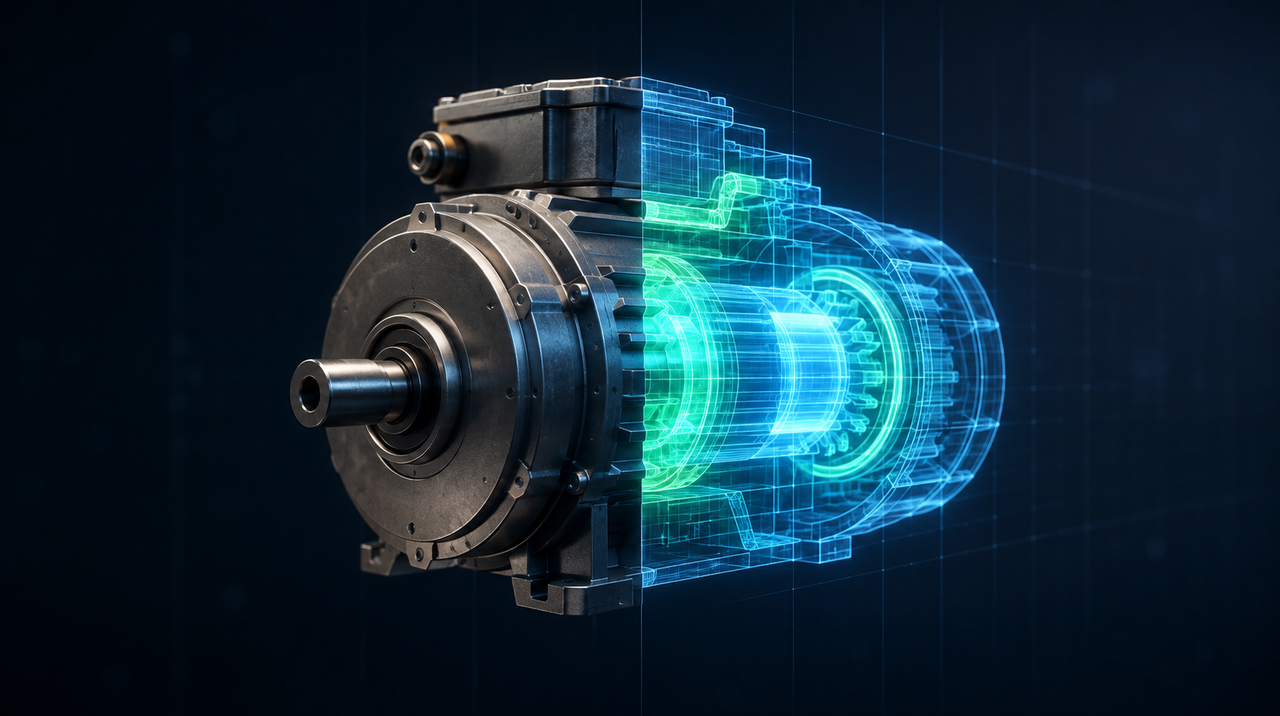
CGI is 3D computer graphics used instead of a camera — the acronym stands for computer-generated imagery. Rather than building a set, lighting it and filming, the object is built in three dimensions inside the computer, given material and light, and rendered as an image or a video. The result can be indistinguishable from a photograph or deliberately illustrative; that is a project decision.
The question that matters to whoever is commissioning the work is not which of the two is better. It is in which situation each one solves the problem more cheaply. This is the rule of thumb we apply before recommending either.
Four cases where filming cannot deliver
1. The product does not exist yet. A prototype in development, equipment that exists only in CAD, a building still on the plan. There is nothing to point a camera at. Here CGI is not an alternative, it is the only option — which is why almost every developer and manufacturer ends up commissioning 3D before the product is finished.
2. What matters is inside. Showing the path of water through a pump, the airflow in a microinverter, the part hidden under the casing. With a camera you would have to cut the equipment in half and still would not see the movement. In 3D the casing turns transparent and everything else keeps working.
3. Scale makes it impossible. Whatever is too big to fit in a studio or too small for a lens to see. A whole substation, a dental implant, a molecule.
4. There are many variants of the same object. Twelve colours, four finishes, three sizes. Filming means repeating the whole production for each variant; in 3D you swap the material and render again. This is the case where CGI comes out cheaper on the very first comparison, and the one that most surprises people asking for a quote.
Four cases where the camera wins
People. A convincing 3D human is expensive and risky; a camera solves it for a fraction. If the video depends on a face and an emotion, film it.
The real place as the argument. When the value lies in showing your factory, your team, your shop — authenticity is the product, and it cannot be modelled.
Urgency on a tight budget. A shooting day delivers material the same day. CGI has stages you cannot skip: model, texture, animate, render.
A single, simple piece. If it is one object, from one angle, with no variants and no interior, building it in 3D costs more than putting it on a table and photographing it.
What drives the cost of a CGI piece
Almost every quote is explained by five items, and it pays to know them before asking for a price.
The model. Building the object in three dimensions. It is the most expensive item and the only one you pay for once: with the model made, it serves photography, video, the website, augmented reality and next year's catalogue.
The material. Telling the software that this is brushed aluminium, matte plastic or glass. It looks like a detail and it is what separates a convincing render from a video-game mock-up.
The animation. Camera movement is cheap; a part that assembles itself, a liquid that pours and a mechanism that turns are work measured per second of screen time.
The render. Machine time, which grows with resolution, duration and lighting quality. It is predictable and usually the smallest of the five.
The revisions. The item that blows up budgets. Two rounds agreed before starting cost less than one open-ended round at the end.
You may already have the model — and not know it
If your company manufactures something, the product was probably already drawn in CAD so it could be produced. That file is the raw material for 3D, and converting usually costs far less than modelling from scratch.
An example of ours, with measured figures: an industrial assembly exported as STEP was 45.6 MB with 427 parts; converted and optimised, it came down to 1.64 MB, light enough to open on a customer's phone. The work was not modelling — it was preparing.
Two honest caveats, the kind that only show up when you actually do this. First: CAD does not carry appearance. That assembly arrived with 427 parts and zero materials — the nice colour the engineer sees on screen comes from their software, not from the file. Somebody has to say what is metal, what is acrylic and what is rubber. Second: a ready-made model pack can mislead. We once received a 3D car that opened perfectly and rendered completely white, because the textures had never been in the delivered file.
How to ask for a quote without surprises
Send four pieces of information and the price comes back right first time: where the piece will be used (print, website, video, augmented reality — each destination has different requirements), how many variants of the same object you will need, whether a CAD file exists and in what format, and whether motion is needed or a still image is enough.
Missing those four is the most common cause of a quote that changes mid-project — and of a piece delivered in a format that will not open where the client needed it. On picking the right format for each destination, we wrote the guide to GLB, OBJ, FBX and STL.
The rule, in one sentence
If what you need to show does not exist yet, is on the inside, will not fit in the room, or comes in many versions, it is CGI. If it depends on people, on a real place, or on going out today, it is the camera. And if you manufacture something that has already been drawn in CAD, start by asking what already exists before commissioning from scratch.
That is the work we do in 3D modeling and animation — from the engineering file to a piece ready for the website, the catalogue or augmented reality.
Frequently asked questions
What does CGI mean?
CGI stands for computer-generated imagery. In practice it is 3D computer graphics used to produce images and video without a camera: the object is built in three dimensions, given material and lighting, and rendered. The term is strongly associated with cinema, but most commercial use is product catalogue, industrial and real-estate work.
Is CGI cheaper than filming?
It depends on the case. It works out cheaper when there are many variants of the same object, when the product does not exist yet, or when you need to show the inside of something. It works out more expensive for a single simple piece, when people appear on screen, or when the deadline is short — there a camera does it for less.
Can we reuse the CAD file we already have?
Almost always, and it is the cheapest route. The engineering file serves as the base and avoids modelling from scratch. What it does not bring is appearance: CAD usually arrives with no materials at all, so someone still has to define what is metal, plastic or glass, and optimise the model for its final destination.
How long does a CGI piece take?
The stages are modelling, texturing, animation and rendering, and none can be skipped. A still image of a simple product with CAD available is a matter of days; a mechanism animation with several shots is planned in weeks. What delays projects most is not the render, it is revision rounds that were not agreed up front.
Is the 3D model useful for anything else afterwards?
Yes, and that is the main economic argument for 3D. Made once, the same model feeds catalogue photography, video, a viewer on the website and augmented reality. What changes between destinations is the format and the level of optimisation, not the modelling work.
Is photorealistic rendering always the best choice?
No. Photorealism costs more and does not always communicate better. To explain how something works, a more illustrative style — with cutaways, transparency and colour highlighting what matters — is often clearer than an image that looks like a photograph. Choosing the style is part of the brief, not a technical detail.