

On 26 July 2026, China's Moonshot AI released the weights of Kimi K3 for public download — a frontier artificial intelligence model, free, under a licence that permits commercial use. Within hours, newsletters around the world repeated the same headline: your company can now run frontier AI on its own server, without depending on expensive APIs.
It is a good line. The problem is that nobody did the math. We did.
What Was Actually Released
Kimi K3 has 2.88 trillion parameters, built on a mixture-of-experts (MoE) architecture that activates roughly 104 billion parameters per token — 16 experts out of a total of 896. It accepts a 1 million token context window (something like an entire filing cabinet of documents in a single conversation), understands text, images and video, and exposes an API compatible with OpenAI and Anthropic standards.
The licence is a modified MIT, permissive enough for commercial use. And the most cited technical gain is an in-house attention mechanism, Kimi Delta Attention, which the company says makes long-context processing up to six times cheaper.
None of this is marketing exaggeration. It genuinely is a milestone.
Open Weights Is Not the Same as Open Source
Here comes the first distinction almost all the coverage skipped. What Moonshot released were the model's weights — the end result of training. The training data and the code used to train it were not included.
In other words: this is an open-weight model, not an open-source one. You can download it, use it and adapt it. You cannot audit what it was trained on, nor rebuild it from scratch. For most companies that changes nothing day to day, but it changes the claim — and it is worth knowing what you are saying when you say "open".
The Math Nobody Did
Now the practical part. To run this model you have to load the weights into graphics card memory. The independent estimates available point to:
- At FP16 precision: roughly 6,060 GB of VRAM, counting weights, activations and cache.
- Aggressively compressed to INT4: around 1,515 GB.
- The practical minimum sits at about 8 H100 cards with 80 GB each (640 GB total) already with aggressive compression — and 16 or more to run comfortably.
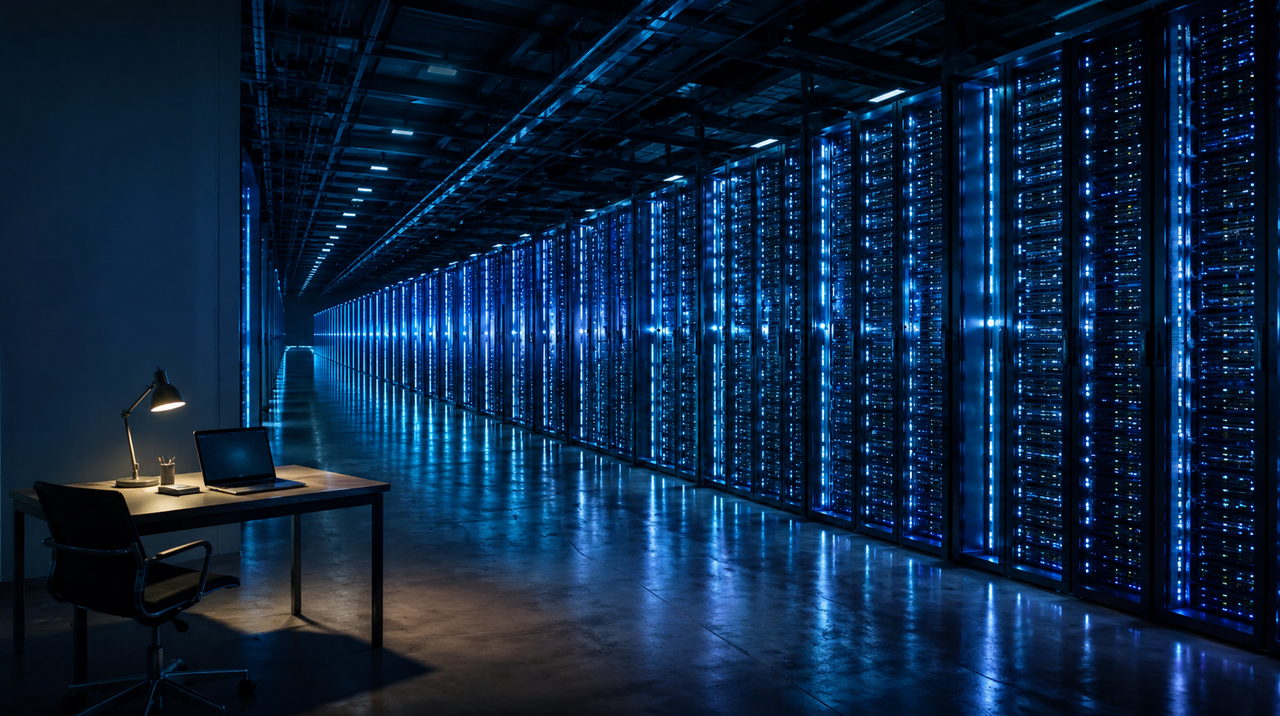
Translated into money: renting that infrastructure in the cloud costs in the region of US$ 25,000 per month. That is not a powerful computer. It is a small data centre.
And here is the comparison that settles it: the model's own official API costs about US$ 3 per million input tokens and US$ 15 per million output tokens. With the same US$ 25,000 from a single month of servers, you buy more than 1.6 billion output tokens through the API.
For scale: a dense page of text runs to about a thousand tokens. One point six billion tokens is the equivalent of something like a million and a half pages produced. No small or medium company comes close to that in a month. Most will not reach it in a year.
When Running It In-House Genuinely Makes Sense
There is a scenario where owning the infrastructure pays for itself. There are two, in fact, and they deserve recognition:
- Sustained, very high volume. If monthly consumption runs into billions of tokens, every month, the math flips. At that point the discussion is legitimate and purely financial.
- When privacy and control are worth something on their own. Health data, customer information, contracts, legal files. If the data cannot leave your infrastructure because of GDPR or contractual requirements, cost stops being the criterion — compliance is. And there is a middle ground here that almost never makes the headlines: smaller open models, running on one or two cards, solve an enormous share of real business cases with total privacy and low cost.
Outside those two cases, a dedicated server to run a giant model is engineering pride paid for with operating money.
What Your Company Should Be Asking Instead
The question "which model should I use?" is almost always the wrong one, and it is the one the headline invites. The model has changed three times this year alone — anyone who picked an architecture from a headline has already redone the work twice.
The right question comes earlier and is far more boring: which process in the company is expensive, slow, or dependent on a single person? Once that is answered, the technical choice becomes a consequence — and it is usually far more modest than the headline suggested. Most of the time what solves it is a pay-per-use API wired into the system the company already runs.
Kimi K3 is excellent news for the market: it pressures prices, reduces dependence on a handful of vendors and widens what can be built. It simply is not, for the overwhelming majority of companies, something you install in-house.
Sources
Frequently asked questions
Can I run Kimi K3 on my computer?
No. Not even on a very good one. Estimates indicate you need several data-centre cards — the practical minimum is around eight 80 GB H100s, with aggressive compression.
So is "free" a lie?
It is not a lie: the weights really are free and the licence permits commercial use. What is not free is the machine required to run them. The cost moved from the licence to the hardware.
What is the difference between open weights and open source?
Open weights means you receive the trained model and may use it. Open source would mean also receiving the training data and code, allowing audit and reconstruction. Kimi K3 is the former.
Is there a path for those who need total privacy?
Yes, and it runs through smaller open models that fit on one or two cards inside your own infrastructure. They solve a good share of business cases without any data leaving your premises.