
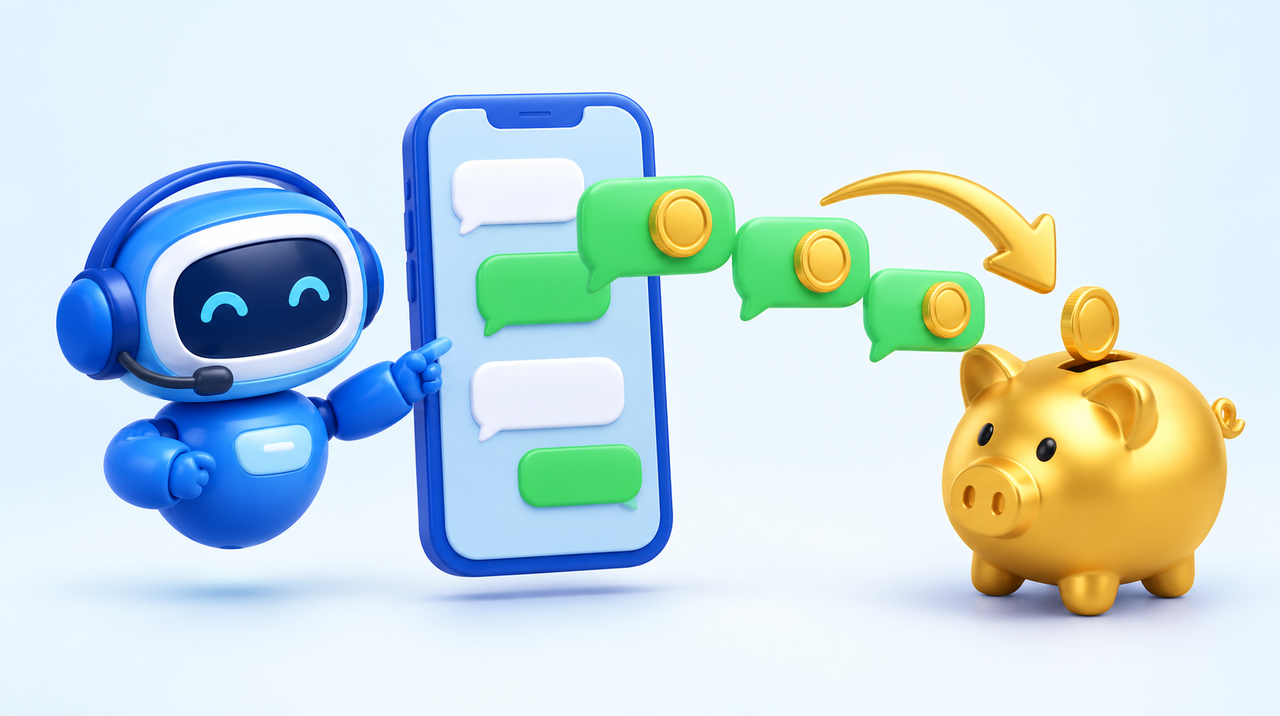
Since October 1, 2026, Meta has charged for the replies businesses send on WhatsApp when they use the official customer service platform, the same one that runs behind chatbots and support systems. Until September, replying to a customer within 24 hours was free. Now, each number gets 1,000 free replies per month, and anything beyond that is charged per message. Before any alarm: if you only use the WhatsApp Business app on your phone, you pay nothing extra. Below, who is affected, what this costs in practice and how to keep the bill low.
First: the free app has not changed
There are two WhatsApps for businesses. The WhatsApp Business app, which you download from your phone's app store and is used by those who handle customers in person, remains free. Replies, catalog, labels and away messages stay the same. If this is how your business serves customers, this change does not reach you. To get more out of it, see our guide to the free WhatsApp Business settings that help you sell.
The charge applies to the official API platform, used when customer service runs through a system: a chatbot, a help desk with several agents on the same number, or an integration with an online store or order system. If your business has hired a customer service platform or a WhatsApp chatbot, it is almost certainly in this group.
What changed on October 1
Meta's documentation describes three changes:
- Customer service replies are now charged. Meta calls "service messages" the free-form messages, which are not approved templates, sent while the conversation is open. This applies both to an agent's reply and to a reply from another company's chatbot. Each phone number gets 1,000 free per month; from the 1,001st on, each delivered message is charged. Whatever is not used in a month does not roll over to the next.
- In-conversation notices too. "Utility" messages, such as order confirmations, tracking codes or appointment reminders, had been free when sent while the conversation was open since July 2025. They are now charged, and with no free allowance.
- Without a payment method, replies stop. Accounts with no card or other payment method on file stop having replies delivered as soon as the 1,000 free ones run out. In practice, the chatbot stops answering mid-month, with no notice to the customer.
Still free: messages the customer sends to the business and replies to people who arrived through a click-to-WhatsApp ad, within a window that can stay open for up to seven days. Government agencies and eligible nonprofits remain exempt until the end of 2027.
What it costs in practice
Meta publishes a price table by country and message type. According to tables released by the platform's official partners, a utility message in Brazil costs about R$ 0.035, and customer service replies above the allowance follow the same price. Taxes are added on top and, almost always, the fee of the platform your business uses. Check the exact figure with your provider, because one of them even worked with a higher estimate while the table in reais was not final.
With that price, the math looks like this, counting only Meta's share:
- Small store, with 3,000 replies per month: 2,000 paid, about R$ 70.
- Restaurant with delivery, with 10,000 replies and 2,000 order confirmations: 9,000 paid replies and 2,000 confirmations, about R$ 385.
- Clinic with a scheduling chatbot, with 20,000 replies and 4,000 reminders: close to R$ 800.
It is not an amount that breaks a business, but it is not zero either, and it grows with the number of messages. A chatbot that sends three short bubbles instead of one complete reply triples the cost of the same conversation.
Who needs to pay attention
- Those with a WhatsApp chatbot. Bots tend to send many messages: greeting, menu, confirmation, "Can I help with anything else?" Each one counts.
- Those who send confirmations and status updates via WhatsApp. Order received, out for delivery, delivered: three utility messages per order, all paid now.
- Those with several numbers. The 1,000 allowance is per number. Consolidating customer service into a single number may exceed the limit sooner; splitting too much complicates management.
- Those who never added a payment method. This is the most serious risk, because the effect is not a high bill, it is customer service coming to a halt.
How to keep the bill low
- Check your payment method today. Log in to the platform account, or ask your provider, and confirm that an active payment method is on file. It is the only urgent item on the list.
- Combine messages. Instead of "Hi!", "How are you?" and "How can I help?" in three bubbles, send just one. Review the chatbot flow looking for messages that can become one.
- Reply better, not more. A chatbot that understands the question resolves in one or two messages what an option menu takes five to resolve. Here, the bot's quality translates directly into savings.
- Choose which notices are worth sending. Order confirmations and tracking codes help the customer; "your order is being picked" perhaps does not. Cut the ones nobody misses.
- Use click-to-WhatsApp ads when it makes sense. Replies to people who arrive through these ads fall outside the charge during the free window.
- Track the volume. Ask your provider for a monthly report of messages sent by type. Without this number, you cannot tell whether the bill is growing because of more customers or a poorly designed flow.
An important reminder: Meta also has rules about what an AI chatbot can do on WhatsApp. We cover them in our post on the WhatsApp AI rule that can block your number.
Is it still worth keeping a chatbot?
In most cases, yes. An agent costs far more per month than thousands of messages, and the chatbot answers at night, on weekends and at peak hours. What changed is that unnecessary messages now have a price. A bot that converses well, with fewer back-and-forths, has become cheaper than a menu-driven bot.
For low-traffic businesses, with fewer than a thousand replies per month, the allowance covers everything and the change only means adding a payment method as a precaution. For high-traffic businesses, it is worth running the numbers and reviewing the flow once now.
How we work
At our agency, AI chatbots are designed to resolve issues in a few messages, with complete replies and no long menus, and the flow is reviewed with each month's volume reports. If you want to review your WhatsApp customer service or build a chatbot that costs little per conversation, check out our AI chatbot.
Sources
- Meta, WhatsApp Business Platform documentation: pricing updates (service and utility messages as of October 1, 2026) and pricing page (customer service window, free ad window, billing in reais).
- Price tables for Brazil published by the platform's official partners (ChatMaxima, AiSensy, Dragapp), consulted in October 2026.
Frequently asked questions
Did WhatsApp Business become a paid service?
The WhatsApp Business app, used on your phone, is still free. The charges that began on October 1, 2026 apply to the official API platform, which is used by chatbots and customer service systems. On that platform, each number gets 1,000 free replies per month, and anything beyond that is billed per message.
How much does each reply message cost on WhatsApp?
According to the price tables published by official Meta partners, it's about R$ 0.035 per message in Brazil, for replies beyond the 1,000-per-month allowance and for utility messages, such as order confirmations. Taxes and the customer service platform’s fee are added on top of that amount. Check the exact price with your provider.
How many free messages does WhatsApp give per month?
Each phone number gets 1,000 free customer service messages per month on the official platform. The allowance doesn’t roll over to the following month. Utility messages sent within the conversation, such as an order confirmation or a tracking code, don’t count toward the allowance.
Can my chatbot stop replying?
It can. According to Meta, if the account has no payment method on file, replies stop being delivered once the month’s 1,000 free messages run out. That’s why the first thing to do is confirm with your provider that an active payment method is in place.
Which WhatsApp messages are still free?
Messages the customer sends to the business, the first 1,000 customer service replies per number each month, and replies to people who arrived through a click-to-WhatsApp ad, during the free window, which can stay open for up to seven days. Eligible government agencies and nonprofit organizations are exempt through the end of 2027.
How can I reduce the cost of my WhatsApp chatbot?
Combine messages that currently go out as several separate bubbles, replace long menus with complete answers, cut notices the customer doesn’t need, and track your monthly message volume by type. A chatbot that understands the question resolves the conversation in fewer messages and therefore costs less.