

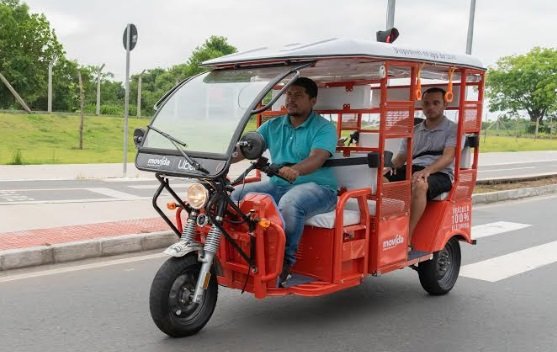
The tuk-tuk is a motorized tricycle for up to three passengers, common in India and Southeast Asia, where it works as a cheap taxi for short trips. In 2019, Uber tested the format in Brazil, and the trial never became a nationwide service. What's left of it is more interesting than the original news.
Why the tuk-tuk makes sense on paper
The math checks out: the vehicle is much cheaper than a car, uses little fuel, takes up less space in traffic, and covers exactly the kind of trip where a car is least efficient — a few kilometers, within the same neighborhood. In Asian cities, it solves the so-called first and last mile, the stretch between home and public transportation.
Why it didn't catch on here
Three obstacles, and none of them is lack of demand:
- Regulation. The motorized tricycle doesn't fit neatly into most Brazilian cities' categories for paid passenger transport, and permits vary from city to city.
- Safety and weather. An open vehicle doesn't fare well in heavy rain or on fast-traffic roads, which is the reality in most large cities.
- The competition got cheap. App-based motorcycle rides took over the same niche with lower cost, greater availability, and regulation already sorted out in most of the country.
Today the tuk-tuk survives in Brazil as a tourist attraction, in historic cities and coastal towns, where the ride itself is the product and speed doesn't matter.
The lesson for anyone launching a new service
The case is a clean example of something common: the idea worked, the market existed, and it still didn't take off — because the obstacle wasn't in the product. It was in local rules and in a competitor that solved the same problem with something already approved.
That's why testing a new service has to start with the most tedious question: what needs to be cleared for this to operate, and who already serves this customer today in a worse way. A good idea that depends on a license nobody has dies in operations, not on the drawing board.
When the test is digital, you can answer that question with little money: a page that describes the service, a contact channel, and a measure of how many people ask for it. That's what we do in website creation and in app development — validate before building the entire operation.
Frequently asked questions
What is a tuk-tuk?
It's a motorized three-wheeler that seats up to three passengers, common in India and Southeast Asia, where it works as a cheap taxi for short trips. It costs far less than a car, sips very little fuel, and takes up little room in traffic.
Does Uber offer tuk-tuks in Brazil?
The company piloted the format in 2019, but the trial never grew into a nationwide service. Today, tuk-tuks in Brazil are mostly a tourist attraction, found in historic towns and coastal cities, where the ride itself is the product.
Why didn't tuk-tuks catch on in Brazil?
Three factors combined against it: motorized three-wheelers don't fit neatly into most municipalities' categories for paid passenger transport, the open-air design doesn't hold up well against heavy rain or fast roads, and app-based motorcycle rides already filled the same niche at a lower cost with regulations already in place.