

Will artificial intelligence solve all of humanity's problems?
| Peter H. Diamandis October 3rd |
Sam Altman has just announced OpenAI's plan to build a gigawatt AI factory per week. Here's why this changes everything over the next decade…
1/ Abundant intelligence as infrastructure, superintelligence as a service.
"We are not just building faster computers — we are now creating the substrate for a post-scarcity world, where every great challenge will be solved."
When Altman describes 10 gigawatts to cure cancer or deliver global tutoring, he is outlining the last era in which humanity must choose between tackling one great challenge at the expense of another. Soon, the rise in computational capacity will allow us to solve ALL of our hardest problems. Intelligence transitions from scarcity to abundance, and problem-solving becomes something every human being can take on — enabling all of us to be Moonshot entrepreneurs and engineers.
2/ The "impossible" is becoming a capacity problem, not a competence problem. As one observer notes: "I still can't imagine that in just 15 years we will have AI models capable of solving any conceivable problem — scientific, economic, medical, or creative — in minutes. The entire concept of 'impossible' will collapse."
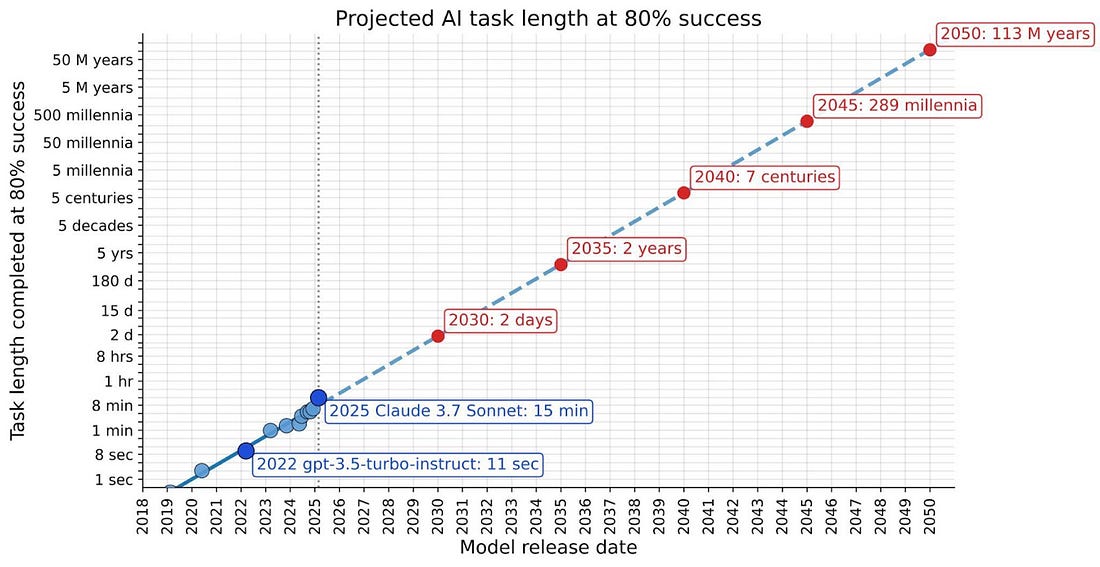
The chart below reveals the trajectory: AI is learning to maintain 80% success rates on tasks with increasingly longer time horizons. Current models successfully complete 15-minute tasks. By 2030, they will handle projects lasting 2 days. By 2035, initiatives that take 2 years to execute.
And by 2050, endeavors equivalent in scope to 113 million years of continuous work.
Think of multi-year drug discovery programs, decade-long infrastructure projects, century-spanning climate interventions. All of it carried out by AI systems.
We are becoming exponentially more capable of handling increasingly complex problems. The only remaining question is: how quickly can the Western world build the computational infrastructure needed to make this future a reality?
3/ Infrastructure is the new geopolitical battleground. Altman's admission that "other countries are building chip factories and generating energy far faster than we are" reveals what is truly at stake. This is about building the factory that builds the intelligence that, in turn, builds everything else.
The country that controls AI infrastructure controls the economic advantage for the next century. China understands this perfectly. The question is whether the United States does. We are in a race to create free and abundant resources to enable a prosperous and promising future.
4/ Compute scarcity is the final bottleneck before solving everything. While everyone debates AI safety and regulation, Altman addresses the real constraint: we have the ability to cure cancer, deliver personalized education to every child, and extend humanity's life expectancy by many decades… but only if we have sufficient computational capacity to run those solutions at scale.
His gigawatt-per-week factory is the first step in determining who will participate in the era of abundant intelligence. The winners will be the nations and organizations that treat AI infrastructure like the Manhattan Project. The losers will be those still debating whether AI is overhyped.
5/ OpenAI is not alone. xAI, Google, and Meta are "ALL-IN" and competing as well. Beyond OpenAI's superclusters, trillions of dollars are also being invested by companies such as xAI, Google, Meta, Oracle, Microsoft, Nvidia, and others. We are methodically covering the surface of the Earth with compute!
Here is what this means:
"We are living through what may be the last decade in which human problem-solving operates under scarcity constraints."
By 2035, every person will have access to personalized swarms of AI agents — responsible for research, education, health optimization, and creative work. Scientific discovery will become autonomous and continuous, with AI running millions of experiments daily. AI tutors will deliver individualized adaptive instruction to every child, in any language.
This is the abundance inflection point: when exponential technologies solve humanity's greatest challenges faster than new problems arise.
Intelligence becomes substrate: the foundational layer upon which civilization operates.
Act accordingly.
Until next time,
Peter