

NASA announced in August that it is restarting its nuclear programme: a compact reactor for the Moon and atomic engines for deep space. The headline number is the trip to Mars dropping from nine months to three. But what matters for anyone running a company isn't the rocket — it's the two management decisions buried in the story, and they apply to a project of any size.
First, the facts
The Fission Surface Power project, run with the Department of Energy and Idaho National Laboratory, is building a 40-kilowatt reactor — enough for a base of four to six astronauts, with habitat, rovers and ice-mining gear. It fits in a 4-metre cylinder, weighs under 6 tonnes and runs 10 years with nobody touching it. NASA wants the lunar version by 2030, with orbital testing as early as 2028.
The reason not to use solar panels is simple arithmetic: the Moon runs on roughly 14 days of sunlight followed by 14 days of darkness. Getting through 336 hours of night on solar power requires a battery farm — and every kilo of battery has to be lifted out of Earth's gravity. As NASA administrator Jared Isaacman put it, without nuclear "you're going to need a lot of humanoid robots on Mars walking around dusting off solar panels".
On propulsion the gap changes order of magnitude. The best chemical engine delivers a specific impulse of about 450 seconds; a nuclear thermal engine, which runs hydrogen through a reactor core instead of burning it, reaches 800 to 1,000 seconds. That cuts the journey from six-to-nine months to three or four — and with it, half the crew's radiation dose, half the bone loss and half the supplies to carry. In deep space, speed isn't a luxury: it's life support.
Rule one: audit the warehouse
When the press reported that NASA was going to spend US$ 2.5 billion on a nuclear spacecraft, Isaacman's answer was that the taxpayer had already spent it — he simply refuses to let the hardware rot in a warehouse. That spacecraft, the SR-1 Freedom, is built almost entirely from repurposed parts: the body is the power and propulsion element built for the Gateway lunar station, electric thrusters already integrated; the reactor baseline comes from components matured over decades at the Idaho lab, paid for by other programmes.
Every company has its warehouse, and it is almost never on the inventory. It's the software licence still being charged that nobody opens. It's the system that was deployed, trained and abandoned in week three. It's the product photo library, the corporate video that was finished and never aired, the website in a language that was never translated, the contact list nobody has written to in two years, the 3D model the factory drew in CAD to manufacture the part — and which serves, at no extra cost, to show that product in augmented reality.
Before approving the purchase of the year, an afternoon of auditing pays: list what the company has already paid for, what actually got finished and what stalled. The question isn't "what else should we buy", it's "what is already mine and sitting still". That list usually yields more projects than the new budget does.
Rule two: one impossible thing at a time
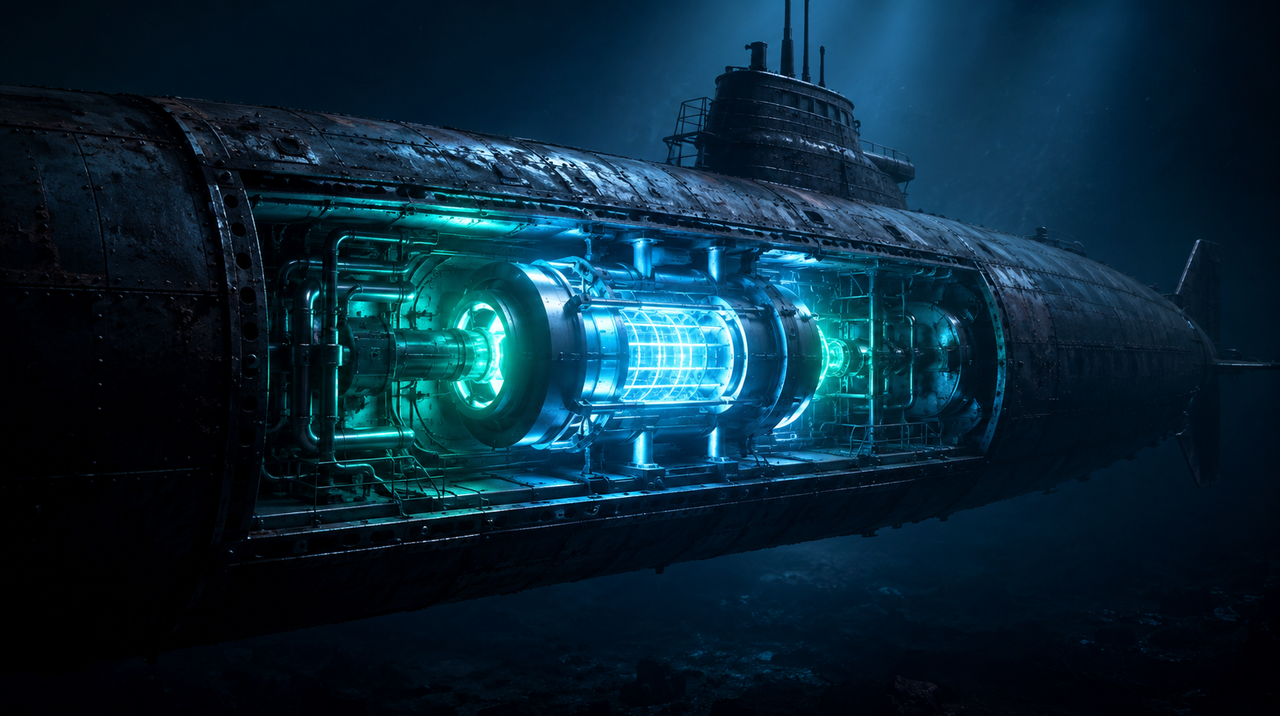
Isaacman's analogy is the best part. The USS Nautilus, the world's first nuclear submarine, was a conventional diesel-era hull with a revolutionary reactor inside. Admiral Hyman Rickover refused to invent the reactor and the hull at the same time. He called it a "70% solution" himself — and that 70% solution gave birth to the entire nuclear navy.
It is the opposite of what usually happens inside a company. The project goes into a meeting, every department adds a requirement, and what was one change becomes three simultaneous ones: change the system, change the process and train everybody, all in the same quarter. When it fails — and it does — nobody knows which of the three broke.
Solving one impossible thing at a time has an advantage nobody advertises: when it goes wrong, you know what went wrong. And a bigger one: the version that flies today teaches you things the perfect version, still on paper, never will. Isaacman sums up the goal as getting astronauts to Mars and back "with the fewest miracles required". Worth writing on the wall of any project room.
Where the 70% rule does not apply
It would be dishonest to sell this as a universal law. Some parts of a system can't take the incomplete version — anything touching customer money, personal data or safety. There the rule inverts: better to delay than to ship half-built, because the cost of the mistake doesn't land on you, it lands on whoever trusted you. The Nautilus had an old hull, but the reactor was no prototype.
So the correct reading is this: be radical where nobody sees it break and conservative where the mistake is irreversible. NASA accepts repurposed hardware in the body of the ship and accepts no improvisation in the reactor core.
What to do with this on Monday
Three questions, in order:
- What have we already paid for that is sitting still? Licences, systems, files, content, equipment, data. Write that list before writing the budget.
- What is the single impossible thing in this project? If the answer has more than one item, the project hasn't started — it has been stacked.
- Which part cannot ship at 70%? Mark it and hold it to a different standard of rigour, deadline and review.
That is how we work in custom software development: first an inventory of what the company already has and can reuse, then a first version small enough to ship and teach us something — with the sensitive parts handled separately from day one.
Source
The figures on NASA's nuclear programme, the surface reactor and SR-1 Freedom come from the "Nuclear Rockets Are Coming" edition of Peter H. Diamandis's Metatrends newsletter, published on 8 August 2026, quoting NASA administrator Jared Isaacman.