
On November 20, 2026, mathematician Levent Alpöge released a proof of the Riemann hypothesis, one of the most famous problems in mathematics, open since 1859. The proof was found with the help of Claude, Anthropic's artificial intelligence. The next day, the teams that maintain Lean, a language in which the computer checks every step of a proof, certified that the proof is correct. The feat is historic, but the most useful lesson for business owners is not in the result. It is in how it was verified.
What happened, in a nutshell
The Riemann hypothesis concerns how prime numbers are distributed among the integers. It was proposed by German mathematician Bernhard Riemann in 1859 and is one of the seven Millennium Prize Problems of the Clay Mathematics Institute, which offers a one-million-dollar prize for solving each of them. Generations of mathematicians tried and failed.
The proof released in November did not come as a traditional paper. It came as a library of about 17 million lines of Lean code, spread across more than 175,000 files. No person read all of it, and no one needed to. Lean is a verifier: it accepts a step only if it follows logically from the previous ones, and it rejects anything that doesn't hold up.
Why a program checked it, and not a person
On November 21, Lean FRO and the Mathlib initiative, which are responsible for the language and for Lean's main mathematics library, published a joint statement certifying that the statement and proof of the Riemann hypothesis are correct. The verification was done in several layers:
- The right statement. Independent tools compared the proven theorem with the version of the hypothesis that already existed in the Mathlib library, written years earlier by other people. This ensures the AI didn't prove an easier version of the problem that merely sounds similar.
- The right steps. The Lean kernel and several verifiers built by other teams re-checked every step.
- No hidden shortcuts. The proof depends only on Lean's three standard axioms, the basic rules every proof in the language uses. There is no extra assumption tucked in the middle.
- Repeatable by anyone. According to the statement, dozens of people reproduced the same result on their own computers, including researchers from universities such as MIT and the University of Waterloo.
What is still not done
It would be wrong to say the matter is closed. Three things remain open:
- The human explanation. A version written for mathematicians to read, prepared by Professor Michael Rubinstein of the University of Waterloo, is still presented by him as a work in progress: it organizes the argument, but leaves important parts as hypotheses not yet demonstrated in the text. Understanding why the proof works will take time.
- Publication. As of the end of November, no paper had been submitted to a scientific journal. The Clay prize rules require publication in a qualifying venue and two years of scrutiny by the community.
- The generalized version. The announcement also mentions a broader version of the problem, but the certification by the Lean teams covers the original Riemann hypothesis.
Even so, the central point is already unprecedented: mathematics has come to accept as correct a proof that no human being has read in full, because it was checked in a way that doesn't depend on trusting anyone, neither the AI nor the author.
The lesson for your business
AI makes mistakes. It invents numbers, cites sources that don't exist, and writes with the same confidence whether it is right or wrong. We have already shown this in tests in our post on how to evaluate an AI. The Riemann proof didn't change that. What it shows is that the way forward is not hoping the AI gets it right, but setting up the work so that it can be checked.
The mathematician didn't ask the AI, "solve it and tell me if it's right." He asked for a result in a format that an independent checker can verify on its own. That is the pattern worth copying, at small-business scale.
Five ways to ask for verifiable work
- Spreadsheets: ask for formulas, not numbers. If the AI returns a typed-in total, you don't know where it came from. If it returns the formula, you check three rows by hand and know the other thousand follow the same rule.
- Text with facts: ask for the source of each number. One link per claim. Open the links. A number without a source that opens doesn't make it into material that goes to the customer.
- AI customer service: build an answer key. A list of 20 real questions from your customers, with the correct answer next to each. Every time the chatbot changes, run the list and compare. If an answer changed, you find out before the customer does.
- Automation: test on a copy first. An automation that touches orders, inventory or billing runs first on a copy of the data, with known cases and expected results. Only then does it go into operation.
- Documents and contracts: ask for the exact passage. Instead of "summarize the contract," ask "copy the clause about late-payment penalties." You can check the copy in seconds; a summary, you can't.
Whoever does the work can't be the one who checks it
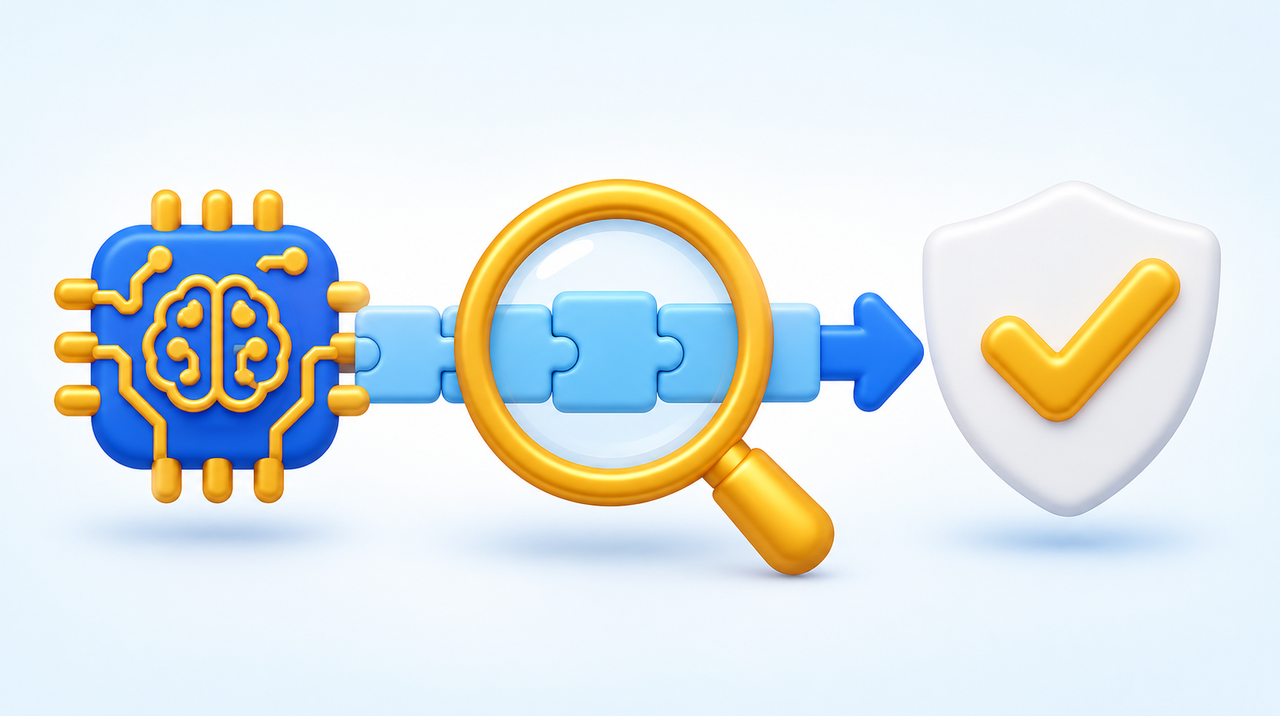
One detail of the Riemann story goes unnoticed: Lean is not the same AI that found the proof. It is a separate checker, with fixed rules, that has no stake in the outcome. In a business, the same principle applies. Asking the AI "are you sure?" checks nothing, because it tends to confirm what it already said. The check has to come from outside: a formula that recalculates, a link that opens, an answer key written by a person, a test with a known result.
It is the same reasoning that applies to your relationship with your customers, who trust promises less and less and rely more on what they can verify, as we discussed in the post your customer doesn't want to trust, they want to verify.
When you can't verify
Not every kind of work has a Lean. A decision to hire, to extend credit, to fire someone or to change prices involves judgment, and no program can tell you whether it is right. In these cases, AI can organize information and lay out options, but the decision stays with a person, who is accountable for it. The practical rule is simple: the greater the damage of an error and the lower the chance of verifying it, the less autonomy the AI should have.
How to start this week
Pick a task where your team already uses AI and ask: if it gets this wrong, how do we find out? If the answer is "only when the customer complains," the task needs a checker. Start with the cheapest options: a formula instead of a number, a source instead of a claim, an answer key instead of trust.
If you'd like help setting this up in your operation, with AI that produces verifiable work and tests that warn you before an error reaches the customer, our team handles AI implementation for businesses, from diagnosis to a working system.
Sources
- Lean FRO and Mathlib Initiative, joint statement of November 21, 2026 on the proof of the Riemann hypothesis (leanprover-community.github.io).
- Michael Rubinstein, University of Waterloo, verification page and explanatory text on the proof (math.uwaterloo.ca).
- Clay Mathematics Institute, Millennium Prize Problems rules.
Frequently asked questions
Has the Riemann hypothesis really been proven?
On November 21, 2026, the Lean and Mathlib teams certified that the proof released by Levent Alpöge, produced with the help of Claude, is correct as a formal proof. An explanation that mathematicians can read is still in the works, and the Clay Institute prize requires publication and two years of scrutiny.
What is Lean?
It is a programming language and a proof checker for mathematics. It only accepts a step if it follows logically from the previous ones. That is why a proof that compiles in Lean, using only the standard axioms, is considered correct even if no one has read the whole thing.
What role did AI play in the proof?
The proof was found by the mathematician Levent Alpöge working with Claude, from Anthropic, and delivered as about 17 million lines of Lean code. The checking was done by independent programs and teams, not by the AI itself.
What does this change for a small business that uses AI?
It shows that the safe approach is to ask AI for work you can check: formulas instead of typed-in numbers, sources with a link for every fact, answer keys of questions to test the chatbot, and tests on a copy before putting an automation live.
Can I ask the AI itself to check its own work?
That isn’t enough. AI tends to confirm what it has already said. The check has to come from outside: a formula that recalculates, a link that opens, an answer key written by a person, or a test with a known result.
When should I not let AI decide on its own?
When a mistake does serious damage and there is no way to check the result, such as decisions about hiring, credit, firing, or pricing. In those cases, AI organizes the information and the options, and the decision stays with a person.