

The Brazilian who buys property today lives with fewer people, is older and, increasingly, lives alone. The 2022 Census measured this precisely. Yet the sales material for most new developments still shows the apartment for a family of four — an audience that has shrunk.
What the 2022 Census shows about who buys property
Four numbers from IBGE summarize the change:
- 2.79 residents per household in 2022, versus 3.31 in 2010. The 18.7% drop over twelve years was faster than in the previous decade.
- 18.9% of households have just one person, versus 12.2% in 2010. It's the fastest-growing household type in Brazil.
- Median age of 35, versus 29 in 2010: half the population is already over 35.
- 32.1 million people aged 60 or older, 56% more than in 2010. And it's in this age group that living alone is most common: 28.7% of older adults live in single-person households.
Together, these numbers describe a buyer different from the one shown in most sales brochures: fewer people per property, older age, more people without children at home.
Why smaller families mean more demand, not less
It seems counterintuitive, but it's simple arithmetic. If the population grows slowly and each household has fewer people, the number of households grows faster than the population — and each new household needs a property. The family that once shared one apartment becomes, in a generation, two or three households.
Pent-up demand also exists. The Fundação João Pinheiro estimates the 2023 housing deficit at 5.98 million homes, 7.6% of occupied households. And the detail that matters most to sellers: 61.3% of that deficit is excessive rent burden — 3.66 million families who have somewhere to live but pay rent that doesn't fit their budget. They're potential buyers, waiting for financing to become affordable.
And credit has started to move. The Central Bank cut the Selic rate five times in 2026: from 15% in January to 13.75% on September 17. It's still a high rate, and mortgage financing rates follow with a lag, not overnight. But the direction has changed.
The mistake: selling the 2026 property with the 2000 brochure
Open the marketing material for any new development. The staged model unit photo shows a living room for four, a kid's bedroom with a toy on the floor, a balcony with a barbecue grill for hosting the family. There's nothing wrong with that — except that this buyer is an ever-shrinking slice of the market.
The same two-bedroom apartment is a different product for each audience:
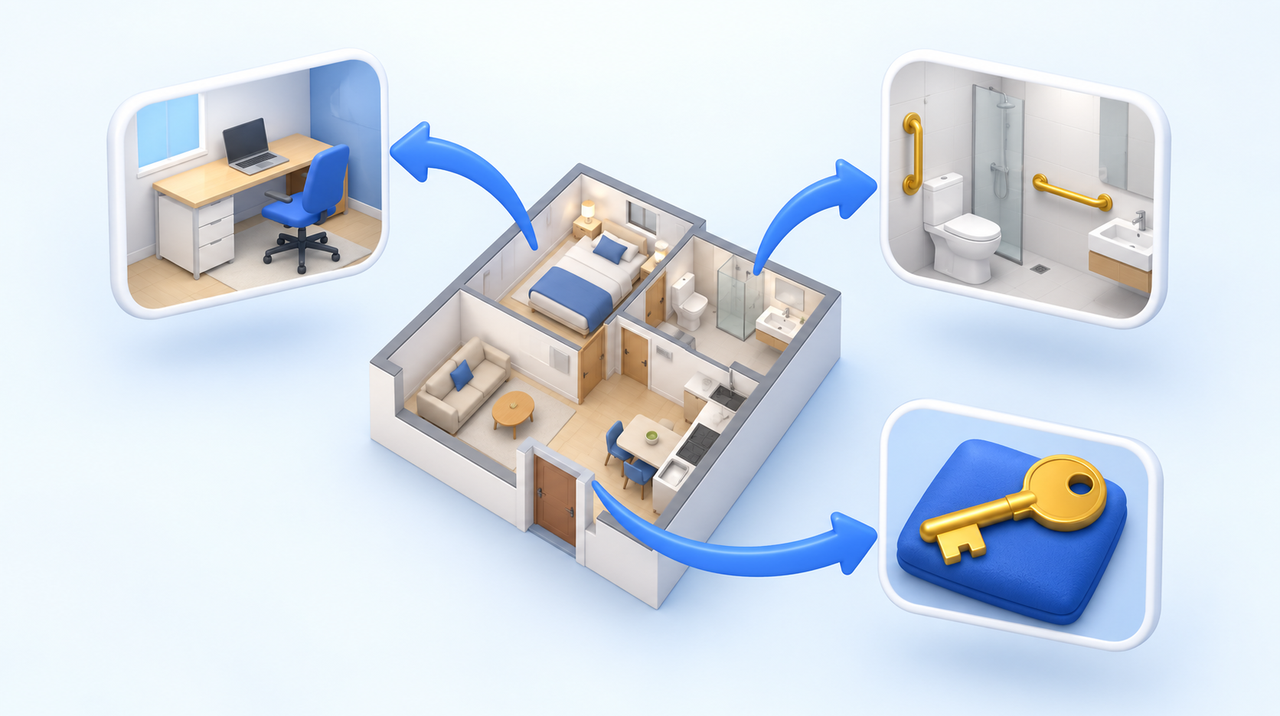
- For someone who lives alone and works from home, the second bedroom is an office. They need to see the desk, the light, and the outlet — not the kid's bed.
- For the couple over 60, what decides it is the step-free bathroom, the wide door, the non-slip floor, the distance to the pharmacy and the hospital. If it doesn't appear, they assume it doesn't exist.
- For the investor who will rent it out, the likely tenant lives alone. They want to see the property ready for that tenant.
The floor plan is the same in all three cases. What changes is what the buyer needs to see to recognize themselves there. And whoever doesn't recognize themselves in the listing doesn't call the real estate agent.
How to show the same property to different audiences
There's only one physical model unit, and staging the same apartment three times is expensive and slow. That's where 3D changes the math: the property model is built once, and each version — office, accessible, rental-ready — is a new staging over the same model, not a new project.
- Images and 3D tour by audience. Each campaign uses the version that speaks to its target: the ad for someone living alone shows the office; the ad for the 60+ audience shows the accessible bathroom.
- Augmented reality model. The development appears on the sales-office table, or on the customer's own table at home, through the phone's camera, and they can rotate it to see every side — no app download required.
- Different pages for the same development. A site with entry points by profile takes each visitor straight to the version that interests them.
3D modeling of the property is what supports all three things, and it's what our agency does for developers and real estate agencies: 3D modeling and animation from the floor plan, and augmented reality to bring the model to the client. If two 3D quotes come back very different, we explain why in CGI rendering: what it is and why quotes don't match.
Launching a development for an audience that's no longer the family of four?
We model the property once and generate versions for each buyer profile.
Four questions before commissioning material for the next development
- Who really buys this floor plan? Look at the sales data from recent developments: age, how many people will live there, whether it's for living in or renting out. The brochure should speak to that audience, not the usual one.
- Does the buyer over 60 see themselves in the model unit? Accessibility that doesn't appear in the image doesn't factor into the decision.
- Is the second bedroom a bedroom or an office? Show both versions and let the buyer choose.
- Does the investor ad show the likely tenant? Today, it's almost always someone who lives alone.
What the numbers don't say
Census data are national averages, and the real estate market is local. In Rio de Janeiro, 23.4% of households have a single resident; in other states, far fewer. Before redesigning the material, it's worth looking at the profile of buyers in your city — and your neighborhood.
The Selic rate cut also doesn't guarantee cheaper financing next month: banks pass it on slowly, and rates remain high. What the numbers show with certainty is the direction — smaller households, older buyers, more people living alone — and it shows no sign of reversing.
On what technology has already taken away from real estate agents and what's left for the neighborhood agency, see Will real estate agencies disappear?
Sources
- IBGE — 2022 Demographic Census: household characteristics (residents per household and single-person households).
- IBGE — 2022 Demographic Census: population by age and sex (median age and people aged 60 or older).
- Fundação João Pinheiro — Housing Deficit in Brazil, base year 2023.
- Banco Central do Brasil — historical series of the Selic rate target.
- Ricardo Amorim — Na Mira, September 15, 2026 edition, which covered the topic.
Frequently asked questions
How many people live, on average, in a Brazilian household?
According to IBGE's 2022 Census, 2.79 people per household. In 2010 it was 3.31 — an 18.7% drop over twelve years, faster than the decline seen in the previous decade.
How many Brazilians live alone?
18.9% of Brazilian households had just one resident in 2022, up from 12.2% in 2010. Among people aged 60 and over, the share is even higher: 28.7% live alone.
How big is Brazil's housing deficit?
The Fundação João Pinheiro estimates 5.98 million homes in 2023, equal to 7.6% of occupied households. The largest driver is excessive rent burden, affecting 3.66 million families — 61.3% of the deficit.
Does the falling Selic rate make home financing cheaper?
It tends to, but not right away. Brazil's Central Bank cut the Selic rate from 15% to 13.75% over the course of 2026, with the latest cut on September 17. Banks pass the reduction on gradually, so interest rates remain high for now.
How do you showcase an off-plan property to different audiences?
By staging the same 3D model of the furnished unit in different ways: one version with a home office for people living alone, another with accessibility features for the 60+ market, another styled ready to rent. The model is built once, and each version builds on that same work.
Why use 3D instead of photographing the furnished show unit?
Because there's only one physical show unit, and staging it three different ways is costly and time-consuming. With 3D, every new version is simply a new styling of the same model — and it can even be turned into a virtual tour or an augmented-reality scale model.