

What happened
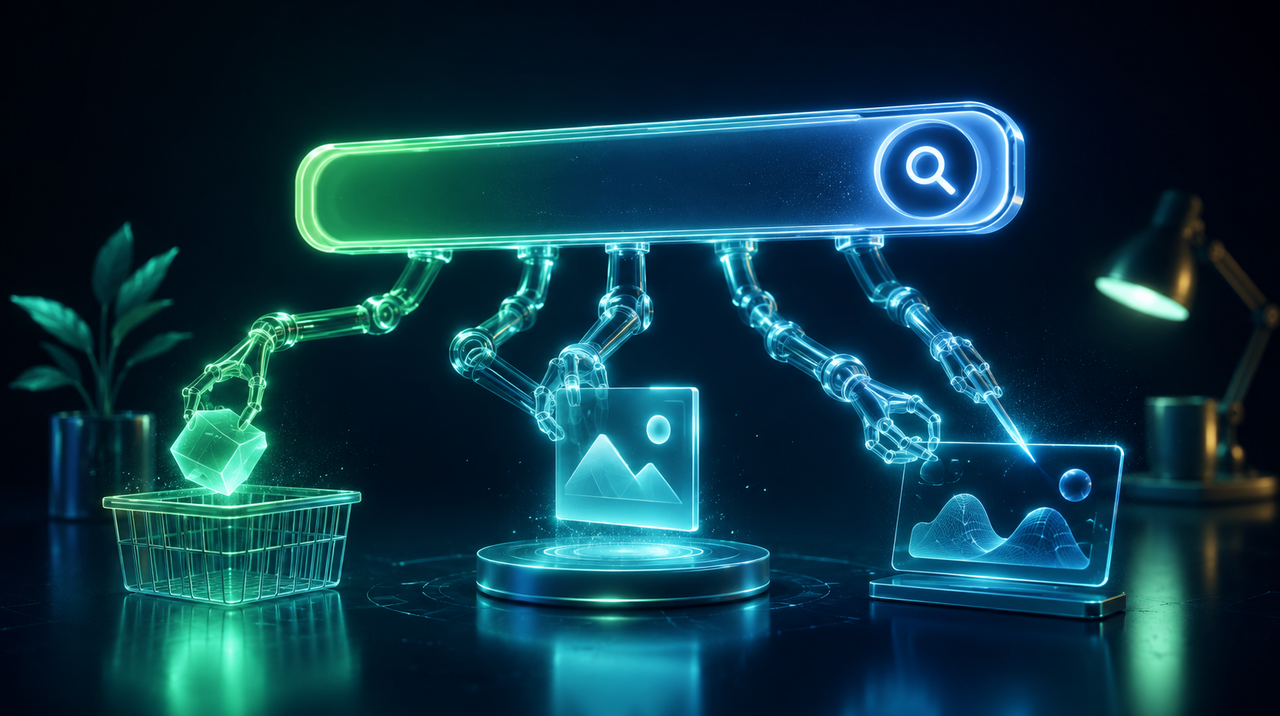
In July 2026, Google began connecting third-party apps to its AI search mode (AI Mode). The first were Canva, Instacart, and YouTube Music. In practice: you ask for a playlist for a mood and YouTube Music builds it; you ask for an event invite and Canva generates the layout using data from your calendar; you ask for a barbecue shopping list and Instacart already drops the items into your cart.
For now it's rolling out only in the United States, and Google has already said more partners are coming. It may look like a distant novelty — but what it signals changes the game for any business that depends on being found on Google.
The deeper shift: from "finding links" to "doing the task"
For 25 years, Google search did one thing: show a list of blue links for you to click and go solve on another site. The whole SEO game was born from that — the fight was to appear at the top of that list, because the click was worth the visit to your site.
What these integrations show is a different search: one that solves the task within itself. Instead of sending you to a design site, it does the design there. Instead of sending you to the store, it fills the cart. Search stopped being an index of links and started becoming an assistant that executes.
Why this matters for a business owner
Here's the point no one in your industry is talking about. If search solves the person's need within itself — answering, summarizing, executing — the click on your site may simply not happen. The person gets the ready-made answer and moves on, without visiting anyone.
This was already happening with AI-generated answers at the top of search (the ones that summarize without you clicking anything). App integrations are the next step: search doesn't just answer, it acts. For a business, the effect is that "being found" is ceasing to mean "appearing in the list of links".
What now matters: being the answer, not just one of the links
When the search AI (or ChatGPT, or Gemini) builds the answer, it picks a few sources to cite and recommend. Being among those sources is the new "first place." This even has a name: AEO — answer engine optimization (the evolution of SEO for the AI era).
In practice, what makes a company get chosen by the AI as the answer:
- Content that genuinely answers questions, clearly and quotably — not generic storefront text.
- Consistent information about your business across the internet (name, address, phone, what you do) so the AI is sure who you are.
- Technical structure that AIs understand (structured data, organized information), so you get read and cited with confidence.
It's the same work as always — being relevant and trustworthy — but aimed at a new judge: the AI that builds the answer, not just the algorithm that ranks the links.
The honest caveat: no panic
None of this means SEO "died" or that your site became useless. Two truths coexist: (1) these integrations are still US-only and early; (2) most searches still lead to the traditional click. What's happening is a transition, not a blackout. Those who prepare now — being citable by AIs, on top of being rankable on Google — cross the change ahead of everyone, without having to scramble later.
Sources
Frequently asked questions
Does this already work in Brazil / Europe?
The app integrations (Canva, Instacart, YouTube Music) started in the United States. But the logic — AI search answering and executing — is already present everywhere through AI-generated answers at the top of search.
So is SEO over?
No. It's adding up with AEO — showing up in AI answers too. The base is the same (relevant content, trustworthy site), with a new layer designed to be read and cited by AIs.
What should I, a business owner, do now?
Make sure the information about your business is consistent and clear across the internet, and have content that genuinely answers your customers' questions. That's what makes the AI choose you as the answer.
Will I lose visits to my site?
Some searches that used to become a click now get solved within search itself — that's real. That's why the focus shifts from "just attract the click" to "be the source the AI recommends," which is where attention is going.