

We published this article in 2020, when an 80-kilometer range was a remarkable feat. We updated the text in July 2026 — and today's numbers reveal the magnitude of the leap.
Why hydrogen flies longer than a battery
The endurance of an electric drone runs into a physical limitation: lithium batteries are heavy relative to the energy they store. The longer you want to fly, the more battery you need to carry — and the more weight you need to keep airborne, which in turn consumes more energy. It is a cycle that closes quickly, which is why most commercial drones achieve between 20 and 40 minutes of flight time.
The hydrogen fuel cell breaks that cycle by separating the two functions: the cell generates the electricity, and the compressed hydrogen is the fuel. Carrying more fuel adds far less weight than carrying more battery. The practical result is several times greater endurance in an aircraft of the same size.
The 2020 case: 80 km inspecting a pipeline
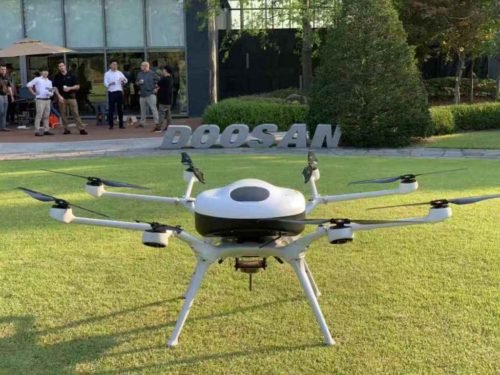
Drone manufacturer Doosan Mobility Innovation and hydrogen supplier ReadyH2 partnered to inspect a pipeline in the United States using a hydrogen-powered octocopter capable of flying more than 80 kilometers for nearly 2 hours per mission. The operation was organized by consultancy Skyfire, with the goal of establishing inspection procedures over six months.
At the time, Skyfire CEO Matt Sloane captured the excitement well: "distances like that simply aren't possible with battery technology." The same company had previously delivered medical supplies to the U.S. Virgin Islands, covering 66 km.
Want to greatly improve your chances of landing on Google's first page?
This article reached you through a search. That is exactly the work we do on our clients' sites.
2025: 188.6 km and a Guinness World Record
Five years later, the benchmark is in a different league. On November 16, 2025, the Chinese drone Tianmushan-1 flew 188.605 kilometers in over four hours, earning it the Guinness World Record for the longest distance flown by a hydrogen-powered multirotor.
The specifications put that achievement in context: developed by the Tianmushan Laboratory at Beihang University, the aircraft has a 1,600 mm wheelbase, weighs 19 kg empty, carries up to 6 kg of payload, and achieves 240 minutes of unloaded flight. It completed its first flight in August 2024 and entered production in April 2025 — this is not a laboratory prototype.
And 30 hours in the air
In the same year, in April 2025, a drone developed by AVIC (China's state-owned aerospace corporation) in partnership with Tsinghua University remained airborne for 30 hours in continuous flight — an endurance record for its class. The aircraft weighs 50 kg and uses fuel cells with an energy density of 600 W/kg; researchers report achieving 55% system efficiency using a lighter stack and a catalyst with reduced platinum content.
Thirty hours exceeds the flight duration of many crewed aircraft. For perspective, it is the difference between overflying an area and monitoring it for more than an entire day without landing.
Where this technology is already in use
Extended endurance changes the type of work a drone can perform:
- Linear inspection: pipelines, transmission lines, railways, and highways, where the drone must follow kilometers of infrastructure rather than orbit a single point.
- Emergencies and disasters: continuous mapping of affected areas and supply delivery to locations without ground access.
- Agriculture and environment: surveying large areas in a single sortie, without swapping batteries every 30 minutes.
- Surveillance and monitoring: where the value lies in staying airborne, not in getting there quickly.
The limitations that still exist
An honest counterpoint is warranted. Hydrogen is still expensive and, above all, difficult to refuel: you need the cylinder and the refueling logistics on-site, which makes little sense for operators who fly near a power outlet. The fuel cell also adds mechanical complexity to equipment that, in its battery-powered version, is essentially plug-and-play.
Furthermore, flying long distances runs into regulation: beyond-visual-line-of-sight operations require specific authorization in most countries, and that — not endurance — is typically what limits the actual range of a commercial mission.
For this reason, hydrogen drones do not replace battery drones for everyday use. They address a specific niche: long missions, over great distances, where swapping batteries is not viable.
Sources
- Xinhua — Chinese hydrogen-powered drone sets longest distance flight record
- electrive — Hydrogen-powered drone stays 30 hours in the air
- Fuel Cells Works — Chinese hydrogen drone sets world record with 188.6 km flight
Want to greatly improve your chances of landing on Google's first page?
Technical audit, the words your customers actually search for and content that answers them — the same method that put this article in front of you.
Frequently asked questions
How long can a hydrogen drone fly?
It depends on the size. Commercial hydrogen multirotors typically achieve 2 to 4 hours, compared to 20 to 40 minutes for their battery-powered equivalents. In larger fixed-wing aircraft, records have already reached 30 hours.
Do hydrogen drones pollute?
The fuel cell emits water vapor during flight. The actual environmental impact depends on how the hydrogen was produced, since a significant share of the hydrogen available today is derived from fossil fuel sources.
Is it worthwhile for a small business?
In most cases, no. Without long and recurrent missions, the cost and logistics of hydrogen do not justify the investment compared to a battery-powered drone with spare batteries.