

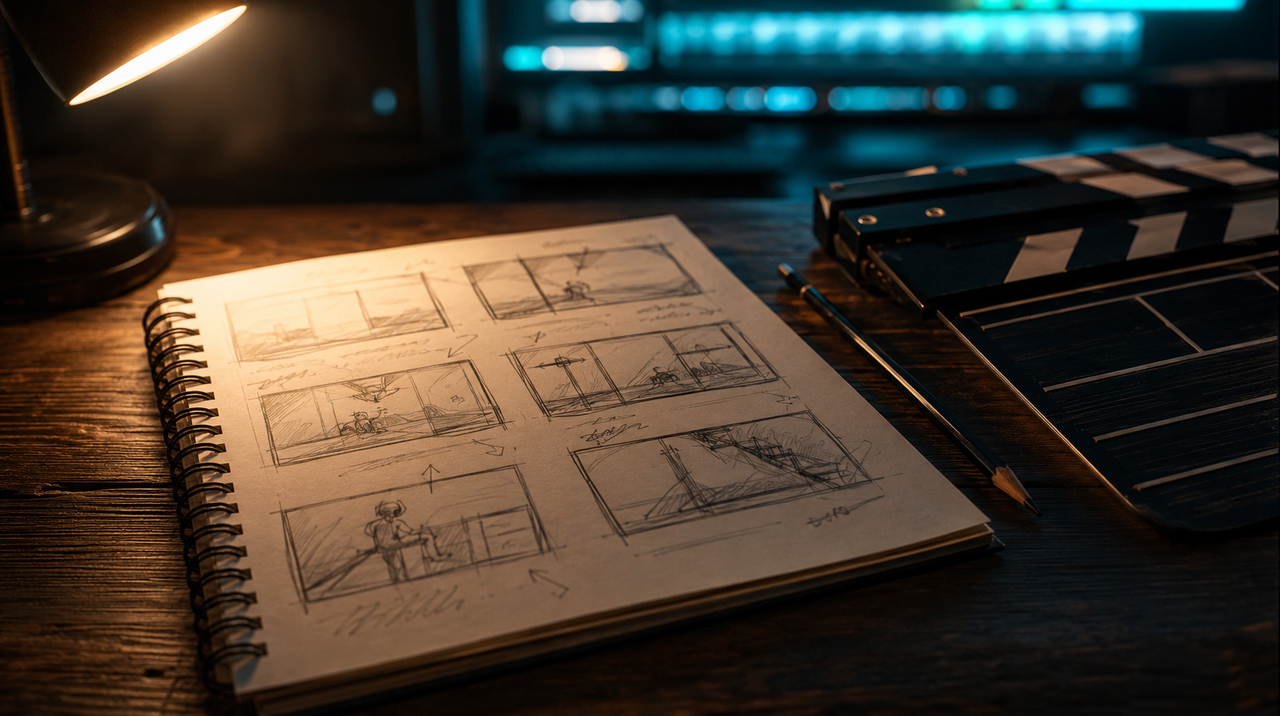
Today one of the world's best-known AI filmmakers published something almost nobody publishes: the full prompt used to generate a scene from the film he is producing. PJ Accetturo, CEO of the studio Genre.ai — the same one behind the Kalshi commercial that travelled the world — opened up the exact request that went to the machine.
And the prompt looks nothing like a chat message. It looks like a shooting brief.
The Prompt That Reads Like a Shot List
It comes divided into named sections, like a production document:
- Characters. "The Mother — pale ancient dragon, roughly twenty feet long, elephant-sized, feather-like white scales, antlered horns, amber-gold eyes, white whiskers, four clawed limbs, bursting out into a violent, sweeping assault across the camp." And the marauders: wolf-helm warriors, dark fur-trimmed hide armour, each with their own action.
- Weapons. Marauder muskets — one fired before its wielder is seized. Smoke grenades: pins pulled, thrown, releasing purple smoke.
- Location. "Leviathan Skull Encampment interior — colossal fossilised beast skull looming behind the action, firepits scattered through the camp, snow-covered ground, warm firelight against cold blue-grey stone."
- Scene context. A six-shot sequence, handheld throughout, and the subject of every shot is the Mother.
Notice what this is: character, prop, location, coverage. It is exactly the discipline of people who made films before AI existed — just typed instead of shot.
Why This Matters If You Don't Make Films
The useful conclusion is not about cinema. It is about the difference between asking badly and asking well — and it applies just the same to generating a product description, a payment reminder, or a contract summary.
Almost everyone writes prompts the way you order at a counter: one vague sentence, hoping the machine guesses the rest. Then they conclude "AI isn't good enough". What actually happened is that the request did not carry enough information for anyone to execute — not even a human.
Try it: hand your last prompt to a new employee with no explanation. If they cannot execute it, neither can the AI.
The Anatomy of a Request That Works
The film's prompt, translated into business terms, has five layers — and they work for any task:
- Who or what. The subject, with concrete attributes. Not "a customer", but "a first-time customer who abandoned their cart two days ago".
- The elements in the scene. The objects, data and documents involved. In the film, muskets and grenades; in a company, the order history, the returns policy, the deadline.
- The context. Where it happens and what the mood is. In the film, snow and firelight; in a company, brand tone and the channel where the message will appear.
- Format and length. "Six-shot sequence" becomes "three paragraphs, the last one a question".
- The constraints. What must not happen. The most forgotten layer, and the one that saves the most rework.
None of this is an AI technique. It is a brief — the same thing an agency asks a client for before starting any job.
The Detail Almost Nobody Copies
Alongside the prompt he left a note on method: generate each segment several times, then pick the best ones.
That dismantles the most common expectation about AI — that the tool delivers finished work on the first try. It does not, and that is not how it is used well. Human work moved from execution to selection: generate plenty, have the judgement to recognise what holds up, and discard the rest without attachment.
Anyone treating the first answer as the final answer is using a tenth of the tool.
And the Crew Is Still Credited
The final detail is the most revealing. When publishing the film, he credited the crew by role: directing, writing (two people), images and animation (three people), editing (two people).
A film "made by AI", at the frontier of what the technology allows today, involved enough people to fill a credits list — organised by exactly the usual roles. The machine replaced the camera, not the direction.
How to Apply This Tomorrow
Take the task you repeat most with AI and rewrite the request in named sections — subject, elements, context, format, constraints. Save it as a template. Run it three times and pick the best output.
It is a twenty-minute exercise, costs nothing, and improves results more than switching tools. A great tool with a bad request loses to an ordinary tool with a well-written one — every time.
Sources
Frequently asked questions
Is a longer prompt always better?
No. A more specific one is. Long and vague is still vague. The film's prompt is long because every line carries a concrete decision, not because it pads.
Do I need to learn "prompt engineering"?
Not as a technical discipline. What solves 90% of cases is writing a decent brief — a skill anyone who has ever delegated work already has.
Is it worth saving prompts that worked?
Very much, and it is the asset almost nobody builds. A library of tested requests is worth more than any tool subscription.
Does this apply to text or only to image and video?
To everything. Image and video only make the error more visible — a bad text can be disguised, a bad video cannot.