

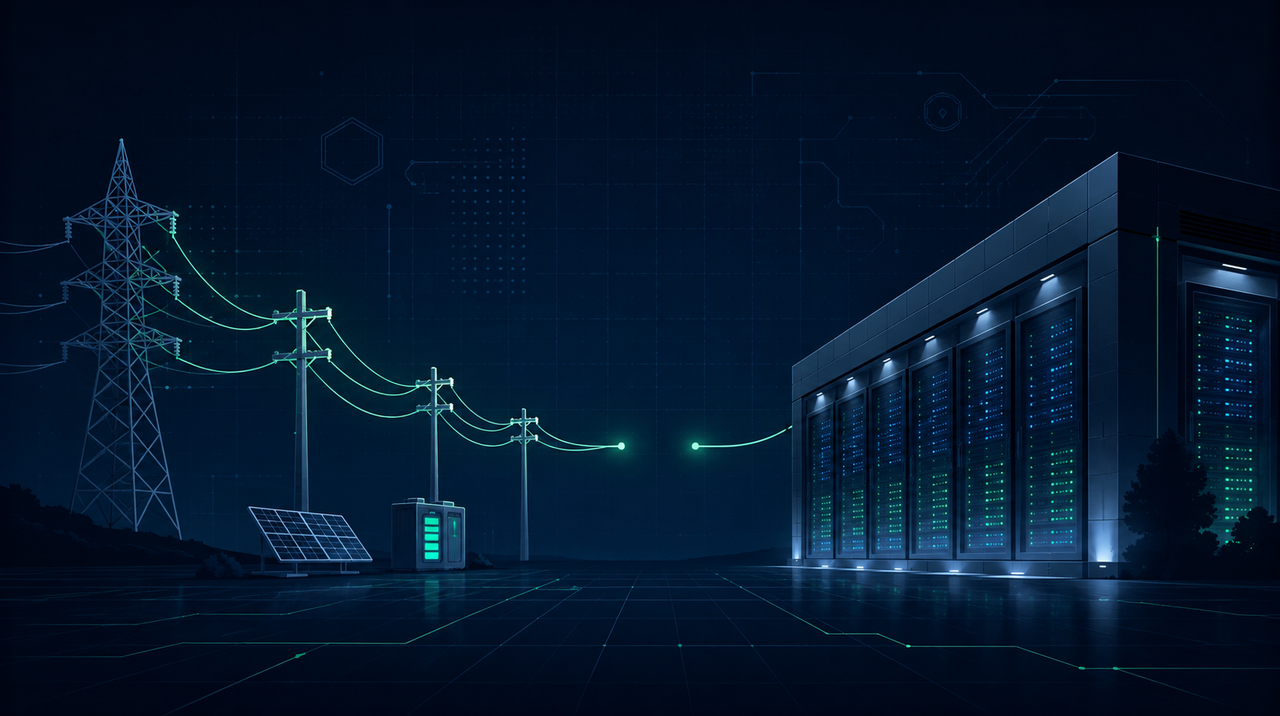
What's holding back artificial intelligence today isn't the chip. It's the utility pole. While everything in technology doubles in capacity and drops in price on predictable cycles, transmission lines never became an exponential technology: they still take years to go from paper to reality. And that's exactly where the AI race is running into a wall.
The numbers out of Texas tell the story better than any forecast. ERCOT, the operator of the Texas power grid, had a queue of more than 438,000 megawatts of requested demand as of mid-2026 — and around 90% of those requests come from data centers. In April, that queue had already topped 410 gigawatts.
Years of waiting just to plug in
Connecting a large new load to the grid has become a years-long process. Data from the Lawrence Berkeley National Laboratory shows that average wait times in interconnection queues have more than doubled over the past fifteen years, and that projects spend on average roughly five years in the queue before entering commercial operation. Texas, at approximately 4.2 years, is among the fastest in the United States — which says a lot about everywhere else.
On June 18, 2026, the Texas regulator approved a new process that now studies large-load requests in batches, allocating capacity and producing a transmission build-out plan instead of reviewing projects one by one. It's official recognition that the problem has stopped being an exception and become the structure itself.
And then there's the neighbor
There's a second brake, and it can't be solved with engineering: a Gallup survey from March 2026, of a thousand adults, found that 71% of Americans oppose building AI data centers in their own community — nearly half say they are strongly opposed. A Heatmap Pro poll in June found similar levels, with 55% in strong opposition. Nine months earlier, the public was split roughly down the middle. The most cited reasons are water and electricity consumption.
In other words: even with money available and chips purchased, two things are missing that money can't buy quickly — grid capacity and social license.
How much power will this actually consume
Here's a correction worth making, since the wrong figure circulates widely. Projections vary quite a bit depending on who's doing the calculating:
- EPRI, the electric power industry's research institute, projects that data centers will consume between 9% and 17% of U.S. electricity by 2030 — a range, not a single figure.
- BloombergNEF works with a figure of about 12% in 2030, rising to 20% by 2035. That's where the 20% figure often misattributed to other sources actually comes from.
- Regionally, the picture is more dramatic: in Virginia, one of the world's largest data center hubs, EPRI estimates that this activity could consume 41% to 59% of the state's electricity by 2030, up from about 25% today.
Remembering the range, rather than the round number, is what separates those who understood the story from those who just repeated it.
Why money alone doesn't fix this
In a recent conversation with Peter Diamandis, energy expert Ramez Naam summed up the counterintuitive twist: a 1-gigawatt data center costs around $50 billion to build, and about $35 billion of that is chips. The cost of power over five years is small compared to the capital invested. The consequence is counterintuitive: AI labs would gladly pay double for electricity if it arrived tomorrow. Power has become a timeline bottleneck, not a line-item cost.
Naam also points out that large gas turbines — the fallback for anyone who can't wait for the grid — are sold out roughly seven years in advance, and that the fastest route available today is solar paired with batteries, capable of going from zero to generation in around twelve months. With one caveat he's careful to flag: batteries solve the gap between day and night, not the gap between seasons — London gets roughly one-sixth the solar radiation in January that it gets in July.
What this means for anyone who just uses AI
You're not going to build a data center. But three consequences reach your business anyway:
- AI pricing doesn't fall uniformly. The cost per task plummets when a new model is more efficient, and stalls when computing capacity is scarce. Planning an annual AI budget on the assumption of a continuous decline is wishful thinking — it's worth reviewing cost per task every quarter.
- Capacity becomes a vendor selection criterion. When contracting a system that depends on AI, ask what happens if the provider caps capacity: is there a configured fallback, or does your process simply stop?
- Not everything needs the biggest model. Much of the work a business needs — classifying, extracting, summarizing, answering FAQs — runs fine on a small, cheap, and often local model. Whoever sets this up now will be less exposed to queues and price hikes later.
We covered this cost-per-task math in how much it costs to have AI in your business. And that design work — which task, which model, which backup plan — is exactly what we do in AI implementation for businesses.
The three-line summary
AI is limited by physical infrastructure, not by ideas. Utility poles, transformers, and permits don't follow an exponential curve, which is why power timelines today are measured in years. For anyone using AI in business, the practical lesson is simple: treat capacity as a scarce resource, not an open tap.
Story inspired by the August 20, 2026 edition of the Metatrends newsletter, by Peter Diamandis, drawing on his conversation with Ramez Naam. Interconnection queue data (Lawrence Berkeley National Laboratory and ERCOT), public opinion data (Gallup and Heatmap Pro), and electricity consumption data (EPRI and BloombergNEF) were checked against their sources before publication.
Perguntas frequentes
Why did energy become the bottleneck for artificial intelligence?
Because grid construction does not keep pace with demand. Average interconnection queue times in the United States have more than doubled over fifteen years, according to Lawrence Berkeley National Laboratory, and projects spend roughly five years in the queue before reaching commercial operation. Chips and capital exist; grid capacity and permits do not.
How much electricity will data centres consume?
It depends who is projecting. EPRI estimates 9% to 17% of US electricity by 2030. BloombergNEF works with roughly 12% in 2030, reaching 20% in 2035. In Virginia, one of the world's data centre hubs, EPRI projects 41% to 59% of the state's electricity by 2030.
How much does a 1-gigawatt data centre cost to build?
Around US$50 billion, of which roughly US$35 billion is chips, according to energy specialist Ramez Naam. The cost of electricity over five years is small next to that investment, which makes energy a problem of timing rather than price.
Do people oppose data centres near their homes?
Mostly yes. A Gallup poll from March 2026 of a thousand adults found 71% opposed to building AI data centres in their own community, with nearly half strongly opposed. A Heatmap Pro survey in June found the same level. The concerns cited most often are water and electricity consumption.
What is the fastest way to generate power for a data centre today?
Solar paired with batteries, which can go from groundbreaking to generation in about twelve months. The limit is seasonal: batteries solve the gap between day and night, but not the drop in solar radiation in winter, which in London falls to roughly one sixth of the July level.
What does this change for a company that only uses AI?
Three things: cost per task does not fall evenly, so budgets need periodic review; supplier capacity becomes a procurement criterion, with a defined plan B; and a large share of business tasks runs on small, cheap models, which reduces exposure to queues and price rises.