

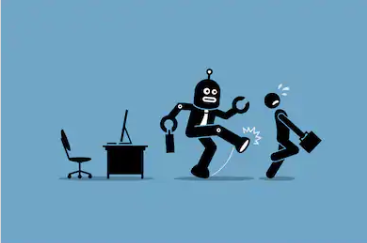
According to a study conducted at Oxford, certain professions face an extremely high likelihood of being eliminated, including: telemarketing, with a 99% probability; bank or supermarket cashiers: 98%; taxi drivers: 94%; fast-food cooks: 81%
Automation, at this point, is not necessarily tied to artificial intelligence — but obviously, given all the technological innovation currently underway, once AI is connected to robotics, the acceleration of human replacement by machines will occur at a pace never before seen in human history.
The core problem is that the professions being eliminated — particularly in unequal countries where educational attainment is very low, such as Brazil — are precisely the occupations that employ the most people. An enormous number of individuals will swell the unemployment figures.
Unemployment brings with it rising crime rates, higher suicide rates, increased poverty, and the breakdown of family structures. Employment is genuinely beneficial for human beings — not only from a financial standpoint, but from the perspective of emotional well-being and social stability. Disrupting that balance is an extraordinarily dangerous undertaking.
Oxford researchers also warn that in order to survive in the future, people will need to avoid competing directly with artificial intelligence. For economist Richard Baldwin, author of “The Globotics Upheaval,” workers will not only need to avoid competing with AI, but will also need to focus on activities that, for the time being, only humans can perform. Douglas Adams, author of “The Ultimate Hitch Hiker’s Guide to the Galaxy,” foresees a society divided into 3 groups:
- the first will comprise brilliant leaders, scientists, artists, and those at the top of the financial ladder
- the second will include service-sector workers, entertainment producers, security personnel, and personal assistants
- For this third group, Adams has one piece of advice: hitch a ride to another planet or galaxy — as the title of his book suggests.
Professor Andrés Oppenheimer, in his book “The Robots Are Coming,” also believes that the society of the future will be divided into 3 classes:
- The first will consist of elites — those who adapt to all the changes and remain at the top of the income scale
- The second will include those who provide services to the first group — a broad category ranging from personal trainers and beauty technique specialists to dance instructors and meditation course providers.
- The third class will be made up of those who cannot fit into either of those categories and will be required to receive a minimum income from the government as victims of technological progress.
The idea of a minimum income is also championed by a group of billionaires led by Mark Zuckerberg. In his view, those who are left out of the labor market in the future will need to receive a basic income. This will be decisive in preventing social unrest or the breakdown of societal equilibrium.
In the United Kingdom, the government has begun training the population for a new labor market dominated by artificial intelligence. £18.5 million will be invested in programs designed to prepare the adult population for this new employment reality. This sum — equivalent to approximately 100 million Brazilian reais — is only part of a broader program targeting individuals in roles that may be replaced by robots, who will be retrained in new technologies. The British government will also fund the development of new online education systems focused primarily on adult training.

A British government document warns that the increasingly intensive use of artificial intelligence will radically transform the industrial, commercial, and service sectors. While new technologies have the potential to add billions to the country's economy, they also tend to eliminate a significant number of jobs. In light of this reality, the British government will fund scholarships in the field of computing, with the aim of developing a skilled workforce for these emerging roles. The goal is to supply the market with trained personnel — both for more entry-level positions and for postgraduate levels such as master's degrees and PhDs. The British government also plans to provide a minimum income to workers who are unable to retrain for this new labor market.

French supermarkets are operating without employees at certain hours. On Sunday afternoons and overnight, only security guards remain on duty. For decades, French trade unions demanded that supermarkets give their staff Sundays and evenings off.

Now, some retail chains are meeting that demand — but for different reasons. They have launched a pilot programme to test fully unstaffed store operations. On Sunday afternoons, customers can shop and pay using their mobile phones. The same applies during overnight hours, after checkout staff have left. Surveillance cameras monitor everything to prevent theft. Many customers prefer this option because it is the only time slot available to them. For employees, however, the risk is that the model will expand and ultimately cost them their jobs.
To secure a place in the future, it is essential to anticipate change and develop original, creative ideas. Population growth is declining, particularly in more developed countries, and people are living longer — which is driving demand for certain professions. The number of people reaching 80, 90, and even 100 years of age continues to rise. This will be a positive factor for society in terms of job creation, as I believe elderly individuals will prefer human caregivers to machines.

In Japan, a trend is emerging that may prove providential. Given the high likelihood of rising unemployment, coincidentally or not, Japanese workers are putting in fewer hours per day — citing exhaustion as the reason — yet this shift could not have come at a better time. If more people work fewer hours, fewer people will be left unemployed, at least in the short term. It would serve as a way to absorb the initial impact of unemployment.
A valuable piece of advice for those striving to remain in the job market: if you currently complain about performing two or three roles for a single salary, be aware that, with advancing technology, this situation is not only likely to persist but to intensify. It would be wise to prepare for a fourth or fifth function.
Robots are taking command of production lines, while information technology is automating office work. The best advice for the moment is to keep a close eye on the emerging professions, such as IT security specialists, data scientists, artificial intelligence specialists, machine natural language specialists, and autonomous vehicle specialists, among others — roles that did not exist just a few years ago.

The most threatened tasks are those that are highly routine, as opposed to those requiring human interaction and creativity. For certain activities in healthcare and social care, robots are unlikely to replace humans — at least not any time soon.
See the likely impact on some higher-level professions:
- Architects: As software continues to learn the arts — there are already robots that have painted pictures and composed music — the risk exists, though professionals who restore historic monuments are likely to be the last affected, since these are highly specific niches requiring an elevated knowledge of art and culture.
- Engineers: It is quite likely they will be gradually replaced, as engineering is a field grounded in exact sciences — an area where machines excel. 3D printers capable of constructing houses already exist; the next step, I believe, will be designing your home in a 3D software environment and sending the data to the printer, which will handle all the necessary calculations and produce the structural elements (masonry, plumbing, and electrical) while finishing work, for the time being, will remain in human hands. Soil assessment engineers are expected to be the last to be replaced.
- Teachers: They face a high risk of being replaced, at least in the role of knowledge transmission — in that regard, Google already outperforms most professionals in the field. What remains is the role of teaching how to learn: developing the human skills that will be necessary to adapt to this new world.
- Dentists: They are likely to be among the last traditional professions to be replaced, as the work is manual, craft-based, and artistic, involving an enormous number of variables.
- Physicians: Most face a high risk of replacement, as medicine involves analyzing inputs — in this case, symptoms and medical history — based on which AI, drawing on virtually real-time access to every paper published worldwide on the subject, will deliver diagnoses and propose treatments with a high degree of accuracy. Not to mention robots that will perform surgeries with greater precision.

The inflection point in medicine will come when machines begin to achieve a higher accuracy rate than human physicians — at that point, it will be nearly inevitable that people will start preferring to consult them. The good news is that, at this initial stage, AI is doing more to assist doctors than to compete with them.

- Lawyers: High risk of replacement. The software will read all rulings from cases similar to a client's in seconds and guide the defense according to established jurisprudence. Here too, the inflection point will come when software begins winning more cases than human attorneys.

- Psychologists: Initially, emotionally vulnerable individuals will prefer to be seen by human professionals. However, applications will emerge with which people gradually become familiar and come to enjoy interacting. These apps will be powered by AI-managed software that knows what to say and in what tone of voice best suits the moment — analyzing the individual's history, likely evaluating traces and indicators of emotional fluctuation left across the patient's social media and that of their family and friends, scanning the internet for clues about the patient's behavior and the most appropriate treatments, ultimately delivering a more precise diagnosis and guidance with a high level of accuracy.
- Journalists: They will be heavily impacted. AI is already capable of writing text in natural language. Information software will scan the internet and deliver to your social media timeline the content you consider most relevant. Try it yourself at: talktotransformer.com — you begin a sentence in English, and the AI completes the text for you.

I believe people have not yet grasped the gravity of the problem. Humanity has undergone great transformations and assumes that, since it managed to adapt to them, it will be able to do so now at the same pace. The problem is that humanity's great revolutions unfolded at an extremely slow pace compared to those that have occurred in recent years — and slower still, in relative terms, than those that are about to take place. In a short time, the pace of change will increase exponentially until we reach the singularity, which is the point at which AI will surpass human intelligence.
Believing that we will adapt the same way we have adapted until now is naive.
We must anticipate and prepare ourselves to try to minimise the impact and study ways to coexist with machines. The ideal scenario — though I am not certain it is achievable — would be for machines to do the work that humans dislike doing, while people devote themselves to things that truly make them happy and bring them pleasure.
A friend once asked me in a brainstorming session: What happens when machines do absolutely everything for us? What will we do? We won't even need money. I had no answer.
I would like to believe that we will find a solution and that we will seize the opportunity to do what people so often say at the end of their lives — whether due to old age or terminal illness: I should have worked less, watched the sunset more often, travelled more, spent more time with family and friends, and above all, with my children.
Text based on the programme Matéria de Capa on TV Cultura
The 6 Human Weapons Against the Machine (Source: Startse)
Do you already know and master the human weapons against the machine? If not, we will now introduce you to all six.
To do so, our competencies will be divided into two groups: one consisting of those that are losing value, and another of those that are gaining significant value…
And which every HR Professional is already keeping a close eye on.
To explain the main differences between these groups, we will use computers as an analogy. In this case, the machine's “competencies” are divided into:
hardware and software
The hardware is the physical part of the computer: the keys, the screen, the components…
In short, everything we can assess, whether by looking at it, touching it, or measuring it.
The software comprises the systems…
What gives functionality to the keys, the screen, and all the components.
The software determines how the hardware will operate.
In the case of human beings, our competencies are divided between:
Hard Skills:
Everything we are capable of producing that can be quantified…
A project, a sales target, a building, a car — in short…
Everything that can be measured.
And Soft Skills:
Which are summed up in the way we command our Hard Skills.
Soft Skills influence our way of acting, our social interaction, the way we handle data…
In short, it is the way we reflect our mindset in our behaviour.
Soft Skills are highly valued, because they are what make us such individual beings.
It is what differentiates us from the machine.
We do not need programming. We are instinctive and rational.
We are Human Beings.
The evolution of machines, however, is easily capable of eventually replacing all of our Hard Skills…

Because Hard Skills are programmed abilities, and, in general, whatever can be programmed, a machine can do.
Even relatively abstract things that do not necessarily follow a pattern.
However…
In none of these scenarios do they operate alone. At least not yet.
After all, at this point, machines are still not capable of creating data.
You still need lawyers and journalists feeding data into them.
So, machines may well produce things of impeccable quality, but they remain dependent on us.
Our Soft Skills are still far more nuanced and advanced than those of any machine.
Therefore, in a scenario of coexistence between humans and machines…
These are the 6 weapons in the field of Soft Skills for human beings to triumph over machines in the competition for the job market:
— Communication;
— Leadership;
— Creative Thinking;
— Corporate Ethics;
— Empathy;
— Resilience.
The only remaining question is:
Is your company's HR department prepared to recognise, develop, and value professionals who master these 6 weapons?