
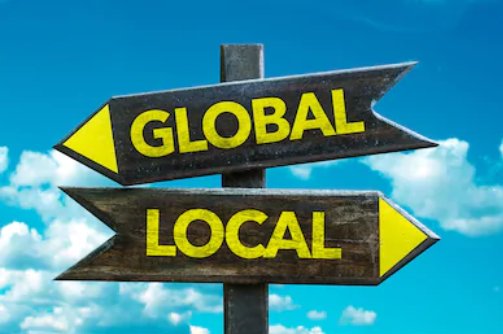
Hyperlocalism is essentially about working a content/product/service in an absurdly local way, focusing its characteristics on the tastes of the population of the micro-region you want to dominate.
It is almost like niching a product not by tribe, but by region.
This applies to journalistic content, entertainment, clothing, food, and more. Essentially, it is an excellent opportunity for small retailers, who can benefit greatly from hyperlocalism.
In fact, some already do it masterfully.
For example, it is not uncommon that when you visit a different city, someone tips you off about that hyper-unique place that is worth a visit.
But why do most Brazilian retailers not think this way and continue to compete solely on offering the lowest price?
In the age of the internet, where it is possible to easily reach a very large number of people through sponsored content, hyperlocalism may seem like an outdated concept.

But think about it: if you run a street-level shop, why would you want to reach a massive audience that cannot actually consume your product?
Some would answer that they want this because, after all, iFood and Rappi can deliver the product in question to anyone in the city.
Others because they believe someone will travel 10km (and, depending on the city, spend more than 2 hours…) just to shop at their establishment.
Of course that will happen if you offer a truly differentiated service. But why don't businesses think about this?
As I mentioned, in recent years the focus has been heavily on price and distribution.
And in those areas it is impossible to compete with the GIANTS of the segment.
I believe there is a clear movement across various segments, where we will have a handful of global companies serving the mass market with commoditized products competing on price and delivery.
But at the same time, we will see more and more small businesses that will need to learn how to differentiate themselves and stand out in what they do.
A dentist, a locksmith, a restaurant, a seamstress, a cake and sweets shop — they all operate very locally and need to be on Google Maps at the very least. When you type a service you need into Google, Maps often appears first and therefore, in these cases, tends to receive far more clicks.
However, the local business owner is using only one tool. What about all the others? Is there not a cheap and effective way to promote your business in the surrounding area? What about Instagram? And Facebook?
In this regard, what is the main pain point for the small retailer? In my view, it is communication.
And that is where NOC saw an opportunity to help small retailers by using this concept of hyperlocalism with micro audiences.
What do they do? Simple: they developed an application that brings together various freelance professionals who were previously only found at advertising agencies and would have been far too expensive for a small retailer to hire.
For a monthly fee of 169 reais they help create campaigns with creatives, copywriters, and photographers, thus highlighting the establishment's strongest points.
And finally, using the concept of hyperlocalism, they charge 49.90 reais to promote that piece of content. That is all you will spend on promotion (yes, the boosting is already included in that amount)!
And how do they manage to do this?
They focus on the hyperlocalism of advertising. After all, ensuring that a small business reaches people within just a few kilometers (very few — it is suggested to stay within 4km) is fundamental to the strategy.
The results they are achieving are impressive. In a single day of campaigning, they can bring more than 20 people into certain establishments.
If you have ever owned an establishment or know any small retailer, you know that number is far from insignificant — especially because the person who showed up is likely to make a purchase.
All of this for just 49.90 reais. That is: just under 3 reais per new visitor!
Did you find this concept amazing? Can you see how it is not outdated and has tremendous growth potential?
So: what do you think about becoming a partner in this startup?
NOC is raising funds via CapTable — the startup investment platform by StartSe — and these are the last days for you to take advantage and join in.
Are you in?
Text from artificial intelligence on the subject:
“It is a technology used in recent years by Google to improve search when search results are downloaded in real time from outside the user's local network.It is a way to make Google's search engine more efficient by providing search links to other websites, which makes it cheaper to deliver a search result in the local area. If you are familiar with how real-time search works, this does not surprise most users. Google also uses it to provide real-time search results when visitors access an online store, such as Expedia.com, and need to return the same results as before their visit. When a shopper does this, it becomes a much more efficient use of resources. How does it work? Here is how HyperLocal works: Search results are sent from Google's server to various servers spread around the world. Each server runs a search in the local area for the specified query, not just for the term, but also for the related term. The server's algorithm uses this content”