


1 – New research explains how solar panels could generate energy at night
Researchers at UC Davis have created a mechanism that could allow solar panels to generate energy 24 hours a day, including during nighttime conditions. Using a technique known as radiative cooling, panels can generate up to a quarter of their daytime energy output at night, leading to an overall increase of approximately 12% in total energy production.
According to one of the researchers, Jeremy Munday, “a regular solar cell generates power by absorbing sunlight, which causes a voltage to appear across the device and current to flow. In these new devices, light is emitted and the current and voltage go in the opposite direction, but you still generate power. You need to use different materials, but the physics is the same.”
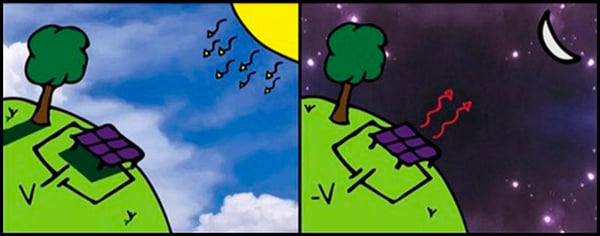
Thermoradiative cells are becoming increasingly popular as a means of producing and capturing wasted energy. Last year, Stanford University developed a similar system, using the heat imbalance between the Earth and the nighttime sky to generate electricity.
This technology could become an essential part of our energy infrastructure, as the researchers noted in their published paper: “Deep space offers an intriguing low-temperature heat sink that has the potential to help provide electrical power at night and during the day, through the intelligent use of photonics, optics, and materials science.”
2 – Samsung foldable phone
Do you know anyone with a foldable phone yet? This week, leaked on Twitter what appears to be Samsung's next foldable phone, the Galaxy Z Flip, set to be announced later this month. Unlike the Fold already on the market (starting at R$ 12,999), the new model is more reminiscent of Motorola's iconic StarTac from the early 2000s, featuring an ultra-thin display. One clear advantage: it fits much more easily in your pocket.
3 – Hyperloop One
Did you know that Hyperloop was a creation of Elon Musk? But it is just one project in a series of others from a man determined to leave his mark on the world.
In 2013, in an attempt to reduce the long journey between Los Angeles and San Francisco, a California state legislator proposed a budget allocation of US $68 billion for what appeared to be the slowest and most expensive high-speed rail in history.
Musk was outraged. The cost was too high, the train too slow. Partnering with a group of engineers from Tesla and SpaceX, he published a 58-page concept paper on a type of levitating train that travels through a vacuum inside a tube and can reach speeds of 1,200 km/h: the Hyperloop.
If successful, you would cover the stretch between Los Angeles and San Francisco in 35 minutes – just enough time to watch your favorite TV episode.
In January 2013, venture capitalist Shervin Pishevar, with Musk's blessing, launched Hyperloop One with Peter Diamandis, Jim Messina (former deputy chief of staff to President Obama), and tech entrepreneurs Joe Lonsdale and David Sacks as founding board members.
A few years later, the Virgin Group invested in the idea, Richard Branson was elected chairman, and Virgin Hyperloop One was born.
“Hyperloop exists,” says Josh Giegel (co-founder and chief technology officer of Hyperloop One), “due to the rapid acceleration of power electronics, computational modeling, materials science, and 3D printing.”
(Earlier this year, Josh Giegel will present some of the latest developments from Hyperloop One at the annual Abundance 360 conference in Beverly Hills.
Thanks to these convergences, there are now ten major Hyperloop One projects spread across the world, at various stages of development.
According to Giegel: “Hyperloop will seek certification by 2023. And by 2025, the company will begin passenger testing.”
But what is faster than Hyperloop?
4 – Rocket travel
As if autonomous vehicles, flying cars, and Hyperloop were not enough, in September 2017, speaking at the International Astronautical Congress in Adelaide, Australia, Musk promised that, for the price of an economy airline ticket, his rockets would take you anywhere on Earth in less than an hour.
Musk wants to use SpaceX's mega-rocket, the Starship, which was designed to carry humans to Mars, for passenger transport on Earth. The Starship travels at 28,000 km/h, far faster than the supersonic Concorde jet, which has been the fastest passenger transport aircraft to date.
Think about what this really means: New York to Shanghai in thirty-nine minutes. London to Dubai in 29 minutes. Hong Kong to Singapore in twenty-two minutes.
So how real is the Starship?
“We could probably demonstrate this technology in three years,” Musk explained, “but it will take a little longer to ensure safety. Aviation is incredibly safe. The probability of dying on a plane trip is lower than staying at home.”
This demonstration is proceeding as planned. In September 2017, Musk announced his intention to replace his current rocket fleet, the Falcon 9 and the Falcon Heavy, with the Starships by 2020.
5 – Rare genetic mutation may hold clues to preventing Alzheimer's disease
In an unprecedented new case, a Colombian woman developed early-stage Alzheimer's but did not experience common dementia symptoms for decades, likely due to a unique genetic mutation.
Although most Alzheimer's cases are not linked to genetics, approximately 1,200 people in Colombia face a high genetic risk of early-onset disease. Individuals carrying the E280A mutation in a gene called Presenilin 1 (PSEN1) are prone to developing Alzheimer's disease at age forty or earlier.
However, while this patient exhibited the same unusually high level of beta-amyloid deposits in the brain as those carrying the E280A mutation, no dementia symptoms such as confusion or memory loss were observed.
In investigating this apparent anomaly, researchers discovered that she carried two “Christchurch” mutations: the E280A and another in the APOE3 gene.
This discovery opens a new field of Alzheimer's disease research, focused on preventing the development of dementia even as the disease progresses. Without normal memory and brain function, it becomes nearly impossible for Alzheimer's patients to live independently.
If the finding is confirmed through further research, a possible genetic treatment would not only extend lifespan but also greatly improve quality of life.
Although the genetic underpinnings of this newly discovered correlation require further exploration, the recent rise of gene-editing tools could certainly help translate these findings into therapeutic applications in the future.
As technological advances and corporate competition drive down the cost of genome sequencing — enabling countless research projects worldwide — the tracking of mutations and their correlations with disease incidence could experience exponential growth.
6 – The “water battery” that reduces energy use by up to 40%
After switching on its three-story “water battery” in September, the University of the Sunshine Coast in Australia (USC) is now receiving enough power to reduce its grid dependency by more than 40%.
Essentially, it is a massive thermal energy storage system. It features 6,000 solar panels (covering campus rooftops and facades), comprising a 2.1-megawatt photovoltaic system.
In turn, this generated energy is used to cool 4.5 megalitres of water inside a three-story tank. Since air conditioning accounts for two-fifths of the campus's energy costs, the water chilled using solar-generated power can offset this, saving the university “US $69 million in energy costs over the next 25 years,” according to Dr. Scott Snyder, COO of USC.
Moving forward with full force, USC Australia has pledged to be carbon neutral by 2025. Now operational, the university's battery system is scheduled to reduce CO2 emissions by more than 92,000 tonnes over the next 25 years (having already reduced USC's carbon footprint by 42%).
Following the receipt of an award at the Global District Energy Climate Awards in Iceland in 2019, the innovation gained greater visibility and is inspiring similar innovations.
Renewable energy generation and storage systems are gradually fulfilling their role in meeting energy needs, bringing us closer to a globally carbon-neutral future.
7 – An energy innovation that could store solar power for decades.
Swedish researchers have recently identified a molecule capable of capturing and storing solar energy for decades, releasing the energy as heat on demand. It is a molecule made of carbon, hydrogen, and nitrogen that absorbs energy from the Sun and retains it until a catalyst triggers its release.
The team, led by Kasper Moth-Poulsen at Chalmers University of Technology in Gothenburg, also created a unique storage unit that can outlast the 5 to 10-year lifespan of standard lithium-ion batteries. Additionally, the group developed a transparent coating that absorbs sunlight and converts it into thermal energy.
Now working to demonstrate the technology at scale, the researchers are coating an entire campus building with this material to reduce electricity requirements for heating and thereby lower carbon emissions. Once successful, the team intends to bring the storage unit to market within six years and the special coating within just three. Meeting this timeline depends on securing the necessary funding streams.
The major challenge that remains for the Moth-Poulsen team is long-term energy storage, not only for heat but also for electricity supply. Although cost is another factor in recent solar harvesting technologies, Moth-Poulsen's approach does not require expensive rare elements.
Converting solar energy into heat through the transparent coating the team developed could provide sufficient heat for vehicles and small buildings without any intermediate machinery that typically produces carbon emissions.
In the future, this technology could even be incorporated into clothing to insulate humans in lightweight designs, or it could be used in window coatings in cold regions, allowing greater access to natural light and ambient heating — without emissions — during winter.
Sometimes the greatest innovations begin at the microscale, harnessing unique chemical combinations for local use where the research is being conducted.
8 – Toshiba to form IoT alliance with SoftBank, KDDI, and others
Toshiba will launch an IoT platform called ifLink Open Community in partnership with SoftBank, mobile operator KDDI, and Tokyo Gas. Set to be formally established next March, the association aims to include more than 100 Japanese companies, making it far easier for member companies to build IoT solutions without significant coding expertise or technical hardware experience.
Similar to Amazon's model of granting connection kits to smart device manufacturers that use Alexa, ifLink also offers access to products originating from the open community. This way, member companies no longer need to design prototypes and services from scratch.
At the intersection of connectivity, sensors, and AI, the Internet of Things market is growing. IDC projects the global market could reach US $1 trillion by 2022, nearly 2X the market value of US $646 billion last year.
The entry of major players such as General Electric and Hitachi, which are building their own IoT systems, has driven the technology forward — broadly propelled by exponential advances in price-performance ratios and sensor miniaturization. Surges in computing power and the considerable increase in internet connection speeds with the emergence of 5G have also contributed to the process.
With this convergence of factors, we are on the verge of witnessing a Cambrian explosion in new business models, smart connected systems, and even intelligent urban networks.
What data would you collect from machines or equipment in your own business if IoT platforms were readily applicable? What insights for increasing output, reducing waste, and boosting productivity could you extract?
9 – AI helps boost copper production
Copper production giant Freeport-McMoRan is introducing a machine learning model into its production processes. The forecast is to increase the mining company's annual output by 90,000 tonnes. The use of AI also aims to minimize capital investment, as explained by chief executive Richard Adkerson. Developed in partnership with McKinsey, Freeport-McMoRan's model sends data obtained from sensors at the Baghdad mine to the company's headquarters in Arizona and suggests methods to optimize production, including adjusting pH levels in processing to recover more copper.
An increase in production of this scale would normally require capital investment in the order of US $1.5 to 2 billion – not to mention considerably more industrial equipment. By harnessing the power of machine learning, however, Freeport-McMoRan plans to use the excess cash generated by the increased production to pay down debt and increase shareholder dividends.
Beyond mining, the use of integrated sensors and artificial intelligence — even in the most technologically lagging sectors — is a tremendous validation of the potential of machine learning. By integrating data from key industrial processes and checkpoints, machine learning models can identify sources of inefficiency, non-intuitive shortcuts, and optimization decisions that create economic value far exceeding the required expenditures.
10 – Multiplying human capital
With 5G on the ground, balloons in the air, and private satellites in space, we are on the verge of connecting every person on the planet with gigabit connection speeds at minimal cost.

As 5G connects trillions of sensors and devices, we are about to live in a world where anyone, anywhere can have access to the world's knowledge. Capital ready for crowdfunding among 8 billion potential investors and startup creators; the intelligence of the masses (collaborative intellectual output is greater than the sum of individual outputs) — not to mention the geniuses who will have the opportunity to showcase their talents to the world and be discovered.
And as the online user population doubles, we are on the verge of witnessing perhaps the most historic acceleration of technological progress and innovation ever known to humanity.
Meanwhile, BCI's innovative progress is bringing us closer to Ray Kurzweil's prediction that our brains will seamlessly connect to the cloud by 2035.
Elon Musk's Neuralink is already striving for a 2-gigabit-per-second wireless connection between a patient's brain and the cloud within the coming years.
And, in the long term, BCIs will amplify average human intelligence and our access to an instant wealth of knowledge.
Welcome to the age of mass genius.
11 – Engineers develop a new way to remove carbon dioxide from the air
Scientists at MIT have developed a new method for extracting carbon dioxide from the air, even when gas concentration levels are very low. The technology essentially works like a large battery that charges when air containing CO2 passes through its electrodes, which are coated with polyanthraquinone (a compound formed from carbon nanotubes).

Unlike some alternatives, the method does not require large pressure differentials or chemical processes and can even supply its own energy.
Most carbon capture technologies require high CO2 concentrations to function, or considerable energy inputs and high pressure or heat to carry out the chemical processes. This device operates at room temperature and regular pressure. Furthermore, it can generate streams of electricity and pure CO2, which are valuable for a variety of agricultural use cases, carbonation in beverages, and various other applications. The real benefit of scaling this method, of course, involves our battle against climate change, where our ability to withdraw carbon dioxide from the air could be a critical step in reversing a potential environmental catastrophe.
12 – Elephants under threat have an unlikely ally: artificial intelligence
Researchers at Cornell University and elsewhere have recently begun applying AI algorithms to track and save African elephants. As forest elephants proved difficult to track visually, Cornell researcher Peter Wrege decided to install microphones and listen for communication signals between elephants among the trees.
First, Wrege and his team divided the forest into 25 km2 areas. By placing audio recorders in the treetops within these areas, the team collected hundreds of thousands of hours of sounds — more than any human could identify and interpret.
By converting these audio files into spectrograms (visual representations of audio files), the researchers were able to apply a neural network to the data and isolate the sounds of individual elephants.
In practice, these algorithmic results are helping park rangers obtain an accurate population census, track elephant movement through the park over time, and even proactively prevent poaching activity.

AI has now been heavily applied to constrained (and growing) use cases in medicine, financial projections, logistics, industrial design, navigation, and virtually any mechanical or logic-based system one can imagine. Today, however, it is increasingly helping us understand unstructured environments and even communication between animals.
Thanks to a convergence of computing power, sensors, and connectivity, methods such as those used by the “Elephant Listening Project” are granting us a better understanding of extraordinarily complex ecosystems — like those of natural species — and may help in our quest to protect them.
13 – 5G
In 1940, when the first telephone networks began to be implemented, we were at 0G. It took forty years to reach 1G, which appeared with the first mobile phones in the 1980s.
In the 1990s, around the time the Internet emerged, 2G appeared. A decade later, 3G inaugurated a new era of acceleration, as bandwidth costs began to plummet at 35% per year with surprising consistency. In 2010, 4G networks unlocked smartphones for mobile banking and e-commerce.
But from now on — already present in some countries — 5G will offer speeds one hundred times faster, possibly at prices lower than today's.

How fast is 5G?
With 3G, it takes 45 minutes to download a high-definition movie. 4G reduces that to 21 seconds. But what about 5G? It takes longer to read this sentence than to download the movie.
14 – Balloons
Even as our terrestrial mobile networks receive a major upgrade like 5G, new networks are emerging. This time, however, they are above our heads. Way above.
Alphabetics is launching Project Loon, whose core idea is to replace terrestrial cell towers with stratospheric hot-air balloons.

Light and durable enough to navigate slipstream currents approximately 20 kilometres above Earth's surface, Google's 15×12-metre balloons are providing 4G-LTE connections to users on the ground.
Each balloon covers 5,000 square kilometres and Google aims for a network of thousands, connecting the unconnected and providing continuous coverage to anyone, anywhere on Earth.
15 – Launch of more than 3 billion satellites in the coming years
While Google's balloons occupy space in the atmosphere, other companies are developing networks that inhabit the space beyond our planet.

Beyond the stratosphere, three major competitors are involved in an entirely new kind of space race. First, the work of an engineer named Greg Wyler, who has long sought to use technology to eradicate poverty. In the early 2000s, on a tight budget, Wyler helped bring 3G to communities across Africa.
Today, backed by billions of dollars from SoftBank, Qualcomm, and Virgin, he is launching OneWeb: a constellation of approximately two thousand satellites, bringing 5G download speeds to everyone. (BTW, Greg Wyler will join me at Abundance360 in January this year to share his vision on hyperconnectivity and its global implications.)
However, despite OneWeb's radical network upgrade, Wyler is a David compared to Goliaths like Amazon and SpaceX. Earlier this year, Amazon joined the satellite competition, announcing its intention to deploy “Project Kuiper” — a constellation of 3,236 satellites aimed at providing high-speed broadband to underserved communities worldwide.
And SpaceX surpassed those numbers in 2019, when Musk's rocket company began launching a constellation of more than 30,000 satellites called Starlink. If Musk succeeds, this will mean global gigabit connection speeds at near-zero cost. Sixty-six of these satellites are already in orbit and another 1,000 are scheduled for launch in 2020.
Even higher?
At 8,000 kilometres, in what is technically called medium Earth orbit, O3B (standing for “Other 3 Billion”) is a satellite constellation developed by Boeing, known as the ‘mPower network’, intended to bring connectivity to all those who currently lack it.
16 – The age of hyperconnectivity
Now entering a tremendously competitive market, today's connectivity building blocks are linking the planet and transforming twenty-first-century livelihoods.
Within just a few decades, we will have built an ever-expanding nervous system uniting human civilization and facilitating the rapid global exchange of ideas, goods, services, and human capital.
Texts by Peter Diamandis