

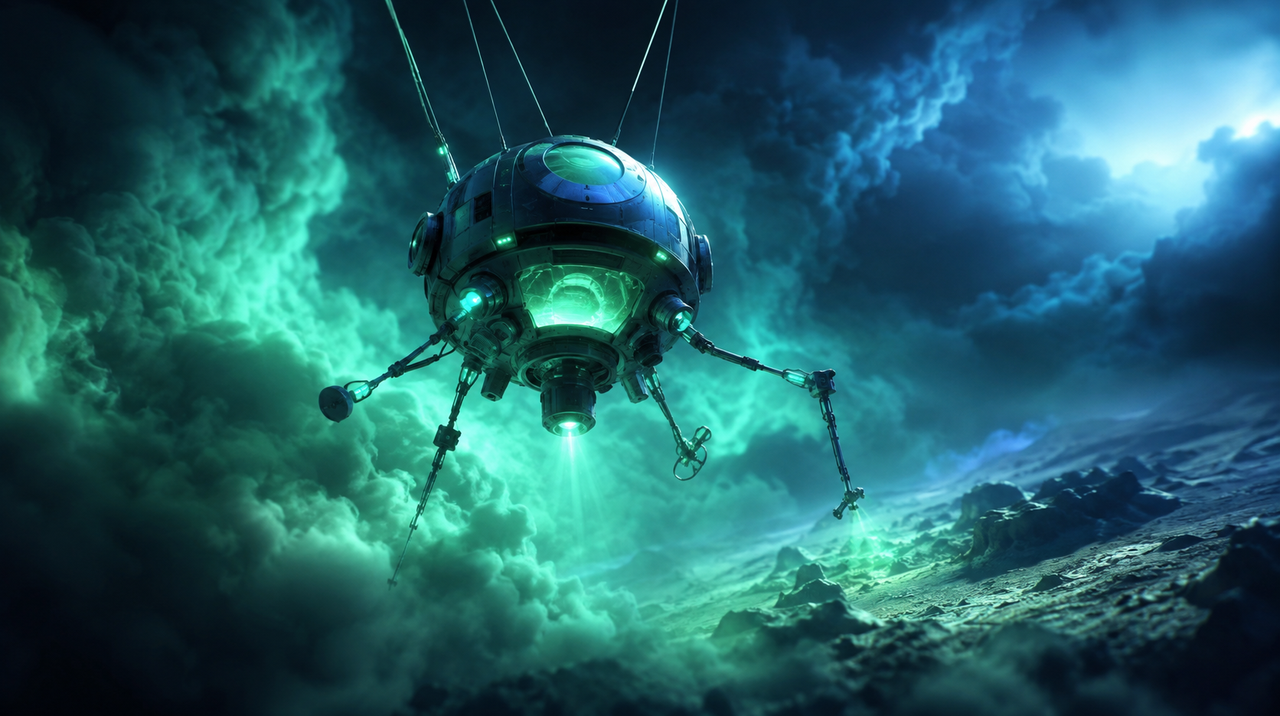
NASA is embedding artificial intelligence in probes that must decide without consulting Earth — and the criterion it used to choose where to do this is the same one any company needs in order to automate without getting hurt: compare the cost of waiting with the cost of the error.
The probe that has no time to ask
The DAVINCI mission, expected to launch around December 2030, releases a descent sphere into Venus's atmosphere. It has about an hour of life. Down there the pressure is roughly 90 times that of Earth and the temperature exceeds 460 °C — hot enough to melt lead. Five instruments need to collect and send what matters before the probe dies.
There is no option to ask. The signal takes minutes to travel there and back, and the probe doesn't have minutes to spare. So NASA is doing what looks radical and is really just arithmetic: putting judgment inside the vehicle. The onboard AI decides which data matters most in the little time remaining and sends that first.
Titan's case is even more extreme. The Dragonfly mission, scheduled to launch in July 2028 and arrive in 2034, is a nuclear-powered drone the size of a small car that flies among the dunes of Saturn's moon. The signal takes more than 80 minutes each way. No one pilots anything like that by remote control. Either the machine decides, or there is no mission.
The criterion, in one sentence
Notice that NASA didn't delegate the decision to AI because the AI got good. It delegated because waiting for a human response became more costly than the machine's error. On Venus, waiting costs the entire mission. That's the calculation, and there's nothing space-specific about it.
Every decision your company makes has these two numbers. On one side, how much waiting costs: the customer who gives up while no one answers, the order that's delayed a day because someone needed to check it, the queue that builds up on a Friday. On the other side, how much the error costs: the discount given to someone who shouldn't have gotten one, the email sent to the wrong customer, the part bought twice.
When the first number is larger than the second, automating is the conservative choice — not the risky one.
Where this already applies today
- First response. Someone who asks for a price at 10 PM and gets an answer at 10 AM the next day has already looked elsewhere. Waiting costs the entire lead; the error from a poorly calibrated automated reply costs a correction.
- Triage. Separating what's urgent from what can wait is a repetitive decision, with a clear pattern and a cheap error — one that can be fixed at the next step.
- Data verification. Cross-referencing two lists and flagging discrepancies is work the machine can do while the person sleeps. The error here is a false discrepancy, which someone dismisses in seconds.
And where it doesn't
The same calculation advises against automating when the error is costly and irreversible: granting a discount outside policy, canceling a contract, transferring money, giving a diagnosis. There, waiting costs minutes and the error costs the customer — or worse. That kind of decision stays with someone who is accountable for it.
The same caution applies when there's no history: a machine without data doesn't decide, it guesses with confidence. And when the process still changes every week, automating just freezes the mess in code.
The robots arrive before the people
NASA's second bet follows the same logic. At the Moon's south pole, where there is water ice, the permanently shadowed regions reach temperatures more hostile than Mars's. The answer isn't to send people with a better suit: it's to send robots first, to build the infrastructure, and save the astronaut for what only they can solve. The timeline under discussion is four to six years for robots to begin that construction — and it's quite possible a humanoid will set foot on the Moon before a human being does this decade.
The translation for a company is direct: the machine doesn't step in to replace the person in the noble task. It steps in so the person doesn't spend the day on the task that wears them down without delivering value.
What to do with this
Take the three processes that consume the most of your team's time this week and write, next to each one, two numbers: how much waiting costs and how much getting it wrong costs. You don't need accounting-level precision — order of magnitude is enough to reveal the obvious thing no one had written down.
Wherever waiting wins by a wide margin, you've found what to automate first. That's how we start AI implementation projects for companies: not by the tool, but by the math. And if your next question is what comes after — machines that not only decide, but also spend —, we wrote about that in autonomous agents that buy on their own.
Source
The data and statements from Jared Isaacman cited here come from the Speed-Running Star Trek edition of the Metatrends newsletter, by Peter Diamandis, published on August 6, 2026. The reading of what this means for a company is our own.