

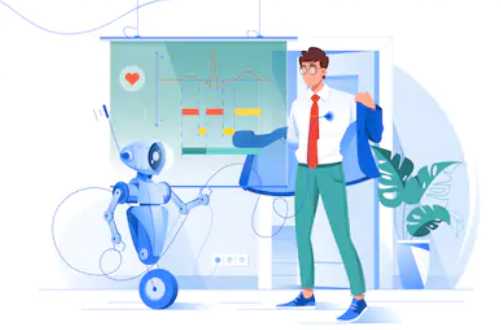
In all likelihood, not too long from now, you will be sleeping in your bed being monitored by an assistant like Google's, for example, which will know your physiology better than your doctor. It will know that you have just completed a REM cycle and are now entering Stage 1 sleep, making it the perfect moment to wake you.
A gentle increase in the room's lighting simulates a sunrise, while optimized light wavelengths maximize alertness and enhance your waking experience.
"Hey Google, how is my health this morning?" "One moment," says your digital assistant.
It takes thirty seconds for a complete diagnosis to run, which is quite impressive considering the system draws on dozens of sensors capturing gigabytes of data.
Smart sensors in your toothbrush and toilet, sensors embedded in your bedding and clothing, implants inside your body, a mobile health monitoring suite with a highly detailed view of your physiology. "Your health looks perfect," says Google. "In addition, blood glucose levels are good, vitamin levels as well."
Google is developing a full range of internal and external sensors that monitor everything from blood sugar to blood chemistry.
And that is just Google. The list of multimillion-dollar medical machines now being dematerialized, demonetized, democratized, and delocalized — that is, transformed into portable sensors — could fill a textbook.
Consider the spectrum of possibilities.
Another device promising to significantly impact certain medical protocols is Openwater, a portable MRI machine. This project is led by former Google X project director Mary Lou Jepsen, and is transforming what is today a multimillion-dollar machine into a consumer electronics device. Products like Openwater could soon give 3/4 of the world's population access to medical imaging that they currently do not have.
However, simpler developments may prove to be more revolutionary.
In less than two decades, wearable devices have advanced from first-generation self-trackers to Apple's fourth-generation iWatch, which includes an FDA-approved ECG scanner capable of real-time cardiac monitoring.
Another product is DxtER by Basil Leaf Technologies (winner of the $10 million Qualcomm Tricorder XPRIZE), a non-invasive, easy-to-use medical device featuring a diagnostic AI, accessible via app, that safely detects more than fifty common diseases.
The development of these devices points toward a future of continuous, affordable, rapid health monitoring that could save thousands or even millions of lives through early disease detection.
The technical term for this shift is "mobile health," a field projected to explode into a $102 billion market by 2022.
The idea here is to place a 24-hour virtual doctor in your pocket. And we are getting close.
Following the convergence of networks, sensors, and computing, AI-powered medical chatbots are now flooding the market. These applications can diagnose everything from a skin rash to retinopathy.
And it is not just physical illnesses. Woebot is now taking on mental health, providing cognitive behavioral therapy via Facebook Messenger to patients suffering from depression.
Proactive Healthcare
So where are these trends heading?
Take Human Longevity Inc., a company founded in 2013. Its flagship offering, the "Health Nucleus," is an annual health scan. The session lasts three hours and consists of whole-genome sequencing, full-body MRI, heart and lung CT scan, echocardiogram, and a series of clinical blood tests — essentially the most comprehensive health check-up currently available.
In 2018, Human Longevity published statistics on its first 1,190 clients. Nine percent of its patients discovered previously undetected coronary artery disease (the world's number one killer), 2.5% found aneurysms (the world's number two killer), 2% identified tumors, and so on. In total, a striking 14.4% had significant issues requiring immediate intervention, while 40% found a condition that required follow-up.
From Damage Control to Prevention
Artificial intelligence capabilities, dematerializing sensors, and cutting-edge computing power are on the verge of being embedded in your wearable devices, in your home, in augmented reality devices, and one day in implants.
Successfully, the current era of expensive, time-consuming, curative 'healthcare' mediated by health insurance is giving way to preventive, continuous, ultra-cheap, personalized, proactive, and rapid monitoring.
Soon, by owning our (technological) doctors — not to mention our health data — we will no longer treat diseases after damage has occurred (when treatment is still possible). Instead, we will minimize risk at an extraordinarily low cost.
Thanks to always-on, always-watching sensors and integrated artificial intelligence, your smartphone is about to become your personal physician around the clock — and it could save your life at any hour of the day, night, or early morning.