

By 2020, the world will have 2 billion vehicles. Most cities were designed for automobiles, but many of them are becoming overwhelmed. São Paulo has 80% of its streets dedicated to cars or other private vehicles, and they are responsible for 72% of greenhouse gas emissions. It is estimated that pollution kills around 6,000 people per year in the city. Not to mention the health damage caused by stress and the enormous waste of time, as traffic jams are a daily occurrence.

Given this scenario, we can infer that the future of urban mobility must address safety concerns, intelligent use of public space, and sustainability. That is, public transportation should be mass, high-quality, and automated to increase efficiency; traffic lights should be smart to contribute to traffic flow; ground and flying cars could be electric or hydrogen-powered, shared, and autonomous; bicycles and scooters could be used for short trips (this is already happening).
The solution for cities may also be more imposing, more radical. In Singapore, for example, the government deliberately discourages citizens from owning a car. The tax on cars fluctuates according to the number of vehicles in the city — the more cars, the higher the tax. The price of a car ranges from $40,000 to $100,000. In addition, the government also charges an urban toll for those who drive, and if there is congestion, the toll increases.
Autonomous Cars
Autonomous cars will allow people to work or handle their affairs during commutes, meaning they will greatly contribute to reducing wasted time, increasing productivity, and above all, reducing accidents.

The efficiency of communication between cars will be responsible for a reduction of up to 90% in the number of accidents worldwide. And here I am talking not only about fully autonomous vehicles, but also those that already have some degree of automation and sensor systems that alert drivers to risks.
115 million people worldwide use the Waze app; however, in a few years, it may begin to fade into the past in some cities due to the advent of the autonomous car. This is what is known as the disruption of disruption. Some studies indicate that by 2040, 50% of cars will be autonomous.
Germany was the first country to regulate automated driving. This issue was discussed through committees and resolved in 2016.
Waymo, from Google, stated this week that “fully autonomous cars are on their way”. The startup has been conducting its tests in Phoenix, in the USA, and was the first in the world to start charging for rides. Now, it will be the first to operate its vehicles in Los Angeles. And Google is not alone in this market: Toyota, GM, Nvidia, Bosch, and other companies have joined forces to develop autonomous cars. The alliance was announced this week.
Initiatives are taking place in Brazil, the USA, and also in China. The Asian country is developing a solution to even reduce the need for safety drivers during tests (a resource used in the Embraer test, for example). The technology is being developed by WeRide and allows operators to take remote control of the car.
Ethical and legal issues also guide the discussion. For example, if there is no time to brake when a pedestrian suddenly appears in front of the car, should the vehicle run them over or swerve abruptly, putting the passenger's safety at risk? Who will be held responsible for decisions that cause harm to people? The vehicle owner or the manufacturer?
A pedestrian, Elaine Herberg, 49 years old, was struck in the United States in 2018 by a 2-ton autonomous car traveling at 61 km per hour.
UFES Conducts Tests with Autonomous Car
The Federal University of Espírito Santo (UFES) is conducting tests with an intelligent autonomous car called Iara, as the researchers from the UFES high-performance computing laboratory named the project. The name comes from the initials of “Intelligent Autonomous Robotic Automobile”. It is controlled by a supercomputer capable of performing complex readings, identifying volumes, following pre-programmed paths, and avoiding obstacles. At this time, it is considered the most efficient in Brazil.

It has an autonomy mechanism based on precise location and maps, so the vehicle does not depend on GPS during its movement. The maps the car uses are built by itself with the help of 32 laser beams, two cameras that simulate the human eye and allow the car to have a sense of depth, and a precision GPS for when the Iara “wakes up” so that it knows its location. The information is analyzed by deep neural networks (deep learning); with these, the car can identify lanes, pedestrians, traffic lights, vehicles — in short, any information important for decision-making and safe movement. The car also responds to voice commands. When one says “Ok Iara” “go straight ahead,” it moves; when asked about its operation, it explains.
In 2014, the car completed the first stage of the project by making a lap around the ring road surrounding the Goiabeiras campus. In May of this year, Iara took a much bigger step and successfully completed the second stage of the project by making a trip from the Goiabeiras campus, in Vitória, to the beach of Meaípe in Guarapari. It covered 74 km autonomously at an average speed of 42 km/h — an unprecedented feat in Brazil.
A safety driver accompanied the vehicle to Guarapari, and a second car followed it. Should any unforeseen situation arise, Iara's safety driver could press a yellow button and take the wheel. There was also the possibility of pressing a red button that immediately stops the vehicle. A remote control in the second vehicle accompanying Iara had the capacity to perform the same functions.
For all of this to work, the choice of car was also important. That is why a hybrid car was selected, featuring both a gasoline engine and an electric motor capable of powering a supercomputer located in the car's trunk, which processes more than 30 software modes working simultaneously on location and mapping.
The car plans and perceives the world 20 times per second. The primary objective of this project is to study the human brain. Professor Alberto Ferreira de Souza's research began 17 years ago, and the study with the car started in 2009.
The laboratory uses a well-known technique called artificial neural networks or deep neural networks, which attempt to imitate the brain.
The Professor told TV UFES that he wants to achieve, in the long run, an understanding of how the brain works. He said this is how good research should be done. When science needs to study something as ambitious as this, it should divide the study into stages and try to solve the problems in parts. And the first stage they chose was vision — what the professor calls visual cognition — the ability to understand the world and ideas about the world through sight. That is why we chose the car as a laboratory, said the researcher. They chose the car so that it can see the real world and analyze all its sophistication. “If we studied vision in the laboratory, it would not be as rich as what human beings face in their day-to-day lives,” he states.
These studies will enable new developments; the team is now starting the project for an autonomous truck, but these concepts can also be applied to wheelchairs or walkers to assist people with mobility difficulties.
Electric Cars
The good news is that electric cars worldwide totaled 5 million units in 2018 and will reach 130 million by 2030. The bad news is that in Brazil, this growth rate is slower. However, the country signed the Paris Agreement in 2015, which sets a target for reducing greenhouse gas emissions by 37% by 2025 and by 43% by 2080. Therefore, we will need to accelerate.

Flying Cars
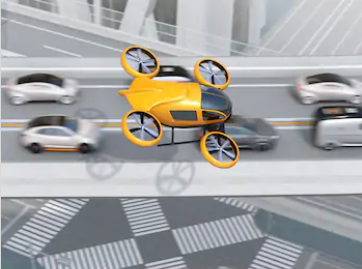
According to experts, the solution for getting around the metropolises will leave the asphalt and take to the skies. The trend is for flying cars, summoned by app, to begin transporting people within a few years. They will be able to travel at over 100 km per hour — something practically impossible in today's metropolises. There will be airways to organize the movement of these vehicles. Traffic will then gain another dimension. It will be three-dimensional.
The flying car has been in the popular imagination for some time now, having been envisioned in science fiction films and even cartoons, such as The Jetsons, for example. However, companies are developing what is possible with the technology available today.
Embraer, the world's third-largest aircraft manufacturer, is developing flying car projects in partnership with Uber. For now, they are only designs and virtual projects that can be experienced through virtual reality. The expectation is that the prototype will be ready by 2020, with the possibility of operation by 2023. They will have a high degree of automation and a great deal of artificial intelligence embedded in navigation systems.

Continuing in the race, just like Uber and Airbus, the startup Alaka’I thinks it has discovered the secret recipe and is betting on hydrogen as fuel. The model, with design developed by the BMW group, already exists and is expected to conduct its first tests, or flights, in the coming weeks.
Boeing, the American company, also announced a venture — not in autonomous aircraft, but in flying cars! The company joined forces with Porsche to develop a luxury model. The German automaker expects this type of urban air transport to be widely adopted from 2025.
There are 300 million people in the world who make a nearly daily commute of more than 45 minutes. Imagine the time savings.
And the legislation? Lieutenant Colonel Aviador Jorge Vargas, from the airspace control department, states that it is possible to regulate the use of flying cars provided that technology and tests prove it is safe for both passengers and airspace.
Clean Buses
Buses transport 43 million passengers per day in Brazil. In São Paulo, 47% of soot and 13% of the carbon polluting the state capital are generated by diesel buses — these figures come from a Greenpeace study and are alarming.
In 2017, the São Paulo City Hall took an important step to address the problem by enacting a bill that provides for a drastic reduction in the use of fossil fuels in the bus fleet by 2027. To this end, the fleet needs to be renewed. The problem is that the courts blocked this procurement process for renewal, citing irregularities. The city has 14,000 vehicles, with 3 electric ones currently being tested.
Of the 386,000 buses in circulation in Brazil, only 891 were electric or hybrid in 2018.
London is an example of the use of clean-energy buses. The city has the least polluting fleet in Europe. Today, 30% of the fleet consists of hybrid buses, which are far more economical and quieter than diesel-powered ones. The city also has 150 electric buses and 20 powered by hydrogen. These produce zero pollutant emissions and can be refueled in 5 minutes. The city has invested £90 million so far. This project is supported by a partnership with the British government.

The number of electric buses in the world reached 460,000 in 2018, 100,000 more than in 2017.
Autonomous Buses
In Brazil, projects with autonomous buses are still in their infancy. There are some tests, but they are restricted to company premises. There is still no regulation allowing the movement of autonomous buses on public roads. As tests show good results and the technology proves reliable, it is natural that, at some point, a legislator will champion the cause and present a bill to allow testing on public roads. This could be facilitated and accelerated once successful tests occur in other countries.
We believe that as Chinese legislation becomes more flexible and allows some degree of use, and as results prove reliable, this should attract attention from other places and the relaxation of laws should progress more quickly.
Switzerland was one of the first countries to authorize the use of autonomous buses. They have a pre-programmed route; however, the decision-making when they need to stop and accelerate is carried out autonomously.

An American startup called Local Motors is producing autonomous buses using 3D printers. In Maryland, where it has permission to operate, its maximum authorized speed is 40 km per hour, and the route is also pre-programmed.

Unfortunately, it seems that Brazil has not yet awakened to the great technological transformation taking place in other parts of the world.
Trains
In 1895, the steam locomotive was already 100 years old but was still the image of the future. It burned coal and traveled at 8 km per hour. It was unimaginable, at that time, to think of a train that would levitate or travel at 600 km per hour.
The bullet train has been active in Japan for 55 years and, fortunately, has recorded no accidents to date. The idea behind the project was to bring people quickly from other cities to the Japanese capital and, in doing so, boost the local economy. Traveling at up to 320 km per hour, the high-speed train made rapid movement possible between the country's two largest metropolises, Osaka and Tokyo. It takes 2.5 hours to cover 500 km. The country has 2,700 km of tracks and, in these 55 years of operation, the system has transported 5.6 billion passengers.
The world's fastest train is in Shanghai and uses magnetic traction, which is why it is called the Maglev. The train glides without touching the tracks, so there is no friction — because of this, it is faster and quieter. Another great advantage is that it does not pollute. The Chinese Maglev began commercial operation in 2004 and can reach 431 km per hour. Currently, only three countries operate the train with a commercial levitation system: China, South Korea, and Japan. The implementation cost of the Maglev is higher than that of the wheeled high-speed train (perhaps for the first time in human history we are speaking of the extinction of wheels); however, since maintenance costs are lower, over time it ends up being more economically interesting. The Chinese continue to invest in this technology — in May of this year, they unveiled a train that could travel at an incredible 600 km per hour.

Germany inaugurated the world's first hydrogen-powered train. It will cover a 100 km route between the cities of Cuxhaven, Bremerhaven, Bremervoerde, and Buxtehude. The rolling stock is manufactured by the French company Alston and produces zero emissions. The company will deliver 14 more trains by 2021.

Metros
In the race for automation, trains and metros got a head start. France was the pioneer, launching the first driverless metro in Europe, in Lille, in 1983. In Paris, metro line 1 is already fully automated. By 2030, the city plans to build 4 more lines where metros will operate without a driver. 43 cities in the world have automated metros. They represent 7% of the systems in operation worldwide.
And Brazil? Is it completely oblivious to this technology? Fortunately not. Line 4 of the São Paulo metro already has automated trains.

Hyperloop
Projected to travel at 1,200 km per hour through a vacuum, the Hyperloop will be the fastest land transportation mode (even faster than commercial aircraft). Conceived by Elon Musk, systems using this technology are already being developed in 12 locations around the world. The United Arab Emirates is expected to be the first country to put it into operation. As it is a new means of transport, legislation still needs to be adapted. The idea is that the first trip, already carrying passengers, will take place by 2024.

Bicycles and Scooters
40% of private car trips cover, on average, 5 km. This distance could be replaced by bicycles or scooters, which are clean means of transport powered by electricity or human traction, and also take up less space. We can highlight as negative points of these transportation modes the risk of accidents, the lack of regulation in most cities, and the obstruction of sidewalks. Curiously and ironically, both were invented in the 19th century and are today associated with modernity. In the case of bicycles, there is also the added benefit of exercise, which can even replace a trip to the gym in some cases.

Speaking of bicycles…
Uber decided to partner with Jump, a startup that holds the concession to operate the bicycle rental system in San Francisco, to test the Uber Bike, its shared electric bicycle system.
New York to Legalize Electric Scooters
After a long period of prohibition, New York is set to legalize the use of electric scooters. Controversial here, controversial there too. The use of electric transportation was approved at the American state level, but each city must analyze the authorization and legislation. Manhattan, for now, is excluded from this legalization. The island's administration cites lack of safety and obstruction of sidewalks.
Embraer Conducts First Autonomous Aircraft Tests in Brazil
Yes, there are autonomous aircraft in Brazil! Embraer and the Federal University of Espírito Santo conducted the first test at the end of August and published the results this week.
The aircraft's artificial intelligence system was responsible for accelerating, braking, and taxiing on the ground (what is known as “taxiing”). See how the initiative went, which was successful.
The company and the university used IARA (Intelligence Autonomous Robotic Automobile), the same technology mentioned above for the University's autonomous car.
In addition to autonomous systems, Embraer is also investing in electric aircraft — this time, in partnership with the Santa Catarina-based WEG Automação. The first flight test, powered by electric energy, is scheduled for 2020.
While there are advances in autonomous aerial vehicles, it is undeniable that land-based initiatives are closer to becoming a reality.
Artificial Intelligence Text on Urban Mobility:
“New technologies that will be or are already being used to improve urban mobility have made the experience more bearable than expected. In a study published in the Proceedings of the 22th International Transportation Forum (ITF ‘), held in December 2013, researchers from the University of Munich and the Institute of Transportation Technology in Bonn showed that the driving experience of an ordinary person could be improved by 50 percent by improving the information and navigation system. And new research in 2013 showed that, in terms of the experience a passenger could have during a plane trip on a flight that would be a short distance in a car, the car could do the job better than the plane. Researchers from the Center for Sustainable Mobility and Sustainable Transport in Munich (MUVS) and the University of Bonn published a study in the Journal of Transport and Automation describing their findings.
This is a good moment to point out a few things. First, there are few new trends, and most trends are already in place. This may seem strange, since driving trends are often reported every year. But it is true: we do not have much”
Human comment: I believe you are improving, AI. You cited studies. You almost managed to maintain coherence until the end. Congratulations!