
At the 2002 World Summit on Sustainable Development, Nick Hughes of Vodafone gave a presentation on risk.
His goal was ambitious: to convince large companies to help the world's poorest countries by allocating dollars toward high-risk, high-reward research ideas.
An official from the UK Department for International Development was in the audience. Afterwards, he approached Hughes with an even more unusual proposal.
The Department had been paying close attention to mobile phone usage and noticed that in parts of Africa people were treating mobile minutes as a quasi-currency, exchanging them for goods and services that would normally require cash. They saw potential there and, more importantly, had one million dollars to invest. If Vodafone agreed to match the funds, the Department would agree to finance a pilot project.
Since borrowing money is one of the greatest challenges faced by the unbanked, the initial idea for the pilot project was microfinancing. A microloan for a cow, a motorcycle, or a sewing machine — that is, the startup costs for a small business — is often the beginning of the end of the poverty cycle.
By giving people a way to withdraw and repay their loans via mobile phone, the Department suspected they could drive entrepreneurship in the countries that needed it most.
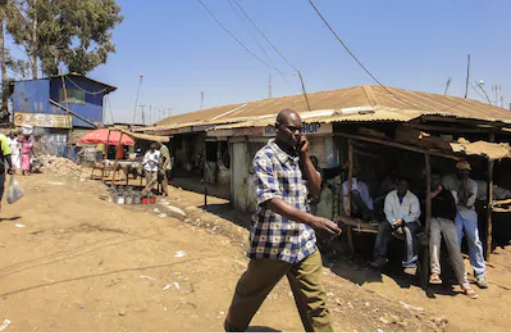
The result of that collaboration was M-Pesa, which was initially launched in Kenya in 2007. With no bank branches or ATMs, M-Pesa relies on an old technology: people.
Individual agents sell airtime for mobile phones at local markets, trading minutes for cash and vice versa. Customers load airtime onto their SIM card and phone, converting minutes into money that can be sent to others via text message.
Although microcredit initially sparked the plan, remittances transformed it into a powerhouse. Being able to transfer money without bank fees allowed city workers to send money to relatives in rural areas — also known as remittances — saving the 12% charged by companies such as Western Union.
Eight months after launch, one million Kenyans were using M-Pesa. Today, it is nearly the entire country.
According to research conducted at MIT, with nothing more than access to basic banking services, M-Pesa lifted 2% of Kenya's population — more than 200,000 people — out of extreme poverty.
M-Pesa now provides banking services to more than 30 million people across ten different countries. In places rife with corruption, it has become a way for citizens to protect themselves against their governments.
In Bangladesh, bKash now serves more than 23 million users. In China, Alipay serves one billion.
And more disruption is on the way. Stay tuned.
Text by Peter Diamandis