

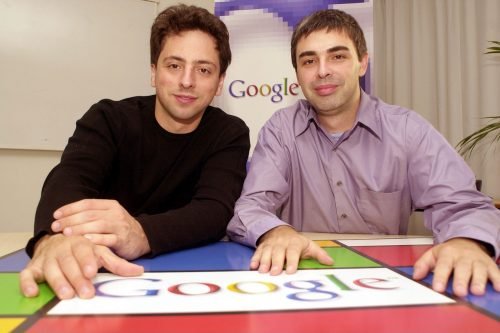
It is the end of an era in the entrepreneurial ecosystem: Larry Page and Sergey Brin, founders of Google, are stepping down from the company's leadership after 21 years.
Page and Brin are leaving their positions as President and CEO (Chief Executive Officer) of Alphabet, Google's holding company, respectively. The role of CEO of Alphabet will be taken over by Sundar Pichai, who already leads Google.
The founders are stepping back from the company's day-to-day operations, but will remain as members of the Board of Directors. "We believe it's time to assume the role of proud parents — offering advice and love, but not getting in the way every day," they wrote in the announcement.

Pichai has been leading Google since 2015, replacing Larry Page following the restructuring of the Alphabet holding company.
In an email sent to all employees, he stated that the transition will not affect the company's structure, which comprises, in addition to Google, Waymo (self-driving cars), Wing (drones), Verily (health innovation), among others. He also noted that he will remain highly focused on Google.
Google is diversifying its portfolio. The company, which started as an internet search engine, today offers mapping services, translation, cloud computing, and hardware — such as the Pixel smartphone, the Chromecast TV accessory, and the Google Nest Mini, a smart speaker powered by Google Assistant.
Google Assistant has been one of the company's biggest bets in Brazil and worldwide. The company recently launched the device in the country and has already announced integrations with companies such as
Nubank, iFood, Rappi, and Banco do Brasil.
The goal is for customers to access these and other services using voice commands alone, without the need for apps. Companies such as Amazon and Apple are also investing in their own digital assistants.
Another development Google is preparing — one that could completely transform the company — is digital checking accounts. According to the WSJ, the tech company will begin offering financial services. The project, called "Cache," is expected to launch in 2020.
The fact that the company is not a bank, yet already has a vast network of millions of customers, could facilitate worldwide adoption of the service. The company has not announced whether it will charge fees for these services.
What about you — would you use a Google digital account? What do you think about the founders' departure?
Source: Startse