

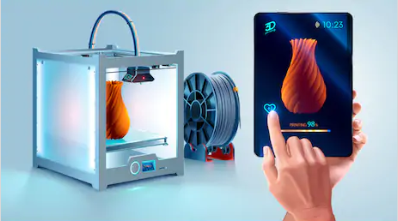
A 3D printer is a device that, instead of printing on paper, prints almost anything in 3 dimensions. Watching one in operation looks like a scene from a science fiction film, but it is absolute reality. Cars, prosthetics, jewelry, and many other products are already being made with 3D printing. This is a market that, by 2020, is expected to move more than 20 billion dollars worldwide and is set to change the way we produce and consume.
3D printing started out very slowly, back in the 1980s, but with advances in technology, the process has become more efficient, simpler, and above all more affordable.
Shall we understand how this technology works? The first step is the concept of the project to be created; a 3D designer then produces a drawing of the object in a 3D software program. The program generates a digital file containing information about all 3 dimensions. This file is sent to the printer, which then heats and melts the raw material — which can be plastic, metal, or other materials — and prints layer by layer. Each layer is initially almost two-dimensional, but as the layers stack on top of one another, the object gains its third dimension. The process can take minutes or even hours.

The general public knows little about the subject; however, in the industry this technology is already widely adopted, as it provides tremendous speed in prototype manufacturing. A prototype that previously could take up to a month to be ready can now be available in a matter of hours. It is therefore an important tool for helping to reduce production time and cost. We are talking about prototypes, but all indications suggest it will not be long before we have finished products being printed in 3 dimensions.

The initial investment for those who want to "play" in this space has been falling considerably. Today there are 3D printing devices available from 1,000 dollars. Industrial 3D printers, on the other hand, cost an average of 600,000 dollars.
Creality 3D Printer

FlashForge Finder 3D Printer

FlashForge Dreamer MX 3D Printer

Makerbot Replicator + 3D Printer

3D-printed houses
If we broaden the term 3D printing, we can include house construction within its scope, as is the case with the Chinese company Zhuoda, which builds houses in less than 3 hours using the technology.


Another 3D house-printing system is the Contour Crafting construction system, developed by Behrokh Khoshnevis at the University of Southern California. Initially the goal was industrial printing; however, it was noted that the technology could also be applied to civil construction. Using this technique, it is possible to build the house directly on-site or to print the parts in a warehouse and assemble them at the location.
3D printer that prints metal
HP has launched a 3D printer that prints metal. Metal printing technology has existed for some time; however, with more companies entering the market competition, the trend is toward lower prices, faster print speeds, and expanded possibilities. Aircraft turbines and rocket components have already been printed, for example.

Before metal printing, parts were made (and still are in many industries) in the following ways:
1 – Machined from metal blocks, which could be a single piece — in that case, it would come out ready.
2 – Machined from metal blocks and welded to other parts.
3 – Or a mold was made — from wax or resin — placed in a form with refractory material (capable of withstanding high temperatures), put in a furnace, and after the material had evaporated, molten metal was poured into the empty space. The part was then machined and finished.
With the advent of metal 3D printing, all these steps are eliminated. The object comes out complete and finished — and, best of all, no matter how complex it is, it contains no welds, dramatically reducing production time and the critical points most susceptible to fracture. The object is simply printed once the 3D design has been sent from the computer to the printer.
Stratasys
The world's largest manufacturer is Stratasys, based in California. The company has been active in this market for 20 years and holds approximately 20% of the entire global sector revenue.

In addition to manufacturing various consumer 3D printing machines, its core business is providing customized services to large clients in the aerospace, technology, medical, automotive, and entertainment sectors.
With annual growth exceeding 50% and more than 100,000 3D printers sold, Stratasys serves clients ranging from small-scale prototype printing to large production runs reaching 10,000 3D objects per project.
The price per part starts at 50 dollars and can easily reach thousands of dollars.
Small businesses begin adopting 3D printing
As 3D printers have become more affordable, enthusiasts and small businesses have started using them. Individuals can produce almost anything that does not require high precision, and small companies can offer the service to other businesses that have no interest in making the investment or in dedicating staff time to learning the entire process.
People typically make parts as a hobby, while small businesses take orders for custom parts, prototypes, and scale models — as is the case with Bolha, a studio that has been operating since 2012, combining technology with creativity in São Paulo.
For those who know how to operate the technology, a hobby can become a small-scale business, as is the case with Buid Shop, a Los Angeles-based company that specializes in 3D jewelry manufacturing and has been gaining market traction.
The company occupies a space that blends a kind of store with an experimental laboratory. There, you bring your idea and leave with the object materialized. The owner has worked in the field for 7 years and has a collection of machines ranging from the oldest to the newest. These machines operate using 5 different printing techniques, including the one most suitable for jewelry manufacturing. The pieces can receive metal plating to add greater sophistication and value to the product.
There are websites offering free 3D objects — just choose, download the file, and send it to the printer.
The São Paulo entrepreneur Alberto Topgian Jr brought from France the idea of creating miniaturized people using 3D printing. With this technique, it is possible to purchase a miniature of a famous artist, for example, or to have your own made.

It works as follows: the person goes through a scanner that captures a digitized 3D image, the software generates a file compatible with the printer, and the printer materializes the person as a miniature. Since color printing is not yet possible, after finishing, the object is painted.
The initial investment was 1.5 million reais, and the products and services are offered at a kiosk in the Ibirapuera shopping mall.
A miniature starts at 150 reais and can exceed 700. The larger the figurine, the higher the price. They produce around 200 to 250 miniatures per month, generating revenue of approximately R$ 60,000.
The entrepreneur intends to turn the business into a franchise, as he receives many requests from other states.
3D printing of organs
Israeli scientists used fat cells from a patient that were first converted into stem cells and then modified to give rise to cardiac tissues and blood vessels. The next step of the study is to make the cells communicate so that pumping blood becomes possible. The model is the first ever produced artificially using human tissues in the world and is still experimental, but the intention in the future is for printers to produce hearts suitable for transplantation.

The advantages are enormous. The organ will be printed at the size most suitable for the patient, using the patient's own cells, thus eliminating the risk of rejection. Within 10 years, organ printers are expected to be present in hospitals worldwide.
In Brazil, researchers at the Heart Institute tested a similar technique to create artificial blood vessels with the intention of producing cardiac muscle; however, the most common use of 3D printing in healthcare is to manufacture custom-fitted prosthetics to replace bones, for example.
In São Paulo, there is a laboratory that found another use for the technology: they print a 3D part obtained from a CT scan that reproduces the patient's bone with all its defects. This enables surgical planning to be carried out with greater precision — selecting the most appropriate plates for the case, the size of the screws, and so on. The surgeon or resident can practice the procedure on the part and then go into surgery with far more information, which greatly reduces the likelihood of complications.
At the Universidade Federal do ABC, researchers used the 3D printer to create silicone breast models for patients who had undergone mastectomy, to use as padding in their bras. They scan the healthy breast, mirror it in the software, and send the 3D model to the printer. In cases where patients have lost both breasts, it is necessary to find a model better suited to the patient's body type.
The world's largest 3D printer
The University of Maine in the United States has just set 3 world records simultaneously. Using the world's largest 3D printer, a team of university engineers built the largest 3D-printed boat in the world. The feat was accomplished in 3 days and was fully documented on video.
The records registered and validated by Guinness World Records officials were:
1 – The world's largest 3D printer.

2 – The largest boat ever produced by a 3D printer.

3 – The largest solid object printed by a printer.
The boat, named 3Dirigo, is 7.6 meters long and weighs just over 2 tonnes.
The University of Maine stated that the 3Dirigo is not the largest object the equipment can print. The team already has several ideas for objects to be printed in the near future. Among the upcoming projects is a partnership with the United States Army for the development of shelter systems for soldiers that can be assembled rapidly.
Very specialized printers are already printing aircraft turbines, dramatically reducing the number of components in the part.
There are even printers that print most of their own parts.
What are we witnessing in this era? Machines that print their own parts, printed organs, houses built by robots.
Are we on the verge of witnessing a new industrial revolution?
A chat with AI about 3D printing
Speaking of revolution, from now on I will include, in some posts on the topic being covered, a chat with artificial intelligence. I asked it what 3D printing is, and it responded with this:
AI: “The use of 3D printers has also brought more women into the workforce. With more people owning and printing their own 3D-printed products, they have also created market demand for affordable fashion products.”
Human: I didn't understand why it said that 3D printing brought more women into the workforce.
AI: “The market also expects an increase in the use of 3D printing in medicine.”
Human: I agree.
AI: “Today, many 3D models can be seen on the streets, in stores, and in workplaces.”
Human: Agreed.
AI: “Although you can already see 3D printing in the market, there are few healthcare startups already working in this space. And, as we have learned, the growth of this sector is expected to reach US$ 200 billion by 2020.
Human: That is not accurate. According to this website, the sector will represent 15 to 17% of a total of 17.2 billion dollars in 2020.
AI: “These 3D-printed products are just the beginning of what we can expect from the 3D printing market.”
Human: Agreed.