

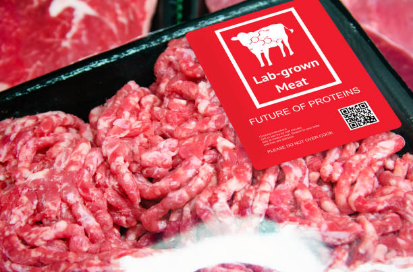
Lab-grown meat gains momentum as it moves from the Petri dish to the dinner table
A Harvard research team has now created lab-grown rabbit and cow muscle cells that closely resemble the texture and consistency of their animal counterparts. By applying regenerative medicine to food, the team at the Harvard John A. Paulson School of Engineering and Applied Sciences (SEAS) developed an edible gelatin scaffold that could transform the scalability of lab-grown meat.
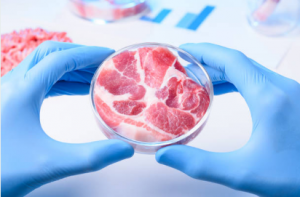
Animal meat is composed primarily of muscle fibers that need to adhere to a structure in order to grow. The team chose to build this structure from gelatin using immersion Rotary Jet-Spinning (iRJS), which uses centrifugal force to spin long nanofibers into specific shapes and sizes. The gelatin fibers mimic the extracellular matrix and promote muscle cell growth. Ultimately, the team hopes to engineer meats with defined textures, flavors, and nutritional profiles — all at an affordable price.
Livestock accounts for 14.5% of total global greenhouse gas emissions. Nevertheless, the global meat market is worth more than $1.8 trillion. One third of the calories consumed by humans come from meat-based products, and the average American today consumes 100 kg of red meat and poultry per year — a significant increase from the 75 kg recorded in 1990.
To curb the harmful environmental damage associated with these consumption habits, we need an alternative that tastes the same. While many lab-grown meat companies have mastered texture, pricing and scale challenges still prevent the widespread adoption of their products.
The SEAS team's gelatin scaffold technology could address both challenges, as it allows muscle cells to grow rapidly and can be ingested along with the meat itself.
Now increasingly price-competitive, several lab-grown products — such as Clara's egg substitute and Memphis Meats' meatballs — are poised to begin undercutting today's plant-based products on the market.
But beyond economics, a range of new advances in food technology is enabling us to customize nutritional content, flavor profiles, and texture.
“Meats” made from plants
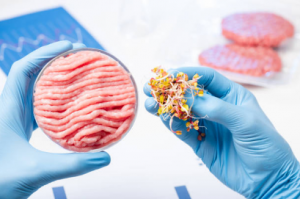
With the premise of developing products that closely resemble animal protein — including juiciness — startups continue to pursue intensive technological research in order to achieve increasingly better results. One of the key challenges is investment optimization, given that the production of plant-based "meats" is nearly 12 times more expensive.
Keeping a close eye on the trend and the growing market, Nestlé has already announced that it will launch its plant-based burger in the coming months under the Sweet Earth brand, acquired in 2017. This represents fierce competition for the startups that moved first. As one of the world's largest food companies, Nestlé has the scale to reduce production costs significantly.
The plant-based meat market in the United States is at full throttle. In a landscape where 18% of Americans state their intention to reduce animal protein consumption, foodtech company Beyond Meat saw its shares reach a record high this week. Shares reached a gain of 720% relative to the initial IPO price, bringing Beyond Meat's market capitalization to US$ 11.9 billion.
Yes, these are impressive numbers on their own — but they become even more striking when compared with the largest tech IPOs of 2019. Below is a summary of the initial offering value and variation through July.
| Beyond Meat | + 720% |
| Zoom | + 171% |
| + 39% | |
| Slack | + 29% |
| Uber | – 2% |
| Lyft | – 8% |
We know that investment returns are built over the long term. However, in this particular case, Beyond Meat — founded in 2009 — has proven to be a sound bet with its vegan products, which only reached the market in 2016.
On the domestic front, the story repeats itself. Fazenda Futuro, a Brazilian foodtech company that produces a plant-based burger, received a Series A round valued at US$ 8.5 million, led by Monashees, with participation from Go4it Capital. The startup's valuation, which brought its product to market just a few months ago, reached US$ 100 million.
Lab-grown meats can help preserve the environment
August 19, 2019, a Monday, became known as “the day that turned to night” in São Paulo. Thousands of people posted on social media expressing their outrage over the fact that, at around 3 p.m., it was as dark as if it were 7 p.m.

They soon reached the conclusion that this was an episode caused by deliberate fires in the Amazon, which has been frequent news under the current administration, amid criticism of Ibama inspectors and environmental licensing.
From 10 p.m. Wednesday to noon Thursday, more than 2.5 million tweets about the Amazon were posted. A global uproar.
Thousands of posts were made criticizing the government's moves, which attempted to dispute data from Inpe (Instituto Nacional de Pesquisas Espaciais), indicating increased deforestation in July and July.
But despite the global outcry and the relentless finger-pointing in search of someone to blame… the truth is that we too bear responsibility in all of this — and it is no small share.
Many people believe that agriculture is the main driver behind the reckless fires in the Amazon… but nothing could be further from the truth.
According to Inpe itself (Instituto Nacional de Pesquisas Especiais), 9 out of every 10 fire outbreaks in areas designated for agribusiness occurred in pastureland used for cattle raising.
According to the study, 6,047 fire outbreaks occurred in areas used for agriculture and livestock farming during the period. Of this total, 5,445 were in pastureland, while 602 occurred in crop-growing areas.
Unless you are vegetarian or vegan (and no, I am neither), your share of responsibility is not small. Consider this:
Approximately 78 percent of deforestation in the Amazon occurred to make way for pastureland, according to the Instituto Homem e Meio Ambiente da Amazônia (Imazon).
Logically, reducing meat consumption (particularly red meat) would relieve the pressure to expand these pastures into the forest.
Every day, the Amazon is deforested for cattle ranching that will end up in supermarkets and, ultimately, on our tables. We fund this system every day.
But the problem extends far beyond the preservation of the Amazon: the meat industry has already proven unsustainable, and data indicates that approximately 60 percent of global biodiversity is being impacted by crop cultivation to feed animals.
One of the foremost advocates of the campaign for less meat and more forests is American biologist Edward Wilson, from Harvard University.
He argues that feeding the world's population by the end of the century — estimated at 10 billion people — will only be possible if everyone adopts a vegetarian diet.
And as much as that may sound like madness to us barbecue lovers, “the reasoning is mathematical,” Greif contends. According to the scientist, feeding cattle with pasture or grain is the least efficient way to generate calories:
Grain production from a 100-hectare farm can feed 1,100 people eating soy, or 2,500 eating corn. However, if that same land's output is used for cattle feed or pasture, the beef produced would feed the equivalent of just 8 people.
Even if the population reduced or completely boycotted red meat consumption, it would not be enough, since raising chickens and pigs also affects forests — feeding these animals requires clearing trees to plant soy and produce feed.
Nevertheless, when analyzing the cost-benefit ratio between space, natural resources, and caloric yield… beef (red meat) is still the worst offender.
Today, in Brazil, there is nearly one head of cattle for every person — we maintain 195 million bovines, and approximately 35 percent of them are found in the Amazon. To fatten this entire herd, ranchers have had to deforest an area of roughly 550 km², equivalent to the state of Minas Gerais.
Is stopping meat consumption the solution?
Indeed, in light of all this data, theoretically, ceasing the consumption of animal-derived foods would appear to be the solution. However, this is a utopian view when one considers the deeply ingrained cultural and behavioral factors in people's daily lives.
One example is the Brazilian passion for barbecue, which goes beyond the mere act of eating meat — it carries an entire social appeal surrounding the occasion. It is unlikely, at least over the next decade, that this will change.

A second challenge would be convincing the lower-income segment of the population — those who have only recently celebrated their upward social mobility and gained sufficient purchasing power to afford meat — to give up that pleasure.
With the stabilization of the global economy, many people ate their first daily steaks over the past decade. “Telling this population that they can no longer eat meat for the sake of the Amazon is, at the very least, cruel.”
Opportunities for the future
According to A.T. Kearney — one of the world's most respected consulting firms, with offices in 90 countries, 3,500 employees, and revenue of $1.3 billion in the last year — by 2040, 60 percent of the meat consumed worldwide will NOT be of animal origin.
According to the data presented, the number of vegans and vegetarians will continue to grow, and even those less committed to the cause will begin paying greater attention to issues surrounding the reduction or elimination of meat consumption — such as environmental impact, health risks, and empathy toward animals.
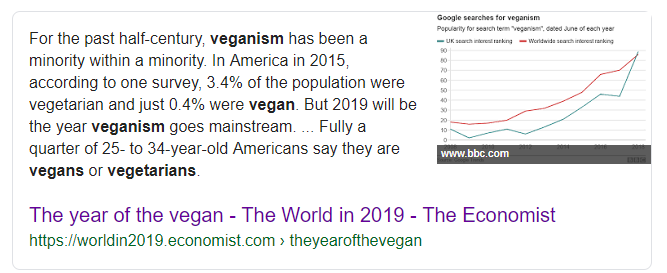
While this figure may not yet be particularly significant relative to the total number of citizens, it is striking when one considers that, just 5 years ago, the percentage of vegetarians in Brazil stood at 9 percent.
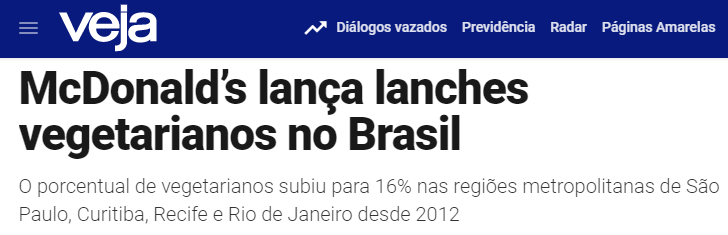
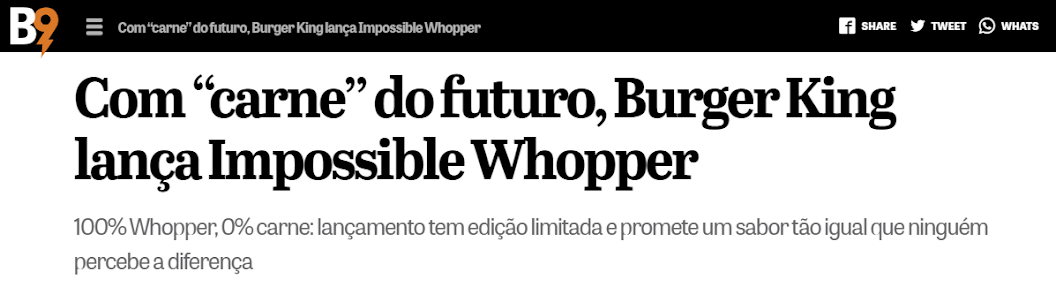
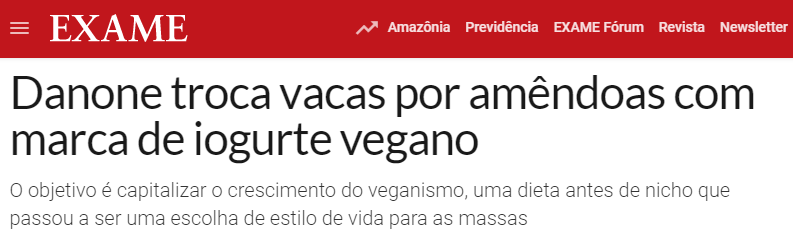
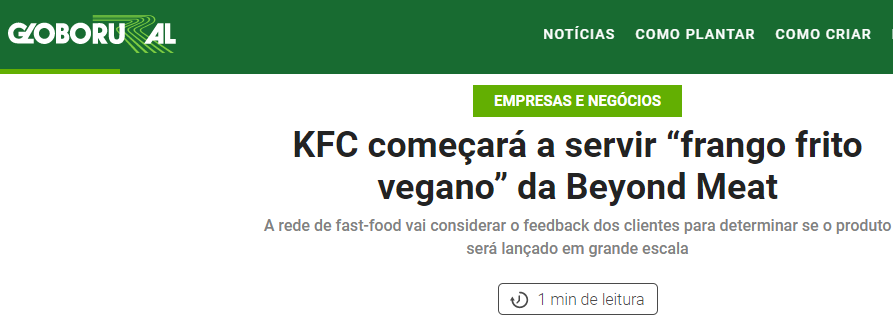
The “noise” made by vegetarians and vegans has grown too loud to ignore. McDonald’s, Burger King, BRF, Nestlé, JBS, Tyson Foods, Danone, and KFC are just a few of the major brands that have recently embraced the veggie trend, investing heavily in products that meet the demand of these audiences.

Pat Brown, CEO of Impossible Foods (Beyond Meat's biggest competitor in the US), launches yet another alternative in the plant-based meat category: “pork”. His vision is to progressively transform humanity and its habits by offering options that are not derived from animals.
Or, as he himself puts it, “nobody likes the fact that meat is made from an animal carcass.” Thus, he continues on his relentless mission to solve two problems at once: catastrophic climate change and the collapse of biodiversity.
But why pork? It is the most consumed protein in the world, and that positions the company one step closer to achieving its goal. These issues cannot be addressed without considering highly populous countries — India and China come to mind immediately, though they are far from the only ones — that contribute significantly to this consumption.
But technology also plays a role in this decision. Another reason the company chose to develop plant-based “pork” before fish or chicken was texture. The ingredients used to produce the “beef” burger and replicate the texture of meat are very similar to those that would be needed to create pork, with only the proportions adjusted.
The brand will also be launching a vegan sausage, offering yet another option for consumers.
It remains to be seen what professionals in the agribusiness sector and Brazilian livestock farmers will do to ride this wave rather than be swept away by it.