

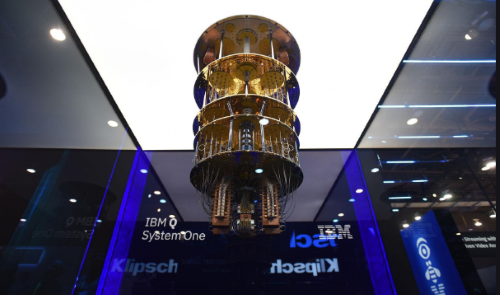
A new type of computer
A quantum computer operates in a fundamentally different way from a classical computer.
In classical computing, a "bit" is a small piece of binary information — a one or a zero.
A "qubit" — or quantum bit — is the latest evolution of that idea. Unlike binary bits, which represent an either/or scenario, qubits leverage "superposition," which allows them to exist in multiple states simultaneously.
Think of the two outcomes of flipping a coin: heads or tails. Now picture a spinning coin — where both states flicker at the same time. That is superposition.
And superposition means power. A great deal of power.
While a classical computer requires thousands of steps to solve a difficult problem, a quantum computer can accomplish the same task in just two or three steps.
To put this in perspective, IBM's Deep Blue managed to defeat world chess champion Gary Kasparov by evaluating 200 million moves per second.
A quantum machine could multiply that figure by a trillion or more.
Google's Quantum Supremacy
If a quantum computer is far more powerful than a classical computer, Google's quantum supremacy announcement represents a major shift in the future of computing.
Using a machine called Sycamore — equipped with a chip composed of 53 qubits — Google's research team managed to execute a task known as random circuit sampling.
This involves running random operations on the qubits, "literally as if the program code were chosen at random," as explained by computer scientist Bill Fefferman of the University of Chicago.
The values of all qubits were measured, the entire process was repeated multiple times, and the resulting distribution is not random.
Ultimately, Sycamore took 200 seconds to repeat the sampling process one million times, while a top-tier classical supercomputer would require approximately 10,000 years to complete the same task.
But Google is far from alone in the race toward scalable quantum supremacy….
The Rigetti Story
The coldest place in the universe is located in sunny California.
On the outskirts of Berkeley, inside a large warehouse, hangs an object that looks much like a giant white cigar. It is a man-made contraption — a next-generation cryogenic refrigerator cooled to 0.003 Kelvin, just above absolute zero.

The tube belongs to Rigetti Computing, the next contender with the goal of building useful quantum computers.
The company was founded in 2013, when a physicist named Chad Rigetti decided that quantum computers were far closer to a launch-ready moment than many suspected — and that he wanted to be the one to push the technology across the finish line.
In pursuit of his vision, Rigetti left a comfortable position as a quantum researcher at IBM, raised more than $119 million in funding, and built the coldest tube in history. With more than fifty patent applications filed, Rigetti now manufactures integrated quantum circuits directly connected to a quantum computer in the cloud.
One of the most exciting aspects of Rigetti, however, is its commitment to the democratization of quantum computing.
Currently, if you visit Rigetti's website (www.rigetti.com), you can download Forest, their quantum development kit. The kit provides a user-friendly interface to the quantum world.
With it, virtually anyone can write a program and run it on Rigetti's thirty-two-qubit computer. To date, more than 120 million programs have already been executed.
And other companies are quickly following suit, as Microsoft, IBM, and Google have all launched quantum cloud services.
So where do we stand now, and where are we headed?
Google's announcement caused significant excitement within the quantum computing community.
In fact, the very notion of "quantum supremacy" is under scrutiny. "Supremacy" implies that quantum computers will replace traditional computing rather than serve as a complement to it.
On the other hand, another frequently used term (proposed by Rigetti) is "quantum advantage." According to the company, this concept is demonstrated when an algorithm running on a quantum computing platform "achieves a faster solution time, a higher-quality solution, or a lower classical computing cost compared to the best classical algorithm."
In either case, quantum computing offers enormous quantitative advantages over classical computers across a range of problem domains.
To grasp the scale: if every atom in the universe were capable of storing a single bit of information, an eighty-qubit computer would have greater information storage capacity than all the atoms in the universe combined.
And today's most advanced quantum computers — including Google's Sycamore and IBM's Q53 — have already reached 53 qubits.
Even now, we have no concrete idea what innovations may emerge once quantum computing matures at scale. But what we do know is tantalizing.
Because chemistry and physics are quantum processes, computing with qubits will usher in what Simon Benjamin of Oxford calls "a golden age of discovering new materials, new chemicals, and new drugs."
It will lift the current computational constraints on artificial intelligence, fundamentally transform cybersecurity, and enable the simulation of systems of unprecedented complexity.
Say you are trying to develop a new cancer drug. Instead of building a large-scale wet lab to explore the properties of hundreds of thousands of compounds in test tubes, you will be able to conduct much of that exploration inside a computer."
In other words, the gap between an experimental question and any new solution — whether a new drug, an optimized material, or a customized product — is about to become much smaller.
Get ready. The era of democratized, scalable, cloud-accessible quantum computing is only just beginning.
Text by Peter Diamandis