

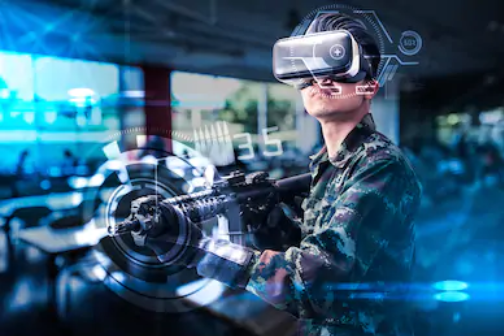
Virtual reality and augmented reality have already begun to impact the professional training market.
As projected by ABI Research, the corporate virtual reality training market is expected to exceed $6.3 billion in value by 2022.
Leading the list, Walmart has already implemented VR in 200 training centers, running more than 45 modules and simulating everything from unusual customer requests to a Black Friday shopping rush.
In September 2018, Walmart placed an order for 17,000 Oculus Go headsets to equip all U.S. Supercenters, neighborhood markets, and discount stores for VR-based employee training.
By mid-2019, Walmart had tracked a 10 to 15% increase in employee confidence as a result of the newly implemented training.
In the engineering world, Bell Helicopter is using VR to greatly streamline the development and testing of its latest aircraft, the FCX-001.
In partnership with Sector 5 Digital and HTC VIVE, Bell found it could compress a typical 6-year aircraft design process down to 6 months by transforming physical models into virtual CAD-designed replicas.
But beyond the design process itself, Bell is now one of the pioneering companies in virtual reality pilot testing and simulations with real-world accuracy. Seated in a realistic virtual cockpit, pilots have already tested countless iterations of the FCX-001 in virtual flight, working directly with the 3D model and making real-time aircraft modifications.
And in an expansion of our virtual senses, several key players are already working on haptic feedback. In the case of VR flight, the French company Go Touch VR now partners with software developer FlyInside on fingertip-mounted haptic technology in aviation.
Virtual reality has drastically reduced the time it takes test pilots to identify problems.
Replicating the texture, rigidity, and even the feel of holding an object, these wearable devices contain a set of actuators to simulate everything from a light touch to high-pressure contact, all controlled by gaze and finger movements.
FlyInside + Go Touch VR
Source: Wired
When it comes to other high-risk simulations, virtual and augmented reality have barely begun to make their impact felt.
Firefighters can now battle virtual blazes using new platforms such as FLAIM Trainer or TargetSolutions.
And thanks to the expansion of augmented and virtual reality medical services such as 3D4Medical or Echopixel, surgeons will soon be able to perform virtual operations before moving on to real ones, thereby reducing the likelihood of error and surgery time — greatly benefiting the patient and their recovery.
But perhaps most urgently, Web 3.0 and its virtual reality interface offer an immediate solution to the constant workforce turnover and large-scale reskilling demands of today.
VR educational facilities with exact replicas of everything from large industrial equipment to intricate circuits will soon give anyone a second chance in the 21st-century job market.
Want to become an electric and autonomous vehicle mechanic at 15? Use a demonetized VR module and learn by doing, testing your prototype iterations at near-zero cost and with no risk of harming others.
Want to be a plasma physicist and experiment with a virtual nuclear fusion reactor? You will now be able to simulate results and test different adjustments, earning Smart Educational Record credits in the process.
As tomorrow's career model shifts from a "one-time graduate degree" to continuous lifelong education, VR-based professional reskilling will enable a continuous cycle of learning, lowering the barrier to entry for those wishing to break into a new industry.
But beyond professional training and virtually enriched real-world work scenarios, Web 3.0 promises fully virtual workplaces and blockchain-secured authorization systems.