

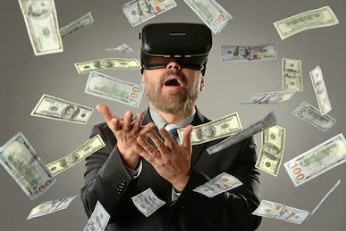
In 2016, investments in virtual reality surpassed $800 million, while augmented reality and mixed reality received a combined total of $450 million. Just one year later, investments in AR and VR startups doubled to $3.6 billion.
And today, major players are bringing virtual reality headsets to market with the power to revolutionize the industry, along with countless others.
VR headset sales volume is already expected to reach 98.4 million units by 2023, according to Futuresource Consulting. But beyond the headsets themselves, Facebook's $399 Oculus Quest generated $5 million in content sales in the first two weeks following its launch last spring.
With companies such as Niantic ($4 billion valuation), Improbable ($2 billion valuation), and Unity ($6 billion valuation) achieving unicorn status in recent years, the VR space is heating up considerably.
In this blog, we will dive into a brief history of VR, recent investment surges, and the future of this revolutionary technology.
A Brief History of VR
Throughout history, our lives have been constrained by the laws of physics and mediated by our five senses. VR is rewriting those rules.
It allows us to digitize experiences and teleport our senses into a computer-generated world, where the limits of imagination become the only brake on reality. But it took a while to get here.
Much like AI, the concept of VR has existed since the 1960s. The 1980s saw the first false dawn, when the earliest "consumer-facing" systems began to appear. In 1989, for $250,000, you could purchase the EyePhone — predating the iPhone — a virtual reality system built by Jaron Lanier's company VPL (Lanier coined the term 'virtual reality').
Unfortunately, the computer powering that system was the size of a dormitory refrigerator, while the required headset was bulky, awkward, and rendered only about five frames per second — six times slower than the average television of that era.
By the early 1990s, the hype had faded and VR entered a deceptive phase lasting two decades. In the 2000s, the convergence of increasingly powerful game engines and AI-driven image rendering software changed the script. Suddenly, the gimmick became disruptive, and the virtual reality universe opened for business.
The Disruptive Phase: Surges in VR Investment
In 2012, Facebook spent $2 billion on Oculus Rift. In 2015, Venture Beat reported that an arena that normally saw only ten new entrants per year had suddenly attracted 234.
In June 2016, HTC announced the launch of its Vive 'Business Edition' for $1,200, followed six months later by the announcement of a wireless virtual reality upgrade.
A year later, Samsung capitalized on this shift, selling 4.3 million headsets and turning enough heads that everyone from Apple and Google to Cisco and Microsoft decided to explore virtual reality.
Phone-based VR appeared shortly after, lowering barriers to entry to as little as $5. By 2018, the first wireless adapters, standalone headsets, and mobile devices began reaching the market.
In terms of resolution, 2018 was also when Google and LG doubled their pixel-per-inch count and increased their refresh rate from VPL's five frames per second to over 120.
Around the same time, systems began targeting more senses than just vision. HEAR360's "omni-binaural" microphone suite captures 360 degrees of audio, meaning immersive sound has now caught up to immersive visuals.
Touch also reached the mainstream, with haptic gloves, vests, and full-body suits arriving in the consumer market. Scent emitters, taste simulators, and every conceivable type of sensor — including brainwave readers — are all vying to put the "very" in verisimilitude.
And the number of virtual explorers keeps growing. In 2017, there were 90 million active users, a figure that nearly doubled to 171 million in 2018. YouTube's VR channel has more than three million subscribers.
And that number is still growing. By 2020, estimates place the VR market at $30 billion, and it is difficult to find a field that remains untouched.
The Future of VR: Emotive and Immersive Education
History class, 2030. This week's lesson: Ancient Egypt. The pharaohs, the queens, the tombs — the full Tut.
Of course, you would love to see the pyramids in person. But the cost of airfare?
Hotel rooms for the entire class? And taking two weeks off school for the trip? None of that is feasible. Worse, even if you could go, you couldn't. Many of Egypt's tombs are closed for restoration and are strictly off-limits to groups of teenagers.
Not to worry — VR solves these problems. And in the world of virtual reality, you and your classmates can easily step inside Queen Nefertari's burial chamber, touch the hieroglyphs, and even climb onto the sarcophagus — opportunities that are impossible in physical reality. You also have a world-class Egyptologist as your guide.
But turning your attention to the back of the tomb does not have to wait until 2030. In 2018, Philip Rosedale and his team at High Fidelity took exactly that virtual field trip.
First, they scanned every square centimeter of Queen Nefertari's tomb. Then they took thousands of high-resolution photographs of the burial chamber. By stitching more than ten thousand photos into a single view and overlaying it onto a digitized 3D map, Rosedale created an extraordinarily accurate virtual tomb. He then handed a classroom full of children HTC Vive VR headsets.
Since High Fidelity is a social VR platform — meaning multiple people can share the same virtual space simultaneously — the entire class was able to explore the tomb together. In total, their fully immersive field trip to Egypt required zero travel time and zero travel expenses.
VR does not only encompass traditional educational content; it also expands our emotional education.
Jeremy Bailenson, founding director of Stanford's Virtual Human Interaction Lab, has spent two decades exploring VR's capacity to produce real behavioral change. He developed first-person VR experiences of racism, sexism, and other forms of discrimination.
For example, experiencing what it would be like to be an elderly African American woman, homeless and living on the streets of Baltimore, produces genuine change: a meaningful shift in empathy and understanding.
"Virtual reality is not a media experience," Bailenson explains. "When done well, it is a real experience. In general, our findings show that VR produces more behavioral change, generates more engagement, and exerts more influence than other forms of traditional media."
Empathy is not the only emotion VR appears capable of training. In research conducted at USC, psychologist Skip Rizzo achieved considerable success using virtual reality to treat PTSD in soldiers. Other scientists have extended this to the full spectrum of anxiety disorders.
VR, especially when combined with AI, has the potential to facilitate top-tier traditional education alongside all the empathy and emotional skills that traditional education has long lacked.
When AI and VR converge with 5G wireless networks, our global education problem shifts from the near-impossible challenge of finding teachers and funding schools for hundreds of millions in need, to the far more manageable puzzle of building a fantastic digital education system that can be offered free of charge to anyone with a headset. That is quality and quantity on demand.
In the workplace, VR will serve as an efficient trainer for new employees.
10,000 of Walmart's 1.2 million employees completed VR-based skills management assessments. Learning modules that previously took 35 to 45 minutes now take 3 to 5. The company plans to train 1 million employees using the Oculus VR headset by the end of this year. The upfront costs of VR headsets will ultimately be recovered through workforce efficiency gains.
Text by Peter Diamandis