

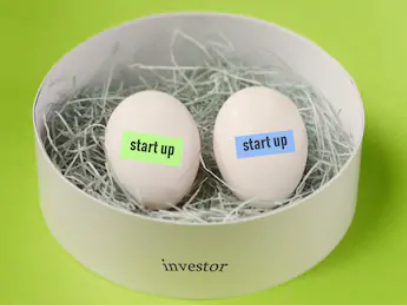
An innovative business does not always need to rely solely on its own resources to grow. The more promising the idea, the greater the entrepreneur's ability to make things happen, and the stronger the traction (steady and consistent growth), the more investors will emerge. Their goal is the same as yours: to make the business take off, secure the first millions, and grow until the company goes public on the stock exchange.
Angel investors, incubators, and accelerators appear along your company's journey, ready to leverage your business.
An angel investor is a person who invests their own money in your business in exchange for an equity stake. When an entrepreneur seeks an angel investor, they should not focus solely on the money. It is crucial to think about Smart Money — that is, trying to bring along not only capital but also an investor who has complementary expertise or who offers mentorship, typically in the areas of entrepreneurship, finance, market knowledge, and networking, so that the business can be connected to potential key clients.

An incubator is a protected environment for newly created businesses that might not survive if exposed directly to the market. The incubator's role is to structure the company, provide legal support, and connect entrepreneurs with investors. In Brazil, many incubators already exist within public universities. A student comes up with an idea for a product or service, develops it in the lab, and — without ever leaving the university — transitions straight into the incubation space.
Accelerators are spaces that welcome startups at a slightly more advanced stage — those that already have an MVP (minimum viable product), already have customers, and in many cases are already generating revenue. As the name suggests, an accelerator helps the business grow faster. Entrepreneurs, who are often young and inexperienced in the business world, receive guidance and support to mature the company and organize its processes.
There are many accelerators in the Brazilian market. Many of them belong to large, established companies that seek startups with synergy to their own business. The idea is that if a startup emerges that could disrupt your business, it should at least be born in your own backyard. This way, the company either acquires it, becomes a client, or becomes a partner. Large corporations have an enormous difficulty changing their DNA and becoming innovative and agile. It is easier to separate a team from rigid processes or to incubate one.
One thing entrepreneurs must be careful about is ensuring that a large influx of capital in the early stages does not kill the company. This can happen because it gives the entrepreneur a false sense of security — having cash in hand can be dangerous if mismanaged. Investor capital must be used in a sustainable growth strategy. That is, the customer acquisition cost (CAC) must not be elevated; it should remain within an economically viable range, and the revenue generated by each customer must exceed their CAC.

The more mature the business and the more scalable it is (meaning it can grow rapidly, with revenue increasing much faster than expenses), the more valuable it will be to investors or accelerators. Therefore, it is not advisable to approach them at a very early stage, unless you have absolutely no means of moving forward on your own.
Those who bet on startups want to obtain a return on their investment at exit (preferably many times the amount invested). The exit occurs when the angel investor or accelerator sells their stake to an investment fund or a VC (venture capital). At that point, the company already has robust and consistent growth, and the capital injection can reach into the millions.
The size of each partner's equity stake varies considerably. The incubator typically takes the smallest share, usually around 3 to 5% in exchange for use of the space and mentorship — and does not always provide cash. The accelerator takes a larger stake, typically between 5 and 20% for 100,000 to 200,000 Brazilian reais. An angel investor may ask for up to 50% of your business if they are a highly strategic partner and depending on the volume of work involved. In return, they may invest anywhere from 100,000 reais to one million reais or more. However, they are aware that they should not take too large a share, to avoid discouraging the entrepreneur.

Both incubators and accelerators avoid having competing companies within the same space. They seek to bring together businesses with synergy that can help leverage one another or even merge.
The role of incubators and accelerators in Silicon Valley is smaller; however, entrepreneurs there tend to be better prepared — some have already failed one or more companies, and that experience is highly valued.
Despite incubators and accelerators taking an equity stake in the startup, competition to enter their spaces is fierce. For example, in the last year, 460 startups competed for a spot at 21212. Startups with innovative ideas, scalability, and cohesive teams with complementary expertise are preferred.
One of them had a particularly interesting idea: it offers excess inventory that merchants no longer need through its website. The founder explains that she had no resources and no network of contacts, which is why she decided to go through 21212's acceleration program.
Inside an accelerator, entrepreneurs also have the opportunity to present their businesses to potential angel investors, as acceleration spaces organize events and invite individuals interested in investing in startups. These are the well-known pitch sessions.

The accelerator market grew significantly last year. Technology parks did as well — there are around 40 in Brazil today. However, a large number does not necessarily guarantee the birth of many unicorns (startups valued at more than 1 billion dollars). An environment with diversity, abundant capital, and universities aligned with the market seems to be conducive to the emergence of these companies, which are the ultimate dream of every angel investor.
21212 celebrates the fact that 65% of the companies that have gone through its space are already generating revenue. But it also issues a warning: if an idea does not take hold, do not become attached to the product or service — the market and the customer are sovereign. Pivot (change the product or change the entire business). It may even be that the product is good, but the entrepreneur may have misjudged the timing. And the sooner we make the decision to stop insisting on a market that does not seem as promising as it appeared in the ideation phase, the better for everyone. This is made very clear in Eric Ries's book The Lean Startup. A well-known Silicon Valley motto that supports this idea is: fail fast and learn fast from your mistakes. If you are not embarrassed by your first product, you launched too late.

The Brazilian ecosystem is developing. Some politicians have awakened to the importance of fostering this sector. The Economic Freedom Law was passed. A few years ago, another law was approved exempting angel investors from direct liability for the companies they invested in. The federal government is providing support through the Startup Brasil program. These are sound decisions that are helping to make the business environment less hostile in the country.
Startups do not necessarily need to invent an entirely new product. They can improve a process — as is the case with one startup that claims to be able to deliver two affordable homes per day using a crew of just four workers. Its founder identified bottlenecks in construction and optimized the processes.
The entrepreneur behind a startup not infrequently sells their stake in one of the investment rounds and then faces a dilemma: What now? What do I do with my life? Some of these entrepreneurs go on to start another business; others become angel investors. By that stage, they will be far more experienced and have capital in hand — so why not help another young person who is just starting out? In this way, the cycle is complete.
The Next Generation of Investors
A study by CB Insights outlined the profile of the next generation of investors. According to the report, by 2030, the millennial generation will have 5x more wealth — the result of a "generational wealth transfer" that has already begun.
For those already keeping an eye on these investors, three pillars are essential: market, product, and liquidity. In addition, this generation seeks more niche digital solutions with ease of use. Design and functionality are key factors for attracting the next generation of investors, as are fully mobile-managed digital banks.
Don't Make the Same Mistakes
And speaking of which… this week, Steve Blank (an author we discussed in the podcast this week) published
a text full of tips for entrepreneurs seeking fundraising. The premise is: how to
convince investors that you are the next Facebook and not the next Friendster
(a social network largely unknown outside the US, and a global failure). In other words, how to enter a
market that has seen countless failed startups — and more specifically: how to convince investors that yours
will not be another one.
Picture a recurring scene: entrepreneurs arrive full of energy, convinced they have the next big idea in their hands. Investors, who have analyzed countless pitch decks — and have watched some (or many) go nowhere — roll their eyes with the feeling that they have seen it all before.
"Ignorance of the past and contempt for the status quo are part of how innovation happens," says Blank in the text. And the fuel that drives all this change is entrepreneurs, angel investors, and venture capital. For this reason, he offers tips — really, questions — on how to avoid being seen as yet another future failure.
-
Which companies have already ventured into this segment? -
Why did some of them fail? -
Which investors lost a great deal of money on them? Tip: it is worth staying away from those… -
How have the market, technologies, and behavior evolved since then? -
What is the insight that makes your startup unique? -
Who else can be considered a player in the direct or adjacent segment? Tip: a jobs-to-be-done
analysis is more valuable here than a segmentation matrix
To go deeper on how to differentiate yourself at pitch time, click here!