
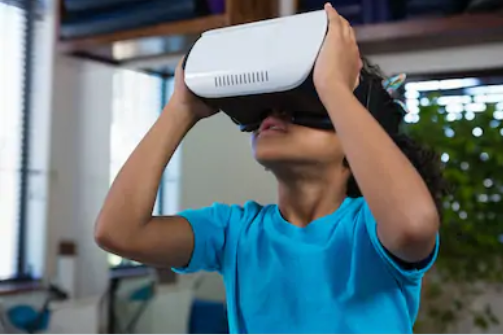
Within medicine, Virtual Reality glasses are being used not only for medical training — they are now also being used to distract patients, especially children, to shift their focus and attention away from the procedure itself, which often caused significant anxiety. VR glasses are used as a distraction tool, reducing stress and greatly facilitating the work of doctors and nurses.
In partnership with the Starlight Children's Foundation, Lenovo is now testing devices to assist healthcare professionals with this new approach.
Participating hospitals, such as Children's Hospital Colorado, have already achieved impressive results. There are reports of a significant reduction or even complete elimination of panic and pain response.
The glasses are being used during procedures such as lumbar punctures and endoscopies when combined with a local anesthetic.
While the use cases for virtual reality in entertainment and even education are fairly obvious, a range of niche medical applications are only now beginning to emerge. Particularly as virtual reality becomes increasingly hyper-realistic — thanks to greater bandwidth and higher resolution — the products born from virtual experience will soon be capable of delivering deep immersive distraction, allowing a person to almost completely disconnect from the outside world (outside the headset).
With children, the reasoning is fairly intuitive. What is interesting is that the technique is also working remarkably well with adults.
So there you have it. You dive into the virtual world while the needle dives into you — and you couldn't care less. Better that way.