
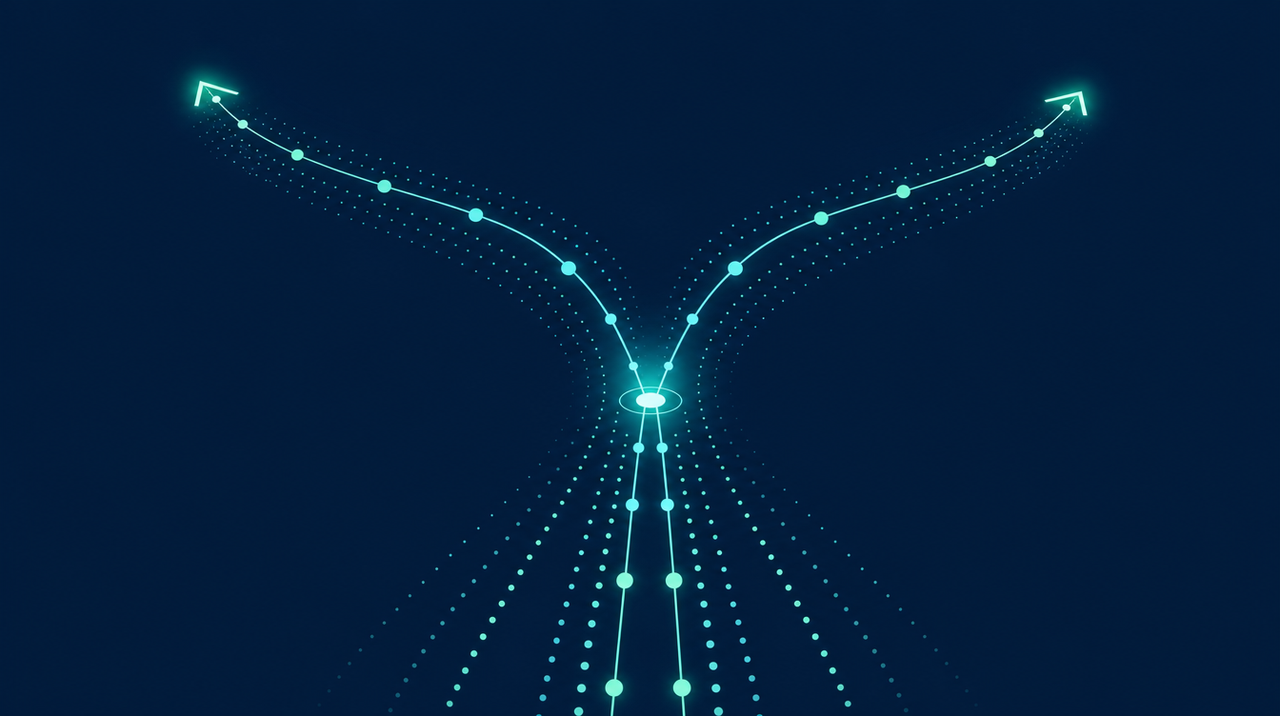
There's a line that sums up one of the most expensive traps for anyone running a business: the decisions that cost you the most aren't the ones you get wrong, they're the ones you never make. It sounds like an exaggeration, but it's the opposite — it's the bill almost no one adds up, because it never shows up as an invoice.
Not deciding is also a decision
When you put off a choice, it feels like you bought time and avoided a risk. In practice, you decided — you decided to stay put. And staying put has a price: the competitor who moved, the customer who got tired of waiting, the opportunity that passed, the problem that grew in silence. The difference is that the cost of a wrong move shows up fast and in plain sight, while the cost of inaction arrives slowly, diluted, with no one to blame. That's exactly why it fools you.
Why indecision feels safe
Our brain treats a wrong decision as a visible wound and an unmade decision as "there's still time." But while you wait for the perfect scenario — more data, more certainty, the ideal moment — the world keeps moving. Opportunity cost is precisely that: everything you gave up earning while you waited to be absolutely sure. And in business, absolute certainty almost never comes.
Analysis paralysis
Too much information stalls you too. It's easy to confuse "studying more" with "moving forward," when often the studying has become an excuse not to choose. You open ten tabs, ask for three more quotes, push it to the next meeting — and six months later you're in exactly the same place, just with less time. Information is only worth something once it turns into a decision; before that, it's just weight.
How to decide better (without deciding on impulse)
The point isn't to rush every call — it's to decide at the right speed for each kind of choice. A simple rule helps: is the decision reversible or not? If it's reversible — testing a channel, changing a creative, trying out a tool — decide fast, because the cost of being wrong is low and the cost of waiting is high. If it's irreversible or expensive to undo, then yes, it's worth moving more carefully and with more data. The classic mistake is treating a reversible decision as if it were final, freezing out of fear of something you could have undone in a week.
And your business
In the day-to-day of a company, indecision usually hides behind reasonable-sounding phrases: "we'll look at it later," "now's not the time," "let's wait for things to settle." Putting off organizing your data, putting off automating a process that eats up hours, putting off testing a new way to serve customers — none of it shows up as a loss at the end of the month, but it quietly erodes the result. Deciding with what you have in hand, instead of waiting for the perfect scenario, almost always costs less than the silent bill of not deciding.
Post inspired by an edition of the Email do Rony newsletter, by Rony Meisler (founder of Reserva), built from the provocation "the decisions that cost you the most are the ones you never make." Worth reading at the source: businessofbrandspost.substack.com.