

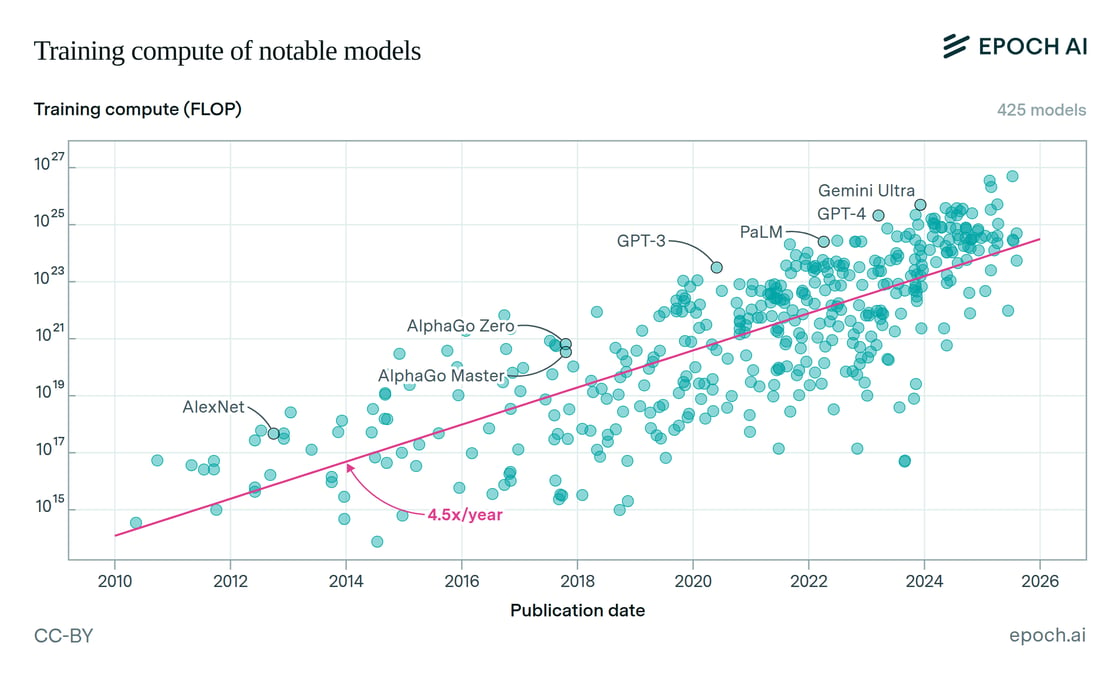
| The computational training of notable AI models has been doubling every 6 months |
| By Peter Diamandis |
| What It Is |
| The AI WARS are in full swing. A civil war, trillions of dollars at stake… advancing at ALL costs. Leading AI companies are competing for the top spot on a weekly basis. Gemini 2.5 > Grok 4 > GPT-5 > Grok 4.2 > Gemini 3.0… it's pretty insane. Elon declared that xAI's goal is to reach 50 million H100-equivalent AI compute units online by ~2030. Sam Altman responded by saying that OpenAI expects to have well over 1 million GPUs online by the end of 2025, with a long-term ambition of 100 million AI GPUs, at an estimated cost of $3 trillion. Meanwhile, Zuckerberg announced Meta's new Superintelligence team, with plans to build a Manhattan-sized datacenter. |
| Why It Matters |
| We are witnessing one of the greatest commercial technological arms races in human history, with over $1 billion invested per day. Five companies (Google, OpenAI, xAI, Meta, and Anthropic) are literally reshaping civilization in real time. The best news is that there will be many winners in the end, and most importantly: ALL OF US. As @BalajiS wrote: “We have many models from many factions that have converged to similar capabilities, rather than a massive lead between the best model and the rest. So we should expect a balance of power among various human/AI coalitions, rather than a single dominant AI that will turn us into paperclips/pillars of salt.” OpenAI: Building the Full-Stack Future OpenAI just shipped GPT-5 and proved why it remains the execution leader. With Sam Altman's recent projection that “we'll surpass 1 million GPUs in operation by the end of this year!”, they are winning users and setting industry expectations at every level. GPT-5's unified architecture, combining reasoning and speed, represents the full-stack approach that may come to dominate consumer AI. Altman's challenge to “100x this” is a roadmap for total market control. Meta: Open Strategy at Unprecedented Scale Meta is going all-in on open models and unprecedented infrastructure. Its Manhattan-sized Prometheus data center and hurricane-proof tent deployment strategy demonstrate that they are willing to break every rule in the construction book to win the infrastructure war. With 40% of its Superintelligence team recruited from OpenAI, 20% from DeepMind, and 15% from Scale AI, Meta is assembling a dream team. Each researcher earning between $10 million and $100 million per year proves that the talent war has reached unprecedented levels. The CapEx forecast of $64 billion to $72 billion for 2025 goes beyond spending… it is economic warfare designed to capture the global ecosystem through scale. Google: The Sleeping Giant Awakens Polymarket prediction markets for the top AI models reveal a fascinating pattern: betting odds show OpenAI leading with 54% against Google's 41% through the end of this month, but Google climbing to 45% compared to OpenAI's 31% by the end of 2025. What Google (DeepMind) has accomplished under the leadership of Sir Demis Hassabis in just 2 weeks is remarkable: Genie 3 – The most advanced world simulator ever built Gemini 2.5 Pro Deep Think – For Ultra subscribers Gemini Pro – Free for university students AlphaEarth – Geospatial model of the entire planet Aeneas – Deciphering ancient texts (featured in Nature ) Gemini – Won a gold medal at IMO 2025 Storybook – Books with art and audio in the Gemini app Kaggle Game Arena – New benchmark for LLMsJules – Asynchronous coding agent, now out of Beta NotebookLM Video Overviews – New feature Gemma – Surpassed 200 million downloads (Google's lightweight, open-source/open-weight models) xAI: Never, Ever, Ever Underestimate Elon Elon's numbers are staggering: Colossus launched just one year ago, in July 2024, with 100,000 H100s, doubled to 200,000 in 92 days, and Colossus 2 launched with 550,000 GB200 GPUs: the equivalent of 5.5 million H100s . His goal of 50 million H100-equivalent GPUs by 2030 represents a trillion-dollar bet on compute. xAI's workforce is less than 30% the size of OpenAI's and Google's, yet Grok 4 still holds strong at the top positions. xAI will release a new version, Grok 4.2, by the end of August to reclaim the lead across all metrics. Infrastructure Will Determine the Winners The race now measures data centers in gigawatts, not square footage. Meta's hurricane-proof tents for its massive Prometheus data center and OpenAI's massive GPU scaling reveal a fundamental truth: the speed of innovation comes down to power and chip access. We are witnessing the first steps toward everything becoming computational. The companies that secure energy and chips will dictate the pace of progress. The Reality of Abundance Anthropic's recent valuation surge from $65 billion to $100 billion in a matter of months, with Claude Code generating over $200 million annually at 60% margins, proves that AI is already creating enormous economic value. These companies are solving real problems and generating real revenue at unprecedented scales. In my view, there is room for many winners in this sector. However, the first company to reach AGI will hold a commanding position in the rest of the industry. Nearly all venture capital investment is being directed toward AI right now, and the founders of the future need to understand this technology landscape above all else. My bet is that we will see some of the largest companies ever created in human history over the next 5 to 10 years — some of which we don't even know about yet. It truly is an age of abundance to build in. Make the most of it. |